
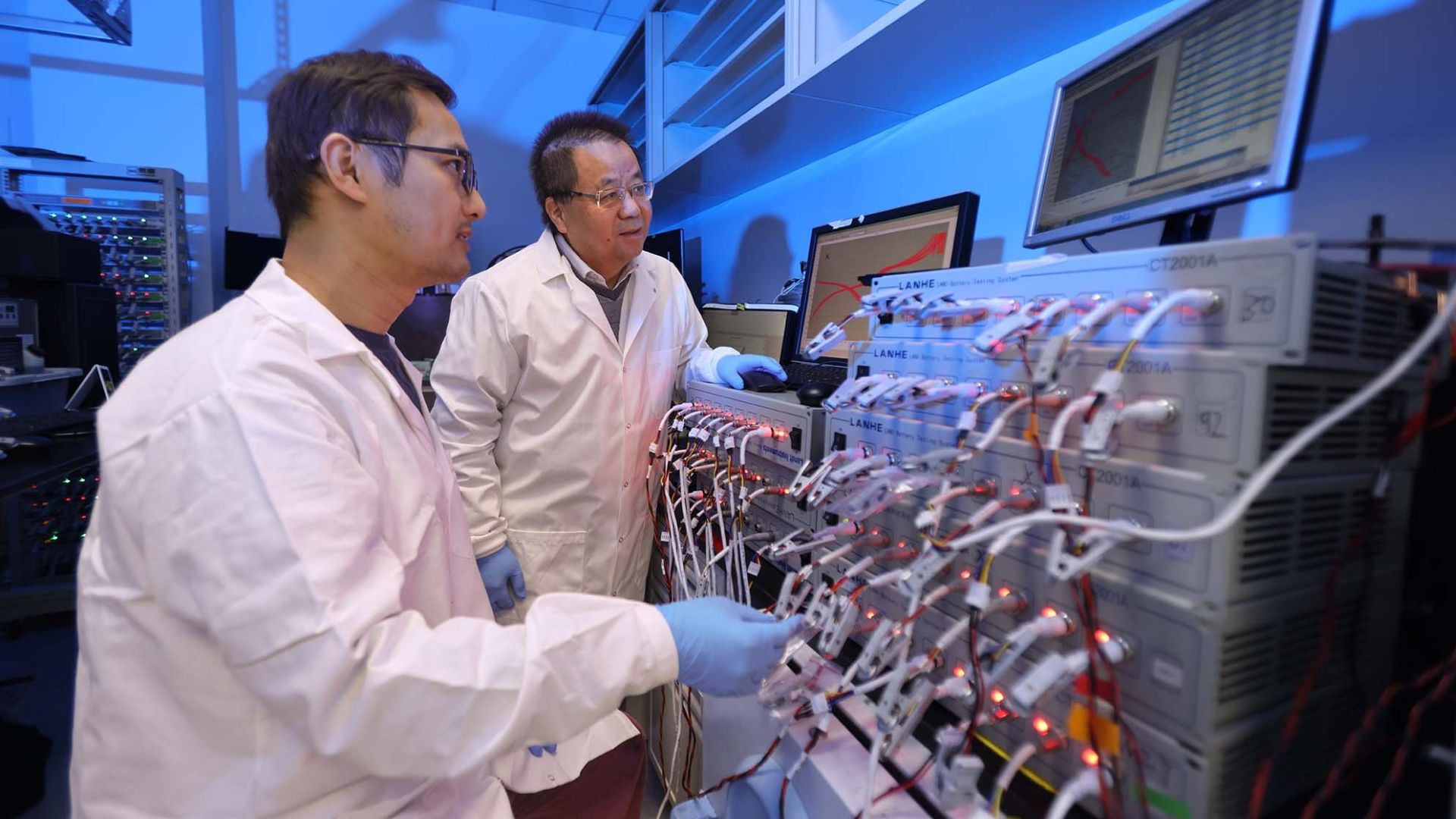
Lithium ions do not travel alone inside a charging battery. They carry solvent molecules with them, and that movement can leave an electrode short of the liquid it needs. University of Maryland researchers have now redesigned an electrolyte to tackle this overlooked obstacle to faster charging. The team tested the chemistry in a four-amp-hour pouch cell, reaching 80 percent charge in 12.8 minutes and 90 percent in 14.7 minutes. The research offers a route toward shorter EV charging stops by changing battery chemistry. Led by researcher Chang-Xin Zhao in Distinguished University Professor Chunsheng Wang’s laboratory, the work addresses a practical challenge: bringing charging times closer to the minutes drivers spend filling a gasoline tank. The researchers now aim to reduce that wait further, to around 10 minutes. During charging, lithium ions move from a battery’s positive electrode to its negative electrode through the electrolyte. Along the way, they pick up solvent molecules and pull them in the same direction. At slower charging speeds, the solvent can flow back into the porous positive electrode, replenishing what has moved away. When charging accelerates, however, that return flow struggles to keep pace. The electrode begins to dry out, and charging slows markedly. The phenomenon, known as electro-osmotic drag, was already familiar to researchers studying fuel cells. Its role in lithium-ion batteries had been overlooked until the Maryland-led study. Previous approaches to faster charging have focused on altering electrode structures. Those changes can reduce the energy a battery holds, creating a trade-off the team wanted to avoid. Changing how the solvent behaves The researchers added fluorine-containing chemical groups to solvent molecules in the electrolyte. This weakened the attraction between the solvent and lithium ions while helping the solvent flow back into the positive electrode more readily. The change reduced the likelihood of the electrode drying out during rapid charging. Testing in the pouch cell delivered an 80 percent charge within the U.S. Department of Energy’s target of less than 15 minutes. The cell also reached 90 percent within that window, although the researchers noted that reaching a full charge quickly remains difficult without compromising other aspects of performance. The demonstrated results came from a small pouch cell, rather than a complete EV battery pack. They establish a laboratory result for the redesigned electrolyte, but further development is still needed. Aiming for a coffee-length stop Wang’s next goal is to combine the fluorinated solvent with an adaptive electrolyte his team developed. That electrolyte separates to protect both electrodes from the stresses of fast charging. “By the time you finish your coffee, the vehicle is charged. That’s what we want to achieve,” Zhao said. Charging speed is only one part of the wider research effort. The team also wants batteries to last longer when unused and operate across a broader range of temperatures. “We want to build a battery that can satisfy all the requirements, without sacrificing anything. That is our goal,” Wang said. The study was published in the journal Science. Get the latest in engineering, tech, space & science - delivered daily to your inbox.Atharva is a full-time content writer with a post-graduate degree in media & amp; entertainment and a graduate degree in electronics & telecommunications. He has written in the sports and technology domains respectively. In his leisure time, Atharva loves learning about digital marketing and watching soccer matches. His main goal behind joining Interesting Engineering is to learn more about how the recent technological advancements are helping human beings on both societal and individual levels in their daily lives.
90% in 14.7 minutes: New EV battery charges faster with redesigned electrolyte
Full Article
Original Source
Read the full article at Interestingengineering →KhanList aggregates and links to publicly available news content. We do not host full articles from third-party sources. Always verify important information with original sources.