
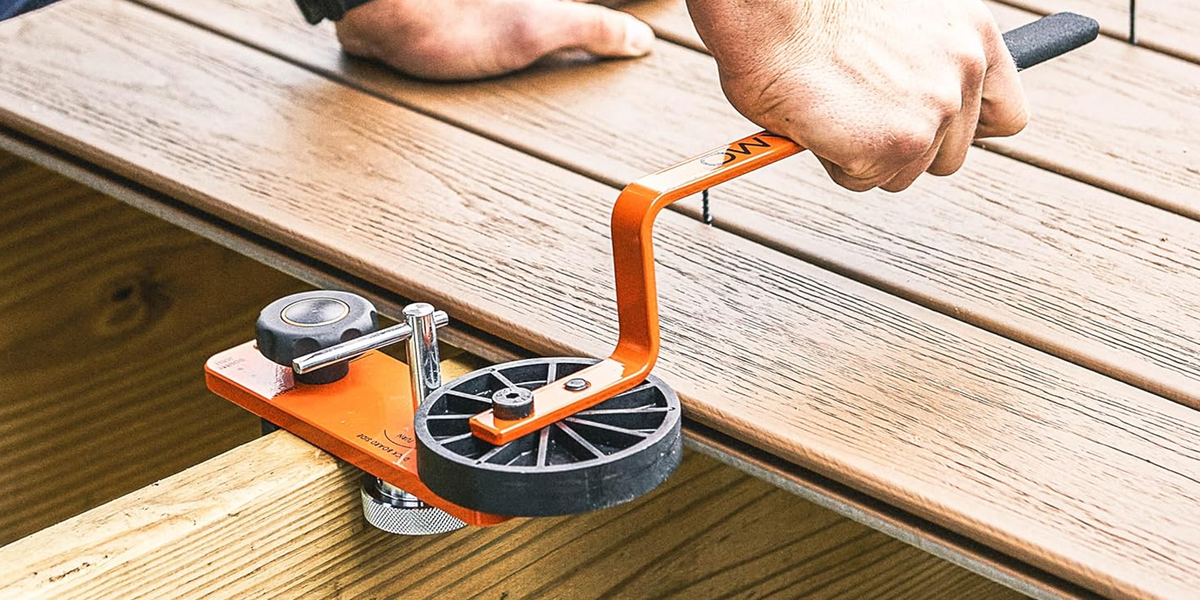
6 min readI’ve accepted that if I spend more than five minutes scrolling Instagram, I’m probably going to discover a new tool gadget that promises to change my life. Let’s be honest—most don’t. I still have a few regrettable purchases hiding in a drawer somewhere. But every once in a while, I’ll stumble across something so clever I immediately hit “add to cart.”That’s become especially true since joining the Popular Mechanics test team. Over the last year or so, I’ve spent countless hours testing some of the internet’s most interesting tool gadgets in my garage, workshop, and truck—and I’ve discovered a few new favorites along the way.Surprisingly, many of them have earned a permanent place there. From ingenious layout tools and sheet-good carriers to modular cargo systems and electric cutters that make opening and breaking down boxes weirdly satisfying, these products prove that viral doesn’t always mean gimmicky. Sometimes it just means somebody finally had a good idea. And built it.Old-school method: Measure for every studHow this tool improves it: Spaces and holds studs in place as you nail themI was unsure of this stud spacer when I first saw it a year or so ago. Having used it a few times, my mind is firmly changed. Sure, you still have to do some proper measuring to land your first stud in the construction of a typical wall run, but once that stud is securely fastened, the spacer takes over, laying out perfect placement—without marks—in 16-inch increments. I found it to be well-made and handy, and it seriously sped up my work on a finished basement build-out.Old-school method: Wedges and pry bars to straighten deckingHow this tool improves it: Clamps to deck stringer and uses a cam to straighten deck boardsThere are several tricks to coax a bent, cambered, or twisted board into one that’s ready to be properly placed. Unfortunately, most of these tricks are rather time-consuming.As a previous fan of Camo’s hidden fastening system, I was intrigued after seeing its lever lock in a social media reel. The tool is adjustable to a variety of rafter designs. It sets up fast and uses a cranked cam against the board to bring it to proper spacing. It was a valuable sidekick on the last deck I built.Old-school method: Using rafter squares to measure anglesHow this tool improves it: Pre-drilled pivot points create a template for common anglesI’ve seen a lot of variations on this idea over the years, none as well-crafted as this model. The tool is basically a fixed combination of a rafter square and an adjustable right-angle square. It’s a great workshop add-on for scribing wood, metal, and pipe via the precision holes drilled through common angles.The square is well-built of anodized aluminum and comes with a handy pivot pin that slots into the angle holes and stores on board via a rubber keeper.Old-school method: Manually stripping wires and twisting them together with linesman pliersHow this tool improves it: Strips wires up to five different gauges and twists them together with the pulse of a cordless drillIt seems like a lifetime ago that I learned to twist my wires together with a pair of linesman pliers prior to capping them. This ensures excellent contact across the copper and limits the chance of one wire slipping free as you tuck the wires into their appropriate outlet, switch, or junction box.But that motion of gathering the ends, pulling the pliers, and twisting them together can be laborious. This set of conical wire twisters eliminates that. Fixed to a small cordless drill, these twisters spin the ends together for a perfect wire union every time. The added wire stripper attachments allow for a clean strip to the ideal depth of five common gauges, which I find really helpful when stripping heavier wire.Old-school method: Lifting plywood or drywall from the ground-level edge and balancing it over your arm, shoulder, and neckHow this tool improves it: Engages a pressure clamp on the top edge, allowing the user to lift and carry safely and comfortablyFew things are clumsier and more taxing on the lower back than hauling plywood or drywall. The Kreg Panel Lift alleviates that in the form of a pressure clamp combined with a rubberized grip. You slide the clamp over the top edge of the sheet in question and lift—sort of like a shoulder carry.The weight is distributed across your arm and shoulder, and you’re left with clear visibility as you move forward—a far cry from the standard lift from the bottom of the sheet, stumbling forward as you brace the weight.Old-school method: Wire-tying the top of the ladder to a gutter (or simply not tying it at all)How this tool improves it: Clamps into and under an existing gutter and around the rails of a ladder, securing it in placeCertain ladder-to-structure relationships make securing the top rungs of a ladder impossible, like when the ladder passes a gutter, for example. These grips lock to the gutter itself and simultaneously brace the ladder in place, which limits side-to-side movement.Safety when climbing to a roof is never more important than the moment you step on or off the ladder to the structure. This system helps you do it with confidence. Bonus that it also has a carabiner you can clip a harness to for an added bit of fall protection security.Old-school method: Crawling into your truck and chasing loose cargoHow this tool improves it: Slides your gear within easy reach while keeping it secure and organizedThe Tmat Bed Organizer System is one of those products you don’t realize you need until you use it. Its interlocking tiles snap together to create a modular cargo mat custom fit to your truck bed, with a growing ecosystem of accessories designed to hold everything from tools and buckets to golf bags and fishing rods.Best of all, the mat slides toward the tailgate, bringing your gear within easy reach—no climbing into the bed or awkwardly reaching over the side rails to get at things—your paint will thank you. It’s ingeniously simple, endlessly customizable, and might just save your back and knees along the way.Old-school method: Struggling to measure across long open distances or inside tight spacesHow this tool improves it: Makes awkward measurements faster, easier, and often a one-person jobI’ve always followed the adage “If it ain’t broke, don’t fix it.” That’s especially true when it comes to tape measures, which is why I used to scoff at the idea of a laser version. Then I spent about 10 minutes with the Mileseey S50 and realized I've been doing things the hard way for too long. Its bright green laser, point-to-point measuring capabilities, and multiple measuring modes make tackling awkward measurements—the kind where you’re bending the tape and guessing or measuring across a ceiling—almost effortless.The S50 is accurate to within 1/16 of an inch up to 400 feet and works unaffected by dust, mist, and reflective surfaces. Say goodbye to that friend with the shaky hand holding the other end of your tape in the wrong spot. And if this version is any indication, I can’t wait to get my hands on the camera-equipped S50C with a built-in laser level that’s on its way in for testing.Old-school method: Tearing through boxes and plastic with a dangerous utility knifeHow this tool improves it: Effortlessly slices through cardboard, plastic, and fabricElectric scissors seem ridiculous. What’s wrong with regular scissors? Are products like these paving the way to our inevitable WALL-E future that we’ve become too lazy to perform even the simplest tasks? Perhaps.But somewhere between breaking down my 37th Amazon box and slicing effortlessly through stubborn plastic blister packaging, I became a convert. These scissors safely blast through all of that awkward bulky material, and the onboard LED is a gem when I’m out on the curb breaking down boxes. I don’t cut fabric and I don’t wrap gifts—trust me, that’s a disaster no one needs to witness—but I imagine these are absolute game changers there, too. Are they necessary? Probably not. But neither is heated leather seating in my truck, and I’m certainly not giving that up anytime soon.Paul Russell Smith is a former NYC ironworker turned screenwriter (Grace Point) and home renovation specialist. He lives in a crooked old farmhouse in Stockton, NJ, where he’s just as likely to be clearing a clogged pipe as rewriting a third act. When he’s not working, he enjoys hiking, pedestrian beer, and cooking over a live fire. His self-proclaimed spirit animal is the English Bulldog.John Gilpatrick is a Senior Reviews Editor for Popular Mechanics, covering tools, home appliances, yard and garden accessories, and smart home tech. He previously worked for Men’s Health and has bylines on numerous other websites, covering topics as disparate as nutrition, tech, and pet care. He is also a former film critic who’s unusually fond of the Star Wars prequels, and he appeared on Pop Culture Jeopardy in 2025 while wearing jorts and a fanny pack. He is a member of the Online Film Critics Society (OFCS).
9 Viral Tool Gadgets That Actually Live Up to the Hype
Full Article
Original Source
Read the full article at Popularmechanics →KhanList aggregates and links to publicly available news content. We do not host full articles from third-party sources. Always verify important information with original sources.