
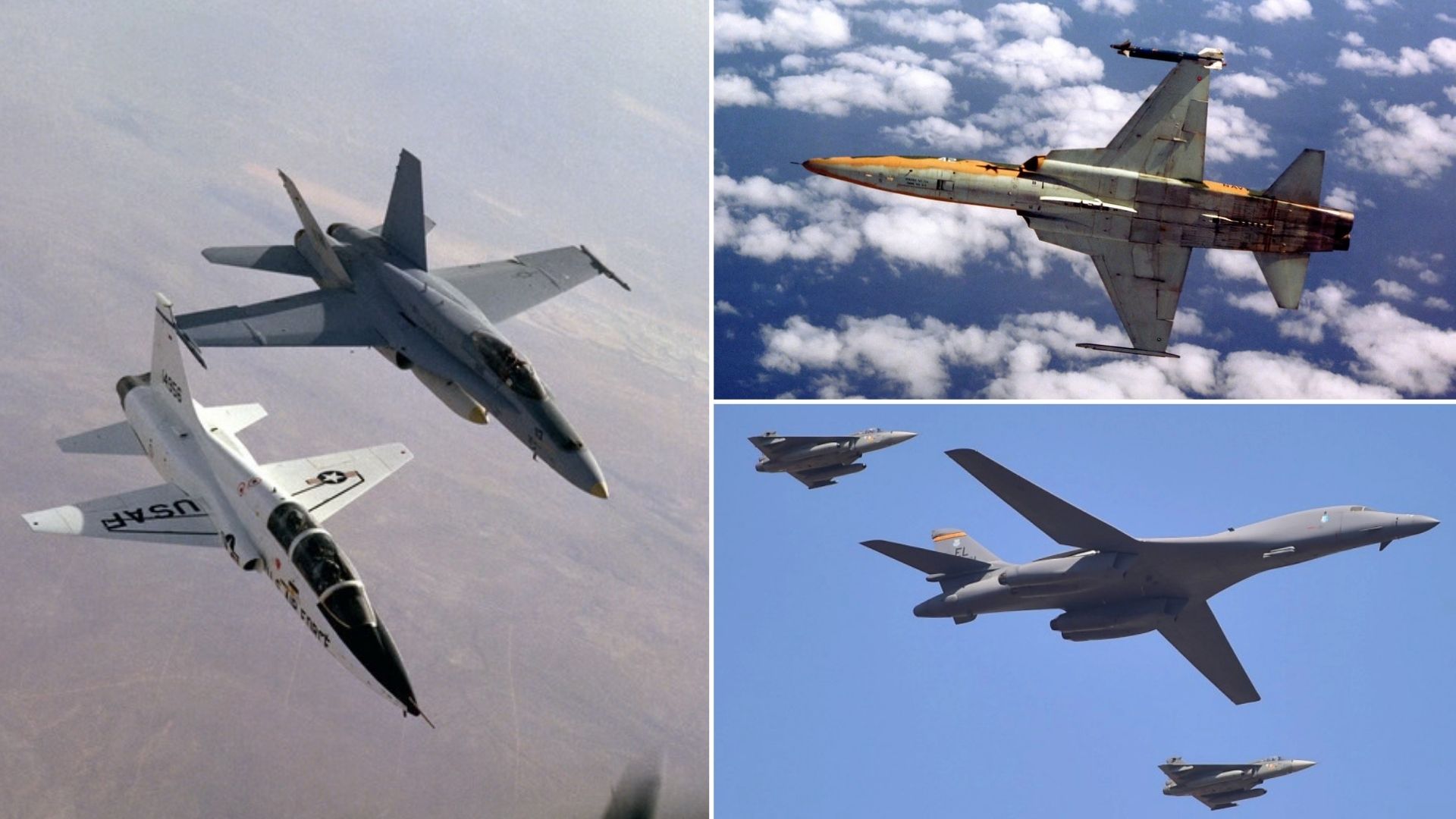
Supersonic flight is often associated with experimental aircraft, futuristic fighters, and Cold War-era icons. Yet the US still operates a surprisingly broad collection of aircraft that can fly faster than the speed of sound. Most are military aircraft, and there is an important distinction here. An aircraft’s supersonic capability does not mean it routinely cruises at supersonic speeds. In fact, for most modern fighters, sustained supersonic flight is something used selectively because it consumes fuel rapidly and can impose significant thermal and aerodynamic loads. For this list, we are counting aircraft that are currently in US military service and have an officially stated supersonic capability. That includes fighters, an electronic-warfare aircraft, a bomber, and even training and adversary aircraft. It does not include retired aircraft or experimental X-planes. Here are nine of them. 1. F-15 Eagle The F-15 remains one of the US’s fastest operational fighters more than five decades after its first flight. The current US fleet includes the F-15E Strike Eagle, while the newer F-15EX Eagle II is entering service. The F-15E has a stated maximum speed of around Mach 2.5, or roughly 1,875 mph. Its two afterburning engines provide the thrust needed for that performance, although the aircraft rarely flies near its maximum speed in combat. The Eagle’s longevity is also part of the story. Rather than replacing the entire family, the US has continued evolving the design into newer variants with modern sensors, weapons, and avionics. 2. F-16 Fighting Falcon The F-16 is considerably smaller than the F-15, but it is still capable of reaching approximately Mach 2 at altitude. The single-engine fighter entered US service in the late 1970s and remains one of the most numerous tactical aircraft in the US inventory. The Air Force describes it as a compact multirole fighter capable of both air-to-air and air-to-surface missions. That combination of speed, maneuverability, and relatively compact size has made the F-16 one of the most widely operated fighter designs in the world. 3. F-22 Raptor The F-22 Raptor combines supersonic performance with something even more unusual: the ability to cruise supersonically without continuously using afterburners. The Air Force describes the F-22 as a Mach 2-class aircraft with supercruise capability. It can cruise above Mach 1.5 without afterburner, potentially covering ground much faster than a conventional fighter operating below the sound barrier. The Raptor was designed primarily as an air-superiority fighter, with stealth, sensor fusion, and maneuverability playing as important a role as raw speed. 4. F-35 Lightning II The F-35 is not the fastest aircraft on this list, but all three US variants are supersonic: the F-35A, F-35B, and F-35C. Their published maximum speed is approximately Mach 1.6. The F-35B is particularly unusual because it combines supersonic flight with short takeoff and vertical landing capability, allowing the Marine Corps to operate it from amphibious ships and austere bases. The F-35’s design prioritizes stealth, sensors, and networking over extreme speed, so Mach 1.6 is better viewed as a capability than its normal operating regime. 5. F/A-18E/F Super Hornet The US Navy’s F/A-18E/F Super Hornet is another carrier-based supersonic fighter. NAVAIR lists its maximum airspeed as Mach 1.8+. The twin-engine aircraft serves as a multirole fighter and attack platform aboard US aircraft carriers. Unlike some older carrier aircraft, the Super Hornet was designed from the beginning around the demands of modern carrier operations, combining supersonic performance with weapons carriage, range, and multirole flexibility. 6. EA-18G Growler The EA-18G Growler looks remarkably similar to the Super Hornet because it is derived from the F/A-18F. Its job, however, is very different. The Growler is the US Navy’s dedicated airborne electronic-warfare aircraft, designed to disrupt and attack hostile radar and communications systems while supporting other aircraft. Despite carrying specialized electronic-warfare equipment, it retains the Super Hornet’s basic high-performance characteristics. US Navy material lists a maximum speed of approximately Mach 1.8. 7. B-1B Lancer Not all operational US supersonic aircraft are fighters. The B-1B Lancer is a long-range strategic bomber capable of reaching approximately Mach 1.2, according to the Air Force. Its variable-sweep wings let it change configuration for different parts of the flight envelope. That makes the B-1B a rather unusual aircraft on this list. It is vastly larger than the fighters above, yet can still cross the sound barrier. 8. T-38 Talon Supersonic capability is not limited to combat aircraft. The US Air Force’s T-38 Talon is a two-seat supersonic trainer used to prepare pilots for high-performance aircraft. The design first flew in the 1950s, making it one of the oldest aircraft designs still serving in the US military. Yet its ability to provide high-speed jet training has kept it relevant for generations of pilots. Its continued presence is a useful reminder that an aircraft does not have to be a frontline fighter to be operationally important—or supersonic. 9. F-5 Tiger II The F-5N/F Tiger II occupies another unusual niche. Although the original F-5 is decades old, the US Navy and Marine Corps continue operating upgraded examples primarily as adversary aircraft, giving US pilots a representative target to train against. The lightweight fighter is capable of supersonic flight, with the F-5 family capable of reaching roughly Mach 1.6. In other words, the US still operates a supersonic aircraft whose primary job is to pretend to be the enemy. What about the X-planes and commercial? This list leaves out some of the most interesting US supersonic aircraft because they are experimental rather than operational. The clearest current example is NASA’s X-59, which broke the sound barrier for the first time in June 2026 and subsequently continued its flight-test campaign. The US also has a long history of X-planes exploring everything from supersonic flight to hypersonics. So while today’s operational fleet is dominated by military aircraft, America’s supersonic story is far from being confined to fighters and bombers. In fact, The Federal Aviation Administration (FAA) is working to lift the 53-year-old ban on overland commercial supersonic flights in the U.S. by mid-2027. The next major chapter may instead be about making supersonic flight quieter, more efficient, and potentially useful for civilian travel.Get the latest in engineering, tech, space & science - delivered daily to your inbox.Kaif Shaikh is a journalist and writer passionate about turning complex information into clear, impactful stories. His writing covers technology, sustainability, geopolitics, and occasionally fiction. A graduate in Journalism and Mass Communication, his work has appeared in the Times of India and beyond. After a near-fatal experience, Kaif began seeing both stories and silences differently. Outside work, he juggles far too many projects and passions, but always makes time to read, reflect, and hold onto the thread of wonder.
9 operational US aircraft that can fly faster than sound
Full Article
Original Source
Read the full article at Interestingengineering →KhanList aggregates and links to publicly available news content. We do not host full articles from third-party sources. Always verify important information with original sources.