
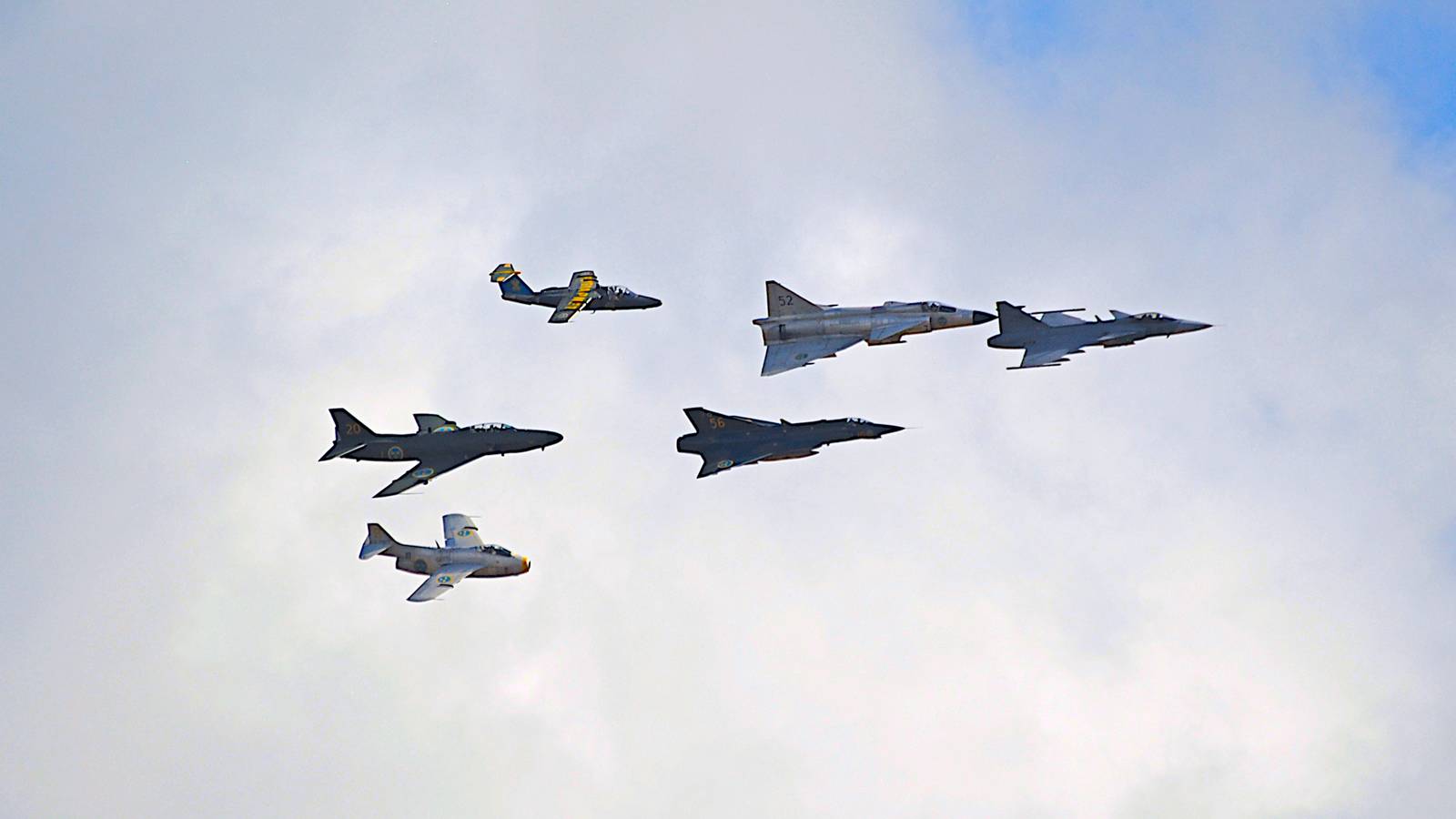
The Swedish Air Force turned 100 in 2026, and a great airshow was held at Malmen Air Base to celebrate. We at Simple Flying had the chance to attend the event, having the opportunity to be surrounded by nearly every Saabfighter jet the company has ever built, most of them sitting quietly on static display and also flying into the sky. Six decades of Swedish combat aviation, kept alive by the volunteer pilotsand engineers of the Swedish Air Force Historic Flight, took to the skies in a single formation alongside the newest jet in the lineup. Saab has never built fighters the way anyone else does. Sweden's historical policy of armed neutrality demanded aircraft that could scatter onto forest roads and frozen fields, fly from strips barely longer than a soccer pitch, and be maintained by conscripts rather than career mechanics, all while staying almost entirely free of foreign components. Saab's own account of its history walks through exactly how those constraints produced some of the most technically daring fighters of the 20th century. Here are eight of them, ranked from the earliest oddity to the aircraft Saab itself calls the culmination of it all. Saab 21R: The World's First Operational Pusher-To-Jet Conversion An ejection seat, a pusher propeller, and then a turbojet Credit: Antonio Di Trapani | Simple Flying The Saab 21 was already an extraordinary aircraft before it became a jet. First flown on July 30, 1943, the single-seat fighter used a twin-boom layout with a Daimler-Benz DB 605B piston engine mounted behind the cockpit and a pusher propeller between the booms. That arrangement left the nose free for concentrated armament and gave the pilot excellent forward visibility, but it created an obvious problem: simply jumping over the cockpit could put the pilot directly into the propeller. Saab's answer was an ejection seat, one of the most important innovations hidden inside the unusual airframe. The system had already been tested before the J 21 entered service, and a live emergency ejection from a J 21 in 1946 demonstrated that the idea could save a pilot's life. In 1947, Saab pulled off something almost nobody else managed. It rebuilt the piston-powered design around a British De Havilland Goblin turbojet, creating Sweden's first jet aircraft and one of only two production fighter designs successfully converted from piston to jet propulsion, alongside the Soviet Yakovlev Yak-15, as migflug's history of the type lays out in detail. The conversion went far beyond simply replacing the engine. The tailplane had to be raised clear of the exhaust, the fuel system was enlarged, the wing leading edge was modified, and additional air brakes were introduced. Its performance was not sufficient to keep it competitive as a fighter, and the aircraft was soon converted to the A 21R attack configuration. Yet the 21R established something more important than a long service career: Saab had gone from building a piston fighter to operating a jet within a few years. The J21R ranks eighth because its jet career was brief, but its piston-to-jet transformation laid the groundwork for Saab's future fighters. Saab 29 Tunnan: The Almost Supersonic Flying Barrel A round fuselage hiding a genuinely fast fighter Credit: Antonio Di Trapani | Simple Flying The J 29 Tunnan looked almost comical beside the sleek fighters that came later. Its unusually wide, rounded fuselage earned it the nickname "Flying Barrel," but the shape concealed an aircraft at the cutting edge of early jet fighter design. First flown on September 1, 1948, the Tunnan entered Swedish service in 1951 and became the most-produced Saab fighter, with 665 aircraft built in six versions. Powered by a license-built de Havilland Ghost turbojet, it could reach roughly 660 mph (1,060 km/h), and in May 1954 a stock Tunnan set a 500-kilometer closed-circuit world speed record. Its most important innovation was the wing. Saab's engineers had obtained German aerodynamic research after the Second World War and used it to develop a 25-degree swept wing. The Tunnan became the first Swedish aircraft to use this configuration and the first European aircraft with swept wings to enter operational service. The Tunnan is also the only Saab fighter to see actual combat: Swedish Air Force examples flew ground-attack and escort missions for United Nations forces during the Congo Crisis in the early 1960s, a rare deployment for a famously neutral air force, as Simple Flying's history of the type recounts. At Malmen, the Tunnan flew in a formation alongside a Polish-built Mikoyan Gurevich MiG-15 and a Canadian-built F-86 Sabre, three Cold War rivals from opposing blocs sharing the same stretch of sky. The Tunnan ranks seventh because it established Saab as a serious jet-fighter manufacturer, even if later designs were far more ambitious. Saab 32 Lansen: The All-Weather Workhorse Sweden's first fighter-bomber with all-weather capability Credit: Antonio Di Trapani | Simple Flying The Saab 32 Lansen marked the decisive shift in Swedish fighter development into the electronics age. First flown in November 1952 and entering service in 1955, it was designed around a demanding requirement: one aircraft family had to cover attack, interception and reconnaissance missions while operating in Sweden's difficult weather and from dispersed bases. The Lansen was Saab's first aircraft to bring radar and sophisticated electronic systems into operational service, marking the company's entry into the electronics age. Its radar was another major step forward. Unlike the earlier Tunnan, the J 32B could detect and engage aircraft at night and in poor weather, turning the Lansen into a genuine all-weather fighter rather than simply a faster jet attack aircraft. Saab describes the J 32B as having a more powerful engine and radar specifically suited to air defense in darkness and bad weather. The family concept was just as important as the individual technology. The A 32A was optimized for attack, the J 32B for interception, and the S 32C for reconnaissance. The latter carried cameras and a radar optimized for maritime surveillance, particularly important for monitoring the Baltic Sea. Some recon and electronic-warfare Lansens remained in Swedish service into the late 1990s, years after the type was supposedly obsolete, a longevity story migflug's Lansen retrospective traces from prototype to retirement. The Lansen takes sixth for bringing afterburning propulsion, radar and its multirole capability into Saab's fighter lineup. Saab 105:The Trainer That Refused To Be Just A Trainer A light jet with an unusually long career Credit: Antonio Di Trapani | Simple Flying Known in Swedish service as the Sk 60, the Saab 105 is easy to underestimate because it began life as a trainer. First flown in 1963, the twin-engine aircraft was designed primarily to prepare Swedish military pilots for more demanding combat aircraft. Saab designed the airplane with two compact engines mounted in nacelles on the rear fuselage, a side-by-side cockpit, a relatively high wing loading for a trainer, and multiple hard points that allowed armed versions to perform light attack and reconnaissance missions. Few trainers anywhere have logged sixty years of near-continuous service, and the Sk 60's straightforward, twin-podded-engine layout has kept it cheap enough to fly long after flashier types were retired. But the Saab 105 acquired another particularly relevant identity: aerobatic aircraft. The Swedish Air Force's Team 60 was formed around the Sk 60 in 1974. It began with four aircraft before expanding to six, and the first display under the Team 60 name was flown in Gothenburg in 1976. The team turned a military trainer into a remarkably capable display aircraft, performing formation aerobatics with the same basic design that had spent its career teaching pilots to fly fighters. The Saab 105 ranks fifth because its versatility and extraordinary training and aerobatic career made it far more than an ordinary trainer. Saab 35 Draken: Sweden's First Mach 2 Fighter The double-delta design that redefined what a small air force could build Credit: Antonio Di Trapani | Simple Flying The Draken may be the most visually recognizable Saab fighter ever built, but its strange appearance stemmed from a serious aerodynamic problem. Sweden wanted a fighter capable of very high supersonic speed while still being able to operate safely from relatively short runways. Those requirements normally pulled aircraft design in opposite directions. Chief designer Erik Bratt's answer was the double-delta wing. Instead of using one conventional delta, Saab combined a sharply swept inner wing with a less sharply swept outer section. The inner portion provided the characteristics needed at high speed, while the outer section improved low-speed handling. Saab describes the configuration as the world's first series-produced fighter double-delta wing. The design worked. The first Draken flew on October 25, 1955, and the type became Sweden's first aircraft capable of Mach 2. Powered by a license-built Rolls-Royce Avon, designated RM6C, the J 35 could reach approximately Mach 2, or about 1,320 mph (2,125 km/h). Draken pilots training to recover from high-alpha departures inadvertently invented the "Cobra" maneuver years before it became famous on the Su-27, a story Simple Flying's piece on the Draken's aerobatic firsts covers well. The type went on to serve Denmark, Finland, and Austria, with the last Austrian Drakens retired only in 2005. The Draken ranks above the 105 because its influence reached far beyond Sweden, both technologically and operationally. Saab 37 Viggen: The First Aircraft Outside The US With An Onboard Computer Built to land on a country road in under 500 meters Credit: Antonio Di Trapani | Simple Flying The Saab 37 was conceived around Sweden's dispersed-airbase doctrine. In a crisis, fighters could not depend on large conventional air bases surviving an enemy attack. Instead, they had to land, turn around using reverse thrust, and take off again from a strip barely 1,640 feet (500 meters) long. Powered by a license-built Pratt & Whitney JT8D turbofan (the Volvo RM8), it first flew in February 1967 and entered service in 1971. Its large canards worked with its delta wing to provide useful low-speed lift and control. Its twin-wheel nose gear and robust landing gear were designed for austere operations. Most dramatically, the aircraft used a thrust reverser, allowing it to shorten its landing roll and rapidly turn around after landing, and its tailfin was designed to fold sideways to allow the tall fighter to fit inside low-ceiling, rock-excavated mountain bunkers and hardened shelters built during the Cold War. The other revolution was hidden inside the fuselage. In the US, the North American A-5 Vigilante's VERDAN (Versatile Digital Analyzer) actively managed navigation data, the multimode radar, and bombing systems, interfacing with one of the earliest head-up displays (HUDs) in military aviation history. Saab developed the CK37 digital central computer for the Viggen, describing the Viggen as the first aircraft outside the United States fitted with an onboard digital computer. That leap underpinned its automatic gun-aiming radar and its family of dedicated attack, interceptor, reconnaissance and trainer variants (AJ, JA, SF, SH and Sk). At Malmen, the Viggen performed its signature reverse-thrust turnaround on the runway, a maneuver almost no other fighter in the world can replicate even 50-plus years later. The Viggen moves into the top three because few Saab designs combined so many innovations into one operational system. Saab A3-001: Sweden's Stealthy Glimpse Of A Crewless Future The concept model that stole the static display Credit: Antonio Di Trapani | Simple Flying On August 21, 2026, one day before the flying displays began, Saab wheeled out a full-scale mock-up it calls the A3-001, part of its Autonomous Collaborative Platform program and Sweden's broader KFS initiative, short for Koncept för Framtida Stridsflygplan, or Concept for Future Combat Aircraft. Tailless, low-observable, and clearly built around stealth shaping, it looked like nothing else on the flight line, as Saab's own announcement of the concept makes clear. Saab says the design is meant to fly uncrewed alongside the Gripen E and future manned jets as a "loyal wingman," taking on high-risk missions such as electronic warfare and suppressing enemy air defenses. Two smaller technology demonstrators, designated A1 and A2, are already expected, and further reporting on the program notes Saab intends to fly a fighter-like uncrewed demonstrator before 2030. The A3 ranks second because its potential is extraordinary, but unlike the aircraft above it, that potential has yet to be proven in service. JAS 39 Gripen E: The Culmination Of Decades Of Swedish Fighter Development Where Draken and Viggen's lessons finally landed Credit: Antonio Di Trapani | Simple Flying Descended aerodynamically from the Draken and Viggen's delta-canard thinking, the Saab JAS 39 Gripen entered Swedish service in 1996 as a lightweight, single-engine multirole fighter designed to replace both of its predecessors at once. The latest Gripen E variant, built around a General Electric F414 engine and an active electronically scanned array radar, carries roughly 40% more internal fuel than earlier models and can be turned around for a new sortie in as little as 10 minutes. Export success has followed: Brazil, South Africa, the Czech Republic, Hungary, Thailand and Colombia all operate or have ordered Gripens, and Simple Flying's guide to the aircraft details how its short-field performance and low operating costs keep winning it new customers even against larger, more expensive rivals. At Malmen, the Gripen E put up a very entertaining flying display, flying with yellow and blue smoke at the wingtips, the colors of the Swedish flag. The Gripen takes the top spot because it represents the fullest expression of Saab's fighter philosophy after decades of development. Saab calls the Gripen the culmination of everything the company learned building the seven aircraft above it, and after a weekend watching them fly together, it is hard to argue otherwise.
9 Legendary Saab Fighter Jets That Stunned The Aviation World
Full Article
Original Source
Read the full article at Simpleflying →KhanList aggregates and links to publicly available news content. We do not host full articles from third-party sources. Always verify important information with original sources.