
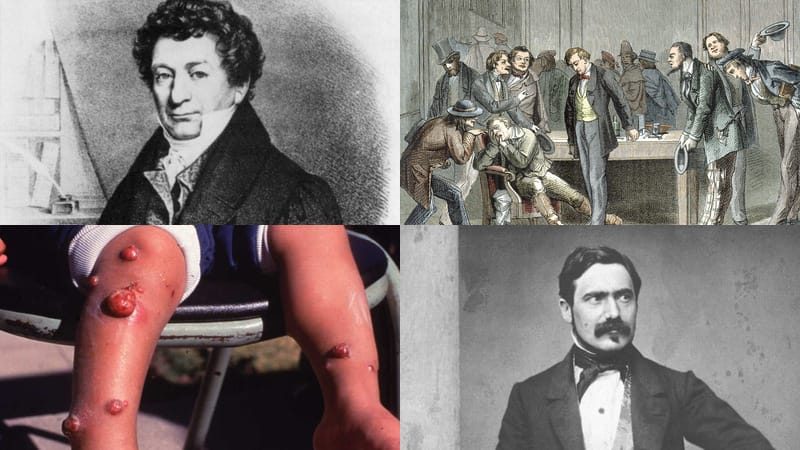
ss-fig1.jpgResearchers Caught Between Scientific Pioneering Spirit and Deadly RiskHow far would researchers go to gain new insights? Some put their health — and even their lives — on the line in pursuit of them. They made themselves test subjects, often without fully understanding the possible consequences.They ingested unknown substances, deliberately infected themselves with dangerous pathogens, or performed medical procedures on their own bodies. What seems almost unimaginable today was regarded by some scientists at the time as the only — or at least the fastest — way to test a hypothesis. They were driven by curiosity, scientific conviction, and the desire to advance medicine. At times, however, ambition and overconfidence also played a role.Self-experiments from the 19th and 20th centuries show just how fine the line can be between scientific pioneering spirit and life-threatening consequences. Some led to significant medical discoveries; others resulted in serious harm, or even death.ss-fig2.jpgFriedrich Wilhelm Sertürner: A Risky Self-Experiment and the Discovery of MorphineWhen the young German pharmacy assistant Friedrich Wilhelm Sertürner (1783-1841) examined the components of opium in 1804, he made a landmark discovery: He isolated its most important pain-relieving active ingredient, thereby laying the foundation for modern pharmaceutical research.But Sertürner also wanted to investigate the substance’s effects on the human body. Together with three adolescents, all no older than 17, he undertook a risky self-experiment, which he described in 1817. The participants ingested the isolated active ingredient multiple times, gradually increasing the dose.Soon, facial flushing, nausea, headaches, and drowsiness set in. After the third dose, their condition deteriorated dramatically: The youths experienced severe abdominal pain, extreme exhaustion, and a numbing sensation bordering on unconsciousness. Sertürner was also affected.When he realized the danger, he gave himself and his companions strong vinegar to induce vomiting. They all did so — violently. They survived but felt the effects of the experiment for several more days.Sertürner had discovered a highly effective but potentially life-threatening substance. He named it “morphine,” after Morpheus, the Greek god of dreams. His research showed that the compound could relieve severe pain but, if taken in too high a dose, could also cause serious poisoning. The self-experiment became an important chapter in the history of medicine.ss-fig3.jpgHorace Wells: A Self-Experiment on the Path to Pain-Free Dental TreatmentIn the 19th century, dental treatment was usually a torment. Patients often had to endure tooth extractions without effective anesthesia. The American dentist Horace Wells (1815-1848) wanted to change that. A chance observation in December 1844 gave him a crucial idea.During a public demonstration of nitrous oxide by the chemist Gardner Quincy Colton (1814-1898) in Hartford, Connecticut, Wells observed how the young pharmacy clerk Samuel Cooley (1821-1900) jumped around exuberantly after inhaling the gas and injured himself on a wooden bench. But Cooley did not notice the injury at first. He later explained that he had felt no pain whatsoever.The very next day, on December 11, 1844, Wells ventured to conduct an experiment on himself. Colton administered nitrous oxide while Wells’s fellow dentist John Mankey Riggs (1811-1885) extracted one of his upper molars. Wells later reported enthusiastically that he had felt virtually no pain.However, when Wells attempted to demonstrate his discovery to doctors and medical students in Boston in January 1845, he failed. The patient complained of severe pain during the tooth extraction, and the audience consequently deemed the procedure unreliable. The reason for this remains unclear to this day.The decisive public breakthrough came just under two years later through the work of another dentist: William Thomas Green Morton (1819-1868), a former partner of Wells’, successfully demonstrated ether anesthesia during surgery on October 16, 1846, at Massachusetts General Hospital in Boston. This marked the beginning of the international ascendancy of inhalational anesthesia.Wells’ self-experiment had already demonstrated the potential of nitrous oxide for less painful dental treatment. However, he was initially denied recognition for his pioneering work.ss-fig4.jpgDaniel Alcides Carrión: A Self-Experiment With Fatal ConsequencesIn 19th-century Peru, doctors faced a medical mystery: The dreaded Oroya fever caused high fever, severe anemia, and was often fatal. Verruga peruana, by contrast, primarily led to skin growths and was usually much milder. Were the two diseases perhaps different forms of the same infection?Medical student Daniel Alcides Carrión (1857-1885) wanted to answer this question. On August 27, 1885, the 28-year-old had infectious material from a skin growth on a 14-year-old patient injected into both of his upper arms at Hospital Dos de Mayo in Lima. With this risky self-experiment, he hoped to observe the course of the disease from the very beginning.At first, Carrión remained symptom-free. But 21 days later, he began experiencing joint pain, weakness, and malaise, followed by fever, chills, and severe pain in his limbs. He carefully documented his symptoms as his condition progressively worsened.Soon, nausea, vomiting, and severe anemia set in. Eventually, Carrión became so weak that his fellow students had to continue documenting the course of his illness. Instead of the expected skin growths, he developed the typical symptoms of the life-threatening Oroya fever.This strengthened the suspicion that both diseases were caused by the same pathogen. For Carrión, this realization came too late: on October 5, 1885, he died at the age of only 28 — just 39 days after becoming infected.A year later, the two clinical forms were united under the name “Carrión disease” in his honor. Today, we know that the bacterium Bartonella bacilliformis causes the disease and is transmitted primarily by infected sand flies.Carrión’s deadly self-experiment provided important evidence of the connection between the two forms of the disease. At the same time, his fate illustrates the price that the pursuit of scientific knowledge can exact.ss-fig5.jpgMax von Pettenkofer: A Sip of Cholera for ScienceIn the 19th century, cholera claimed thousands of lives in Europe. How the disease spread remained a matter of debate for a long time. The Munich hygienist Max von Pettenkofer (1818-1901) was convinced that soil composition, groundwater, and hygienic conditions were the primary factors determining the outbreak of an epidemic.This brought him into conflict with Robert Koch (1843-1910), who had identified the cholera pathogen in 1883-1884. Pettenkofer did not fundamentally deny the role of bacteria, but believed that they became dangerous only under certain environmental conditions.When a devastating cholera epidemic broke out in Hamburg in 1892, claiming more than 8000 lives, his theory came under increasing pressure. While Hamburg relied largely on unfiltered water from the Elbe River, the neighboring district of Altona was affected far less severely thanks to its sand filtration systems.Pettenkofer nevertheless wanted to prove his conviction. On October 7, 1892, the 73-year-old drank a liquid containing an estimated 1 billion live cholera bacteria. He had previously neutralized his stomach acid with baking soda so that the pathogens would reach the intestines as intact as possible.Surprisingly, Pettenkofer survived without developing severe disease. Although he developed watery diarrhea and intestinal discomfort, he did not experience any life-threatening symptoms. Numerous cholera bacteria were detected in his excretions. To him, this confirmed his theory.His student Rudolf Emmerich (1852-1914) repeated the experiment but became much more severely ill. He, too, survived. The different clinical courses illustrated how differently people can respond to the same pathogen.Today it is well established that cholera is caused by toxin-producing strains of Vibrio cholerae. The bacteria, usually ingested through contaminated water or food, produce a toxin in the small intestine that can trigger life-threatening fluid loss.Although Pettenkofer drew the wrong conclusions from his self-experiment, his scientific legacy remains significant. As a pioneer of modern hygiene, he advocated for clean drinking water, better sanitation, and healthier living conditions.ss-fig6.jpgAugust Bier: Needle Pricks, Hammer Blows, and a Burning CigarAt the end of the 19th century, doctors were searching for ways to perform surgery painlessly without general anesthesia. The Kiel-based surgeon August Bier (1861-1949) investigated whether localized anesthesia could be achieved by injecting cocaine into the subarachnoid space, which surrounds the spinal cord and nerve roots. His experiments laid an important foundation for spinal anesthesia.After Bier had used the method for the first time during an operation on August 16, 1898, he wanted to test its effects on his own body. Together with his assistant August Hildebrandt (1868-1954), he planned a risky self-experiment.On August 24, 1898, Hildebrandt inserted a hollow needle into his supervisor’s lower back. However, the syringe did not fit properly onto the cannula. Some of the cocaine solution was lost, and large amounts of cerebrospinal fluid leaked out. The anesthesia failed. The two doctors then switched roles. This time, the injection was successful.Bier administered 5 milligrams of cocaine into his assistant’s cerebrospinal fluid space. Within a few minutes, Hildebrandt lost sensation in large parts of the lower half of his body. The anesthesia lasted about 45 minutes.To test the effect, Bier resorted to drastic methods: he pricked Hildebrandt’s skin with needles, pinched him, struck his shin with an iron hammer, and held a burning cigar against his body. Even plucking pubic hairs and vigorously squeezing and pulling the testicles were among the recorded pain tests. Hildebrandt felt little or no pain during these procedures.In 1899, Bier published his findings under the title “Experiments on the Cocainization of the Spinal Cord.” Although the American neurologist James Leonard Corning (1855-1923) had already experimented with similar injections as early as 1885, Bier succeeded in applying the method during surgery and in documenting it systematically.Today, spinal anesthesia is an established procedure, used, for example, in leg surgery or during cesarean sections. Instead of cocaine, safer local anesthetics are used.ss-fig7.jpgJesse Lazear: A Mosquito Bite Was Supposed to Explain Yellow Fever — Then the Researcher DiedAround 1900, yellow fever was one of the most feared infectious diseases in the Americas. The disease caused high fever, headaches, and muscle pain and could be fatal due to internal bleeding and organ failure. But for a long time, it was unclear how the disease spread.As early as 1881, the Cuban physician Carlos Juan Finlay (1833-1915) suspected that mosquitoes might transmit yellow fever. This contradicted the widely held belief at the time that the disease was transmitted primarily through contaminated objects or direct contact with infected individuals. His theory initially received little recognition.In 1900, the US Army sent a research commission led by military physician Walter Reed (1851-1902) to Cuba. The scientists were tasked with determining how yellow fever was transmitted. Among them was the young physician Jesse Lazear (1866-1900). He allowed mosquitoes to feed on the blood of patients with yellow fever and then investigated whether they could transmit the infection to healthy people. On August 16, 1900, he allowed himself to be bitten by one of these mosquitoes, but did not fall ill.A few weeks later, Lazear contracted yellow fever. Whether he deliberately allowed himself to be bitten by an infected mosquito on September 13 or was accidentally bitten while working at the hospital remains a matter of debate.After an initial fever, his condition deteriorated rapidly. On September 25, 1900, Lazear died at the age of only 34. His death shocked the research commission and highlighted the dangers to which scientists were exposing themselves.Despite this loss, the experiments continued. They demonstrated that infectious mosquitoes could transmit yellow fever. Under the conditions studied, however, contact with contaminated clothing or bedding did not lead to disease. The researchers thus confirmed the crucial role of mosquitoes in transmission.ss-fig8.jpgWerner Forssmann: Secretly Inserting a Catheter Into His Own Heart — What Did the X-Ray Show?In 1929, the young resident physician Werner Forssmann (1904-1979) undertook a risky self-experiment: He guided a catheter through a vein in his arm all the way into his own heart. His aim was to prove that the organ could be reached through the blood vessels without opening the chest.At the time, Forssmann was working at Auguste-Viktoria Hospital in Eberswalde, Germany. He hoped to administer medications or contrast agents directly into the heart via a catheter. However, his supervisor prohibited the experiment on humans out of concern for life-threatening complications.Forssmann did not let that stop him. He obtained a thin ureteral catheter, numbed his arm, and made an incision in a vein in the crook of his elbow. He then advanced the tube about 60-65 centimeters through the venous system until it reached his heart.With the catheter in his arm, he went to the radiography department. The radiograph provided the decisive proof: The tip of the catheter was located in the right atrium of his heart. Forssmann’s self-experiment had succeeded. Forssmann published his findings in 1929. But instead of recognition, he initially faced criticism. Many colleagues considered his approach irresponsible and doubted its medical value.It was not until decades later that the significance of his discovery became clear. The physicians André Frédéric Cournand (1895-1988) and Dickinson Woodruff Richards (1895-1973) further developed cardiac catheterization into a reliable diagnostic procedure. For the first time, this made it possible to systematically examine important pressure relationships in the heart and pulmonary circulation.In 1956, all three researchers were awarded the Nobel Prize in Physiology or Medicine. Nearly three decades after his self-experiment, Forssmann was thus honored for a discovery that had initially been met with rejection.ss-fig9.jpgAlbert Hofmann: A Small Dose of LSD With Dramatic ConsequencesIn 1938, the Swiss chemist Albert Hofmann (1906-2008) synthesized LSD-25 (lysergic acid diethylamide) for the first time at the pharmaceutical company Sandoz in Basel. He was actually searching for new drugs based on ergot alkaloids. Because the substance initially seemed unpromising, it was not investigated further at the time.Five years later, on April 16, 1943, Hofmann suddenly experienced dizziness and unusual sensory perceptions while working in the lab. At home, with his eyes closed, he saw intense colors and vivid images. He suspected that he had accidentally ingested a tiny amount of LSD, possibly through the skin.To verify the effects, Hofmann conducted a self-experiment on April 19, 1943. He ingested 250 micrograms of LSD — a dose he considered low. Yet the effect was far stronger than expected. Soon, dizziness, restlessness, and increasingly altered sensory perceptions set in.As his condition worsened, Hofmann rode his bicycle home, accompanied by his laboratory assistant. The ride turned into a nightmare: Although he pedaled vigorously, he felt as if he were barely moving forward. His surroundings appeared distorted; familiar objects seemed strange and threatening. Hofmann increasingly lost his sense of space and time and feared he was losing his mind. Only after several hours did the effects gradually subside. Hofmann later described the dramatic experiences of his self-experiment in detail.In the years that followed, Sandoz marketed LSD under the trade name Delysid for psychiatric research. Scientists investigated possible therapeutic applications. In the 1960s, the substance became increasingly widespread outside medicine and was eventually placed under strict regulation in many countries.ss-fig10-new.jpgBarry Marshall: He Drank Bacteria and Revolutionized MedicineFor a long time, stress, poor diet, and excess stomach acid were considered the main causes of stomach ulcers. Many doctors thought it unlikely that bacteria could survive in the acidic environment of the stomach and cause disease.In the early 1980s, the Australian doctors Barry Marshall (b. 1951) and Robin Warren (1937-2024) made a significant discovery: They found spiral-shaped bacteria in tissue samples from inflamed gastric mucosa. They suspected that these bacteria were not merely commensals but the actual cause of the inflammation.Their hypothesis was initially met with skepticism. When experiments in animal models proved unsuccessful, Marshall decided to conduct a risky self-experiment. In July 1984, he first underwent gastroscopy, which revealed no abnormalities. He then drank a bacterial culture containing the pathogen later identified as Helicobacter pylori.A few days later, he developed nausea, vomiting, and halitosis. A follow-up gastroscopy after about 10 days revealed marked inflammation of the gastric mucosa. Numerous bacteria were found in the tissue samples. Marshall had thus experimentally demonstrated that H pylori can cause gastritis.After about 2 weeks, he began antibiotic treatment and ended the self-experiment. A stomach ulcer did not develop. However, together with subsequent clinical studies, his experiment provided crucial insights into the role of the bacterium in gastric and duodenal ulcer disease.The discovery fundamentally changed the treatment of these conditions: Instead of solely inhibiting stomach acid, clinicians could now also target the bacterial cause with antibiotics.In 2005, Marshall and Warren were awarded the Nobel Prize in Physiology or Medicine for their research. A risky self-experiment had led to a decisive advance in gastroenterology.ss-fig11.jpgScientific Courage or Dangerous Recklessness: Where Is the Line?Medical self-experiments reflect curiosity, determination, and a willingness to risk one’s own health in pursuit of new knowledge. But when does scientific courage become dangerous recklessness?Those who experiment on their own bodies may appear, at first glance, to endanger only themselves. Yet many historical experiments also involved assistants, colleagues, or volunteers. The researchers’ responsibility therefore extended far beyond their own personal risk.From a scientific perspective, self-experiments also have clear limitations: A single experiment can provide important clues, but rarely conclusive proof. Individual reactions, lack of control groups, and personal expectations can all influence the results. Only further studies that are independently verifiable can show whether the findings can be generalized.Today, self-experiments must also meet scientific, ethical, and legal standards. Depending on the project, review by an ethics committee, a careful risk-benefit assessment, and appropriate safety measures are required. Voluntarily assuming risk does not replace these safeguards.This article was translated from Medscape’s German edition.
9 Daring Self-Experiments That Changed Medical History
Full Article
Original Source
Read the full article at Medscape →KhanList aggregates and links to publicly available news content. We do not host full articles from third-party sources. Always verify important information with original sources.