
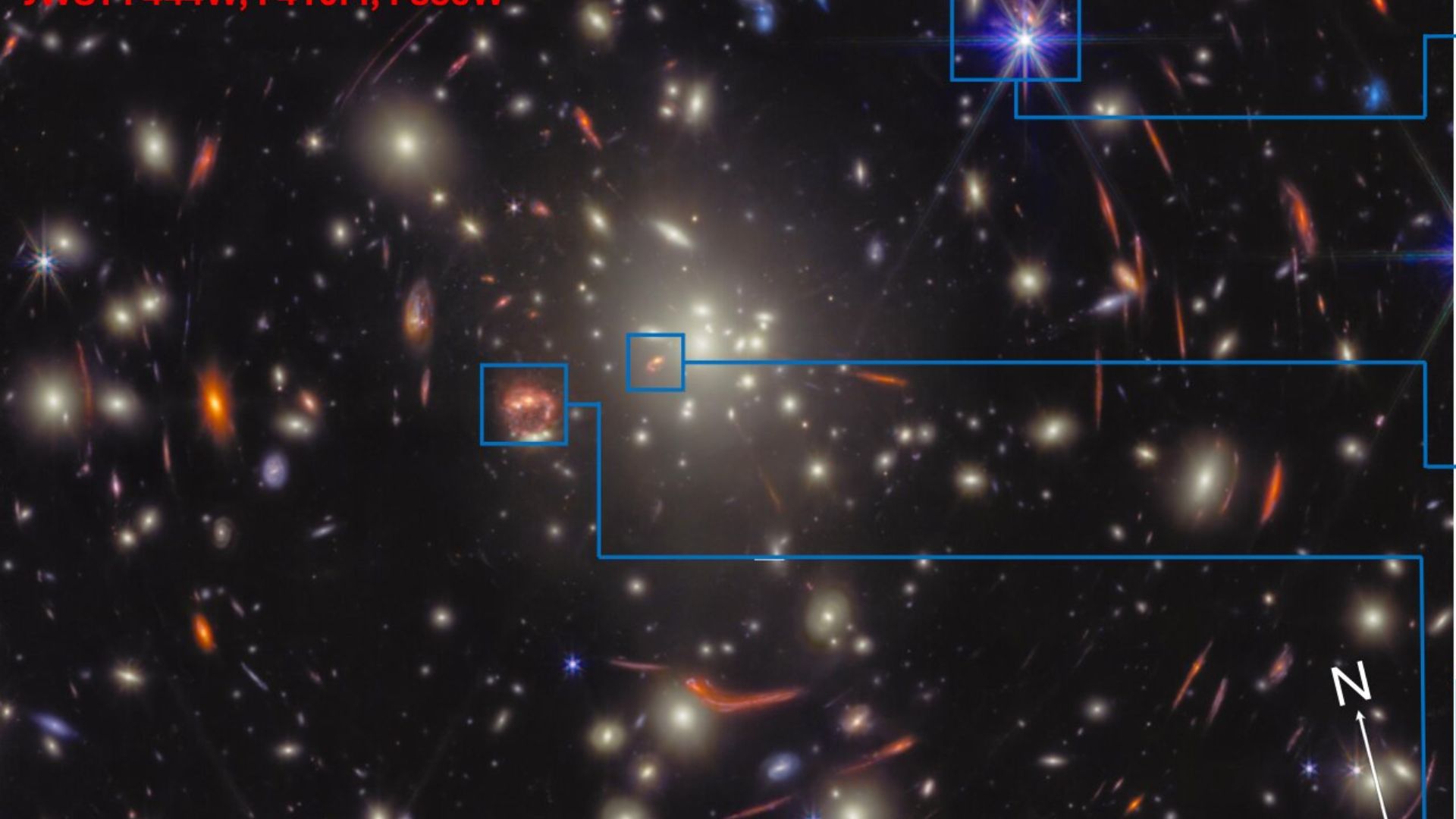
Astronomers at the Space Telescope Science Institute (STScI) have spotted an exploding star from 8.8 billion years ago in high-resolution images from the James Webb Space Telescope (JWST). The images were taken in August 2025, and thanks to gravitational lensing, astronomers will have another chance to view it in about 70 years. The JWST was launched in December 2021 as the successor to the Hubble Space Telescope. A space-based infrared observatory, the project is a joint association between NASA, the European Space Agency (ESA), and the Canadian Space Agency (CSA). Orbiting roughly 930,000 miles (1.5 million km) from Earth, the telescope captures images of exoplanets, star formation, and galaxy evolution, helping us understand the early universe. When it comes to detecting supernovae, the JWST has a stellar record, capturing some of the earliest supernovae, dated to just 730 million years after the Big Bang. Scientists have combined data from Hubble and JWST to explain some ‘missing red supergiants’, while JWST has also spotted the Brightest of All Time (BOAT) supernova signature. This time around, astronomers will be able to spot the supernova, dubbed SN Ares, in another 70 years, thanks to gravitational lensing. What is gravitational lensing? According to Einstein’s general theory of relativity, massive objects warp the fabric of space and time. Even though light has no mass, the spacetime curvature caused by gravity bends light, too. This creates a cosmic magnifying glass or lens that can brighten light from a background source, helping astronomers see faint or distant objects clearly. This is called gravitational lensing. Some examples of this lensing are the Einstein Cross, where gravity splits the light of a distant quasar into four distinct images, arranged in the form of a cross. A molten ring magnifies the light of a background galaxy 20-fold and twists it into a glowing molten ring. In some cases, though, the light bent by gravitational lensing can arrive at different times. While it can be just a few hours apart, in the case of SN Ares, the other light is expected to come in about 73 and 76 years. Light arriving after decades Astronomers spotted SN Ares in near-infrared images of the galaxy cluster MACS J0308.9+2645 taken by the JWST in August 2025. They classified it as a Type IIb Supernova after the spectroscopy results showed helium and hydrogen features, signifying that the star was losing its outer hydrogen layer due to an explosion. Their analysis using a three-lens model shows that two more images of the supernova are yet to reach us. Their expected arrival after seven decades marks a rare inter-generational lensing viewing opportunity. We do not quite know how astronomy will play out in the next 70 years, but it will give the next generation a peek into the past too. Another reason this event is important is that the arrival time of the next set of images depends on the geometry of space. Since the universe is also expanding, measuring the delay in when the images arrive will help astronomers compute the Hubble constant, the expansion rate of the universe. The researchers will make more spectroscopic measurements in 2027 to understand properties of the lens and accurately predict the delay. The research findings were published on pre-print server arXiv. Get the latest in engineering, tech, space & science - delivered daily to your inbox.Ameya is a science writer based in Hyderabad, India. A Molecular Biologist at heart, he traded the micropipette to write about science during the pandemic and does not want to go back. He likes to write about genetics, microbes, technology, and public policy.
8.8-billion-year-old supernova to reappear in 70 years after James Webb sighting
Full Article
Original Source
Read the full article at Interestingengineering →KhanList aggregates and links to publicly available news content. We do not host full articles from third-party sources. Always verify important information with original sources.