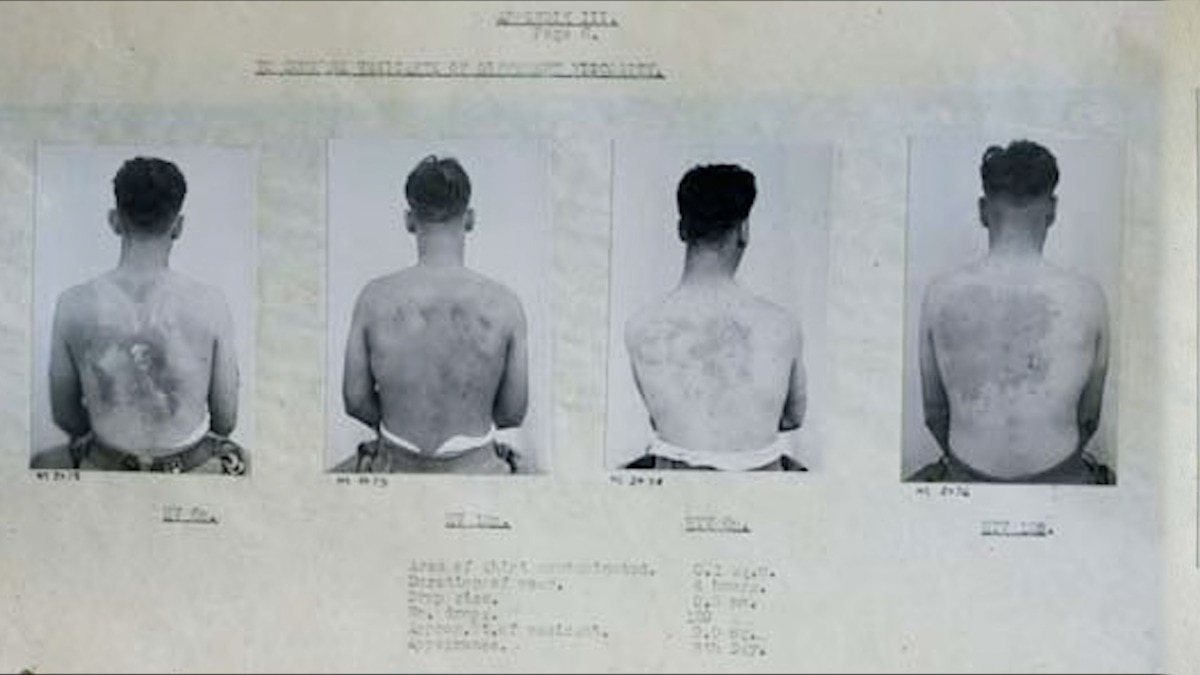
Even 80 years after India's Independence, the British monarchy has never acknowledged the wealth drained from India, the Bengal Famine, or the mustard gas experiments conducted on Indian soldiers at Rawalpindi.British scientists tested mustard gas doses on Indian soldiers at Rawalpindi for years.August 15 marks India's Independence Day, and with it comes a question the British establishment has spent eight decades avoiding. What does Britain actually owe India? Not as a matter of sentiment, but as a matter of historical record.The economist Utsa Patnaik of Jawaharlal Nehru University, in research published by Columbia University Press, calculated that Britain extracted roughly 44.6 trillion dollars from India between 1765 and 1938, using nearly two centuries of tax and trade data compounded at a conservative 5 per cent. Congress MP Shashi Tharoor has long argued that India's share of global GDP collapsed from around 27 per cent at the start of British rule to roughly 3 per cent by the time the British left, a decline he laid out at length in his widely viewed 2015 address at the Oxford Union making the case for reparations. That argument has never received a formal response from the British state, only what can fairly be described as institutional silence. The clearest evidence of the human cost sits in Bengal. Between 1943 and 1944, an estimated two to three million people died of starvation and related disease. A peer reviewed study in Geophysical Research Letters, examining soil moisture records from 1870 to 2016, found the Bengal famine to be the only major Indian famine not linked to drought, attributing it instead to policy failure during British rule. Declassified papers in Britain's National Archives show that Winston Churchill diverted food supplies away from Bengal towards British troops and European stockpiles even as his own Viceroy pleaded for relief, and rejected offers of grain shipments from the United States and Canada. Churchill is recorded as dismissing the crisis by comparing starving Bengalis unfavourably to what he called "sturdy Greeks," a remark that sits alongside his 1919 comment favouring the use of poisoned gas against what he termed "uncivilised tribes."That second remark was not merely rhetoric. Papers held in Britain's National Archives, first reported by The Guardian in 2007, show that scientists from the Porton Down chemical weapons facility ran mustard gas experiments on Indian soldiers at a base in Rawalpindi from the early 1930s through World War II, seeking to establish how differently Indian skin blistered compared with European skin. Soldiers wearing only shorts suffered severe burns to their skin, eyes and genitals, and no compensation or long term follow up was ever recorded. Then came Partition, executed with similar disregard. Barrister Cyril Radcliffe, who had never previously visited India, was given five weeks to draw the border that became the Radcliffe Line, published on 17th August 1947, two days after independence. The line displaced between 10 and 20 million people and left an estimated 200,000 to two million dead in the violence that followed, according to widely cited historical estimates. Its ambiguities over Kashmir, left unresolved because the princely states were permitted to choose their own allegiance, produced a dispute that has since triggered four wars and continues to fuel cross-border terrorism even today by Pakistan. Britain's pattern of drawing borders without regard for the people living on them was not confined to South Asia, and echoes in the unresolved Durand Line between Pakistan and Afghanistan and in the partition of Palestine, a conflict that by 2026 had killed more than 75,000 Palestinians in Gaza alone, according to Ministry of Health figures corroborated by a Lancet Global Health mortality survey.None of this history has been formally acknowledged by the British monarchy, an institution that today still displays the Kohinoor diamond taken from India and the Cullinan diamond taken from South Africa. The current royal family bears no personal responsibility for these events, but it remains the direct beneficiary of the wealth and prestige they generated, and it has never once offered a public acknowledgement that what happened to India was wrong.India today stands as the world's fourth-largest economy by nominal GDP, valued at roughly 4.15 trillion dollars and growing at 6.5 per cent annually according to the International Monetary Fund's April 2026 outlook, making it the fastest growing major economy on the planet. That growth was achieved despite British rule, not because of it, and it invites an obvious question about what India and the wider subcontinent might have become had that wealth, and those lives, never been taken.Britain owes India more than a number and more than an apology. It owes India an honest reckoning with a history it has spent eight decades declining to face.-With inputs from Jyoti Shukla- EndsPublished On: Aug 16, 2026 08:25 IST
80th Independence Day: Britain still owes India an honest reckoning, not silence
Full Article
Original Source
Read the full article at Indiatoday →KhanList aggregates and links to publicly available news content. We do not host full articles from third-party sources. Always verify important information with original sources.