
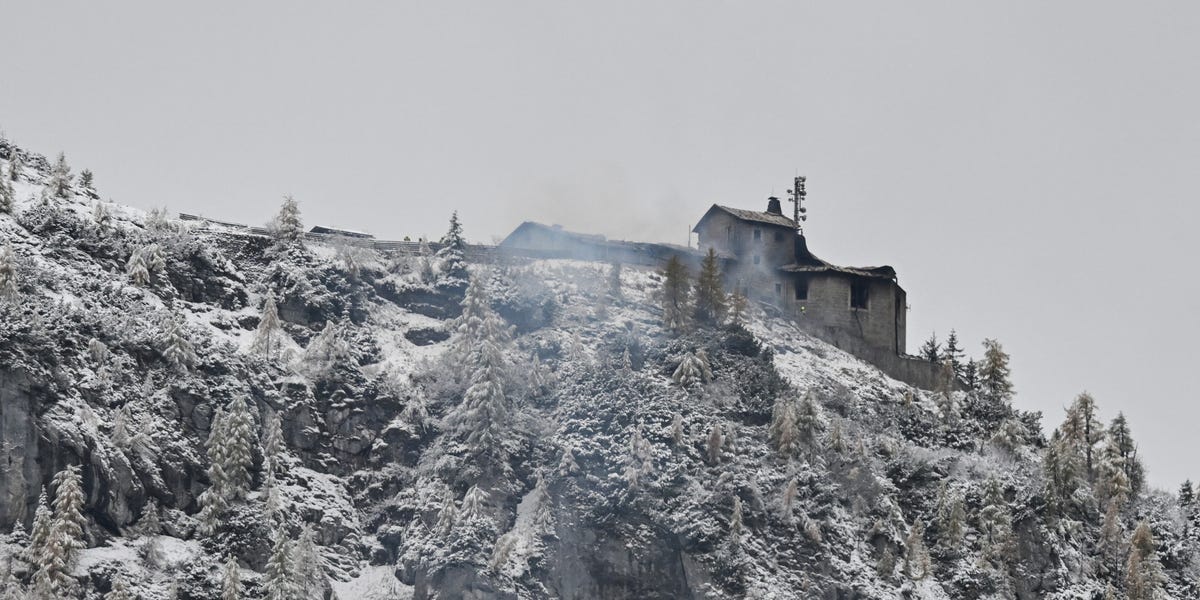
3 min readOn October 24, 2026, flames engulfed the mountaintop chalet that had by now become the most popular tourist spot in Obersalzberg, Germany: the Kehlsteinhaus. Dubbed the “Eagle’s Nest” by the American soldiers who later occupied it, the massive building was commissioned in 1937 by private secretary Martin Bormann for his boss, to serve as a venue for diplomatic functions and other affairs. The mountaintop building survived the war, but nearly 80 years later, was the target of suspected arson.While authorities did apprehend a suspect not long after the fire broke out, the Associated Press reports, they will also “look into the possibility of a political motive in view of the building's history.”The “history” in question is the Kehlsteinhaus’ original owner. Bormann’s boss, after all, was Adolf Hitler.The massive project took 13 months to complete and cost 30 million Reichsmarks (Roughly $120 million in 1937, or $2.81 billion today), but it was ultimately a folly. Hitler only visited the Eagle’s Nest 14 times, disliking heights, distrusting the building’s ornate elevator, and frowning upon Bormann’s excess in its construction.Galerie Bilderwelt//Getty ImagesItalian Foreign Minister Count Galeazzo Cianomeets with Adolf Hitler at the Kehlsteinhaus on August 13, 1939The book Inside the Third Reich: Memoirs by Albert Speer recounts that some around Hitler would remark that “Bormann has created a gold-rush town atmosphere [in Obersalzberg]. Only he doesn’t find any, he spends it.” In response, Hitler reportedly “regretted the hubbub” and remarked that “It’s Bormann’s doing; I don’t want to interfere.”While Eva Braun and her family spent ample time in the mountaintop retreat, including hosting the reception for Gretl Braun’s wedding in 1944, Hitler himself preferred his summer home, Berghof, located just four miles away.The headlines surrounding the fire focus on the Hitler connection, understandably so, as it’s perhaps one of the only Hitler-related sites that was left standing (Berghof was demolished by the Bavarian government in 1952, for example). But a new report in Stars and Stripes calls attention to some other famous occupants of the Eagle’s Nest, and what remnants of them we lost in the fires which consumed the historic site.-//Getty ImagesVideo grab taken from a webcam pointed at the Eagle’s Nest during the Oct. 24, 2026, fire.By May 1945, U.S. Army units reached Berchtesgaden and Obersalzberg, ultimately occupying Kehlsteinhaus, which had been abandoned but remained largely undamaged by Allied bombs. There is some debate around which unit reached the Eagle’s Nest first, but what is certain is that elements of both the 3rd Infantry Division and the 101st Airborne Division entered and occupied the mountain retreat. Amidst the latter was the company known as “Easy Company,” latter immortalized in the book and HBO miniseries Band of Brothers. The occupation of the Eagle’s Nest is depicted in the Emmy-winning series’ finale, “Points.”“American soldiers occupied the site,” Stars and Stripes notes, “used it briefly as a command post and recreation area, and took souvenirs from the interiors.”They also left some souvenirs behind. Kehlsteinhaus boasted a lavish red marble fireplace, a personal gift from Benito Mussolini to Hitler. That fireplace provided a fine canvas for the men of the U.S. Army, many of whom emblazoned it with their names, a little G.I. graffiti to mark their territory.For a time, the Eagle’s Nest served as rest-and-relaxation facilities for American soldiers, before it was turned over to the State of Bavaria in 1960 and converted into a tourist attraction with a restaurant and beer garden.ERIC SCHWAB//Getty ImagesUS soldiers rest in the living room of the KehlsteinhausIt’s easy to bristle at the idea of one of Hitler’s homes being a “tourist attraction.” It’s reasonable, at first blush, to think it gauche that a restaurant operated for decades in a building built by the Nazis. One might even question if anything was truly lost when a monument of such infamy goes up in flames.Yet, a deeper understanding of the building’s full history shows why its continued existence held such significance, and why the Bavarian government intends to rebuild once the dust has settled on the rubble. As the Army newspaper noted: “Generations after the end of the war, American veterans often returned to the Eagle’s Nest, walking the same terraces they had first seen in 1945.”Michale Natale is a News Editor for the Hearst Enthusiast Group. As a writer and researcher, he has produced written and audio-visual content for more than fifteen years, spanning historical periods from the dawn of early man to the Golden Age of Hollywood. His stories for the Enthusiast Group have involved coordinating with organizations like the National Parks Service and the Secret Service, and travelling to notable historical sites and archaeological digs, from excavations of America’ earliest colonies to the former homes of Edgar Allan Poe.
80 Years After It Survived WWII, a Fire Has Destroyed Hitler’s Infamous Eagle’s Nest
Full Article
Original Source
Read the full article at Popularmechanics →KhanList aggregates and links to publicly available news content. We do not host full articles from third-party sources. Always verify important information with original sources.