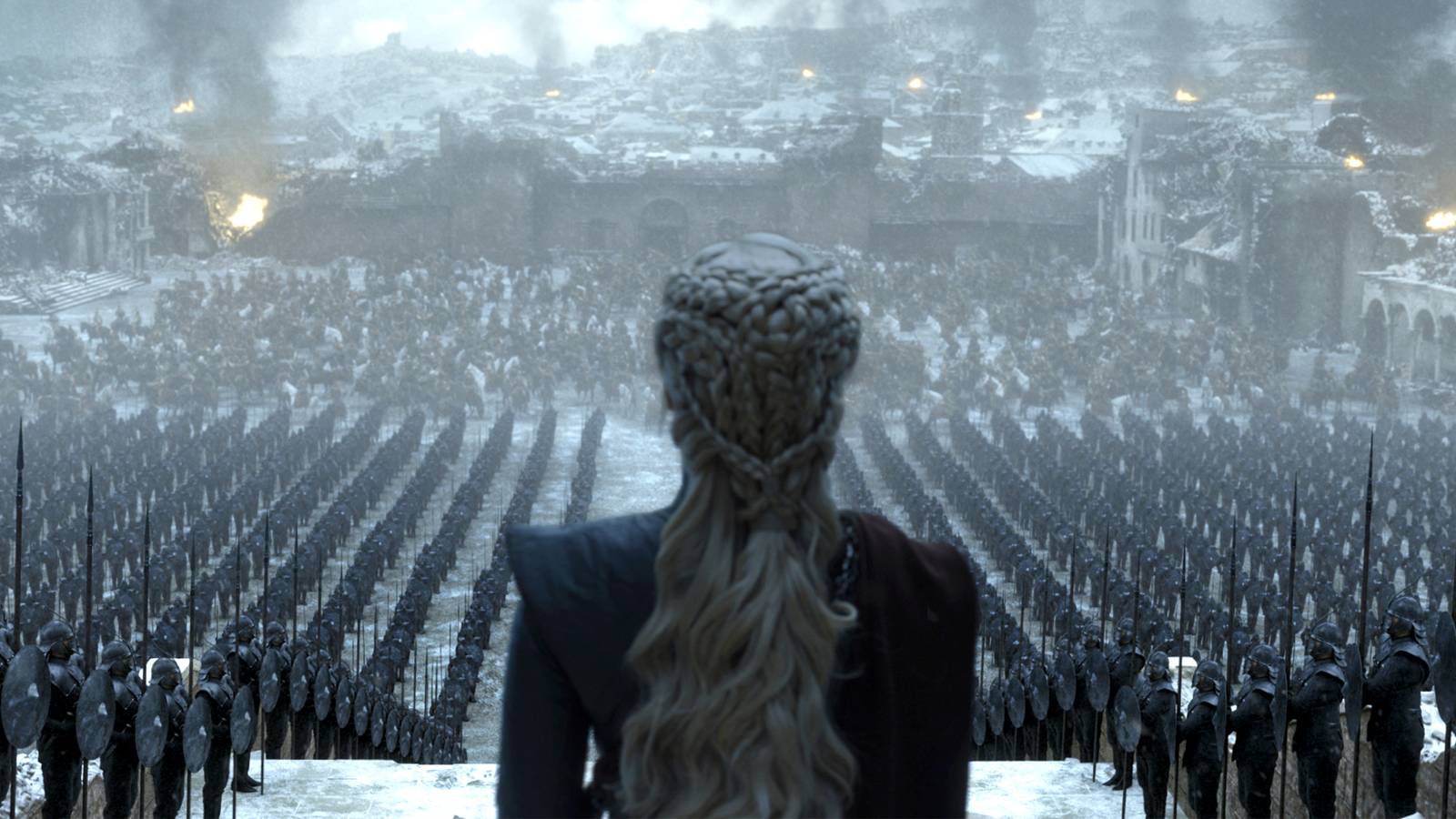
Image via HBO Published Jul 25, 2026, 4:17 PM EDT Jessica is a young writer from Brisbane, Australia. An avid consumer and lover of all things Film and TV, you will never tear her away from a screen. A tendency rooted from childhood, she once had dreams of becoming a member of the famed kids-band 'Hi-5'. Perhaps that's what pushed her to secure an education with a theater background. But now, as dreams evolved, her passions have turned to admiring performances from afar. Frankly, she's just grateful that she can put her binging skills to good use. Outside of work, Jessica recently completed her undergraduate double degree in Arts/Communications. Other than that, she spends most of her free time with family and friends, probably never forgetting to talk about the new movie or show she watched the day prior. Sign in to your Collider account Ending a great television show is one of the hardest challenges in storytelling. After years of building unforgettable characters, intricate relationships, and a devoted fanbase, a finale carries the impossible task of delivering emotional closure while living up to expectations that have been growing for years. Some shows are lucky enough to stick the landing. Others become cautionary tales, sometimes remembered less for everything they did right than for the way they ultimately stumbled over the finish line. In many cases, the warning signs appear long before the final episode. Rushed final seasons, uneven pacing, questionable character decisions, and increasingly over-stuffed storylines that often leave writers with an impossible amount to resolve in far too little time. That final episode is simply the final nail in the coffin. So, while none of these finales erase the brilliance of the shows' past, they do become frustrating reminders that even the greatest of shows aren't guaranteed a satisfying conclusion. 8 'Squid Game' (2021–2025) Image via Netflix After rebelling against the games at the end of Season 2, Seong Gi-hun (Lee Jung-jae) finds himself pulled back into the deadly competition. And though appearing dejected, he still finds himself trying to save as many people as he can while exposing the organization behind the competition. The series ultimately builds toward a tragic end rather than one of justice, closing the story on a far more somber note than most expected. While the first season was praised for its razor-sharp social commentary, the final season never quite recaptures that magic. The rebellion is wrapped up surprisingly quickly, almost every character receives rushed and convoluted arcs, and Gi-hun's final sacrifice divided audiences who hoped for a more satisfying payoff after everything he endured. Despite some emotionally effective moments, the finale felt more interested in making an outright statement rather than delivering the gripping, character-driven conclusion that made Squid Game a global phenomenon. And let's not talk about that final A-List cameo please. 7 'Sex Education' (2019–2023) Image via Netflix With the closure of Moordale Secondary, season four finds most of the students beginning a new chapter at the ultra-progressive Cavendish College, where Otis Milburn (Asa Butterfield) continues to offer relationship advice while navigating his increasingly complicated long-distance romance with Maeve (Emma Mackey). And as the gang continues to prepare for adulthood, the show attempts to wrap up years of friendships, romances, and personal growth. What once felt refreshingly honest and genuinely revolutionary in its depiction of teenage relationships gradually loses its way in the final season. For one, the hyper-progressiveness often feels so exaggerated that it borders on self-parody and cringe, with numerous scenes prioritizing awkward shock value over the grounded emotional storytelling that made Sex Education a hit. Worse still, the show severely underutilizes much of its original ensemble in favor of introducing an influx of new characters just as audiences wanted to spend more time with the old ones (especially since many were bizarrely regressing in development). And sure, while there were some touching moments in the finale—particularly between the parents and children—it was hard to ignore the frantic attempts at resolution. From the bittersweet ending for Otis and Maeve to the lack of meaningful closure for many fan-favorite relationships and friendships, the final episode felt anything but satisfying. 6 'The Umbrella Academy' (2019–2024) Image via Netflix The dysfunctional Hargreeves siblings once again find themselves trying to prevent reality from collapsing after another timeline-altering catastrophe leaves them powerless and scattered across an unfamiliar world. As enemies return and long-buried family wounds resurface, the siblings search for a way to save existence itself one final time, knowing this mission may require the ultimate sacrifice. Unfortunately, the fourth season of The Umbrella Academy feels noticeably smaller and more rushed than its predecessors, with only six episodes attempting to resolve years of increasingly complex mythology. Beloved characters receive surprisingly thin storylines, major revelations arrive with little setup, and emotional moments rarely have enough time to breathe. The finale's bittersweet ending is certainly ambitious, but many viewers felt it reduced years of character development to a conclusion that seemed more interested in tying up timelines than satisfying the emotional journeys that made the show so beloved in the first place. 5 'Stranger Things' (2016–2025) Image via Netflix The fifth and final season sees Hawkins plunged into its greatest crisis yet as the Upside Down finally begins consuming the town. In the case of our surviving heroes, they all unite for one last battle against Vecna (Jamie Campbell Bower), whose endgame threatens not just Hawkins but the entire world. And with years of mythology converging, the season attempts to deliver an epic farewell worthy of one of the biggest cultural phenomenons of the fantasy genre. Instead, the finale left many fans feeling that bigger didn't necessarily mean better. Despite its blockbuster scale, the final season often rushed through important emotional beats while devoting an enormous amount of time to spectacle and nostalgia. Several original heroes got sidelined in favor of unnecessary new characters, important relationships received surprisingly little resolution, and the significant number of half-baked sacrifices significantly lowered the sense of danger and stakes. Add in questionable character decisions (hello bizarre coming out scene), unresolved plot threads, and an ending that leans heavily into sentimentality, and the conclusion struggles to match the carefully crafted emotional storytelling that defined Stranger Things' early years. Because what do you mean the final battle was a CGI hodepodge that resolved itself halfway into the finale? If only "Conformity Gate" was real. At least that would've been more interesting. 4 'St. Elsewhere' (1982–1988) Image via NBC For six seasons, St. Elsewhere chronicled the lives of the doctors, nurses, and patients working at Boston's St. Eligius Hospital. Celebrated for its realistic portrayal of medicine and willingness to tackle difficult social issues, the show became one of television's most influential dramas, helping pave the way for many of the other medical shows we now love today. Sadly, its infamous final scene remains one of the most controversial endings in television history as it utilizes one of the laziest tropes. Specifically, in the finale, it's revealed that the entire series existed only within the imagination of Tommy Westphall (Chad Allen), a non-verbal autistic boy staring into a snow globe containing a miniature version of the hospital. While undeniably bold, the twist left viewers feeling as though six seasons of storytelling had been rendered meaningless. Others admired its ambition, but there's no denying that it fundamentally changed how audiences viewed everything that came before, ensuring the finale would be debated for decades. Collider Exclusive · TV Medicine Quiz Which Fictional Hospital Would You Work Best In? The Pitt · ER · Grey's Anatomy · House · Scrubs Five hospitals. Five completely different ways medicine goes sideways on television — brutal, chaotic, romantic, brilliant, and ridiculous. Only one of them is the ward your instincts were built for. Eight questions will figure out exactly where you belong. 🚨The Pitt 🏥ER 💉Grey's 🔬House 🩺Scrubs FIND YOUR HOSPITAL → 01 A critical patient comes through the door. What's your first instinct? Medicine under pressure reveals who you actually are. AStay completely present — block everything else out and work through it step by step, right now. BTriage fast and delegate — get the right people on the right problems immediately. CTrust my gut and move — I work best when I stop overthinking and just act. DAsk the question everyone else is ignoring — what's the thing that doesn't fit? ETake a breath, make a joke to cut the tension, and then get to work — panic helps no one. NEXT QUESTION → 02 Why did you go into medicine in the first place? The honest answer says more about you than the one you'd give in an interview. ABecause I wanted to be where it matters most — right at the edge, when someone's life is actually on the line. BBecause I wanted to help people — genuinely, one patient at a time, in a system that makes it hard. CBecause I was drawn to the intensity of it — the stakes, the drama, the feeling of being fully alive. DBecause medicine is the most interesting puzzle there is — and I needed a problem worth solving. EBecause I wanted to make a difference — and also, honestly, I didn't know what else to do with my life. NEXT QUESTION → 03 What do you actually want from the people you work with? Who you want beside you under pressure is who you are. ACompetence and calm — I need people who don't fall apart when things get bad. BTrust and reliability — I want to know that when I pass something off, it's handled. CConnection — I want colleagues who become family, even if that gets complicated. DIntelligence and the willingness to be challenged — I have no interest in people who just agree with me. EFriendship — people I actually like spending twelve hours a day with, because those hours are going to happen either way. NEXT QUESTION → 04 You lose a patient you fought hard to save. How do you carry it? Every doctor who's worked a long shift has had to answer this question. AI carry it. All of it. I don't look for ways to put it down — that weight is part of doing this work honestly. BI process it and move — you have to, or the next patient suffers for the one you just lost. CI feel it deeply and lean on the people around me — I don't think you're supposed to handle that alone. DI go back over every decision — not to punish myself, but because I need to understand what I missed. EI grieve it genuinely, find some way to laugh about something unrelated, and try to be kind to myself — imperfectly. NEXT QUESTION → 05 How would your colleagues describe the way you work? Your reputation on the floor is usually more accurate than your self-image. AIntense and completely present — no small talk during a shift, but exactly who you want there. BSteady and dependable — not the flashiest in the room but never the one who drops something. CPassionate and occasionally chaotic — brilliant on the hard cases, prone to drama everywhere else. DBrilliant and difficult — right more often than anyone else, and everyone knows it, including me. EWarm and self-deprecating — not the most intimidating presence, but genuinely good at this and easy to like. NEXT QUESTION → 06 How do you feel about hospital protocol and procedure? Every institution has rules. What you do with them is a choice. AProtocol is the floor, not the ceiling — I follow it until the patient needs something it can't provide. BI respect it — the system is broken in places, but the structure is there for a reason and I work within it. CI follow it until my instincts tell me not to — and my instincts are usually right, even when they cause problems. DRules are for people who haven't thought hard enough about when to break them. EI try to follow it and mostly do — with a few memorable exceptions that still come up in meetings. NEXT QUESTION → 07 What does this job cost you personally? Nobody works in medicine without paying a price. What's yours? AEverything outside these walls — I've given this job my full attention and the rest of my life has gone around it. BMy idealism, mostly — I came in believing the system could be fixed and I've made a complicated peace with that. CStability — my personal life has been as chaotic as the OR, and that's not entirely a coincidence. DMy relationships — I am not easy to know, and the people who've tried to would probably agree. EMy sense of gravity — I use humour as a coping mechanism, which not everyone appreciates in a hospital. NEXT QUESTION → 08 At the end of a long shift, what keeps you coming back? The answer to this question is the most honest thing about you. AThe fact that it's real — that nothing else I could be doing would matter this much, right now, today. BThe patients — individual human beings who needed something and got it because I was there. CThe people I work with — I have walked through impossible things with these people and I'd do it again. DThe next unsolved case — there's always another puzzle, and I'm not done yet. EBecause despite everything — the exhaustion, the loss, the absurdity — I actually love this job. REVEAL MY HOSPITAL → Your Assignment Has Been Made You Belong In…Your answers have pointed to one fictional hospital above all others. This is the ward your instincts, your temperament, and your particular brand of dysfunction were built for. The PittYou are built for the most unsparing version of emergency medicine television has ever shown — one that puts you inside a single fifteen-hour shift and doesn't let you look away. You need your work to be real, not romanticised — meaning over drama, honesty over aesthetics. You find purpose inside the work itself, not in the chaos surrounding it. You've made peace with the fact that this job takes from you constantly, and gives back in ways that are harder to name. Pittsburgh Trauma Medical Center demands exactly that kind of person — and you would not want to be anywhere else. ERYou are the person who keeps the whole floor running — not the most brilliant in the room, but possibly the most essential. You show up, do the work, absorb the losses, and come back the next day without needing the job to be anything other than what it is. You care about patients as individual human beings, not as cases to solve or dramas to live through. You believe in the system even when it fails you — and you understand that emergency medicine is about holding the line just long enough. ER is television about endurance. You have it. Grey's AnatomyYou came to medicine with your whole self — your ambition, your emotions, your relationships, your history — and you have never quite managed to leave any of it at the door. You feel things fully and form deep attachments to the people you work with. Your personal and professional lives are permanently, chaotically entangled — and that entanglement drives both your greatest disasters and your most remarkable saves. You understand that extraordinary medicine often happens at the intersection of clinical skill and profound human connection. It's messy at Grey Sloan. You would not have it any other way. HouseYou are drawn to the problem above everything else — the symptom that doesn't fit, the diagnosis hiding underneath the obvious one. You're not primarily motivated by the patient as a person — though you are capable of caring, even if you'd deny it. You work best when the stakes are highest and the standard answer is wrong. Princeton-Plainsboro exists to house one extraordinary, impossible mind — and everyone around that mind is there because they're smart enough to keep up. The only way forward here is to think harder than everyone else in the room. That is exactly what you do. ScrubsYou understand that medicine is tragic and absurd in almost equal measure — and that the only sane response is to hold both of those things at the same time. You are warm, self-aware, and funnier than most people in your field. You use humour to get through terrible moments — and at Sacred Heart, that's not a flaw, it's a survival strategy. You lean on the people around you and let them lean back. The laughter and the grief are genuinely inseparable here. Scrubs is a show about learning to become someone worthy of the job. You are still very much in the middle of that process — which is exactly right. ↻ RETAKE THE QUIZ 3 'Dexter' (2006–2013) Image via Showtime After years of living a double life as both Miami Metro's blood-spatter analyst and a serial killer targeting murderers who escaped justice, the morally gray Dexter Morgan (Michael C. Hall) finds himself increasingly unable to separate his carefully constructed code from the chaos surrounding him. But as his secrets begin catching up with them, Dexter is forced to confront whether a man like him could ever have a normal life. Although the eighth season had already been criticized for inconsistent writing and underwhelming villains, the Dexter finale amplified those frustrations. Debra's (Jennifer Carpenter) tragic fate felt abrupt, several major storylines fizzled out without satisfying conclusions, and Dexter's decision to fake his own death before living in exile as a lumberjack became one of television's most mocked endings. No wonder they made the new sequel series. They had to repair the damage somehow. Sadly, the original finale still remains a textbook example of how an otherwise exceptional show can flop its way to the finish line. 2 'How I Met Your Mother' (2005–2014) Image via CBS Across nine seasons, Ted Mosby (Josh Radnor) recounts to his children the long and winding story of how he eventually met their mother, weaving together years of friendships, romance, heartbreaks, and countless misadventures alongside his best friends. The final season unfolds almost entirely over the weekend of Barney (Neil Patrick Harris) and Robin's (Cobie Smulders) wedding before finally introducing the woman audiences had spent nearly a decade waiting to meet. Cut to the finale and How I Met Your Mother completely dismantles all that they've been building in one single episode. Barney and Robin divorce almost immediately, the friend group effectively drift apart as they go on to live their own lives, and worst of all, the Mother (Cristin Milioti) is tragically killed off after receiving very little screen time already. In the end, the story circles back to Ted pursuing Robin—a final act that perplexed (and angered) almost everyone as it ignored years of character development. And while this shocking narrative choice was seemingly the plan from the show's earliest days, there's no doubt that the beloved sitcom's long evolution proved how characters can naturally outgrow the conclusion that was originally penned to paper. 1 'Game of Thrones' (2011–2019) Image via HBO After years of political maneuvering, brutal warfare, and supernatural threats, Game of Thrones entered its final season with every major storyline converging. The White Walkers march on to Winterfell, Daenerys Targaryen (Emilia Clarke) prepares to claim the Iron Throne, and the surviving players make one final push to determine the future of Westeros after nearly a decade of unforgettable scheming and conflict. Unfortunately, the final season has become the gold standard for disappointing endings because nearly every criticism stems from one underlying issue: it was rushed. Character arcs built over eight seasons suddenly reversed course, major plotlines concluded with surprising ease, and many of the deaths felt as random (and as empty) as the roll of a die. From the Night King's defeat, Daenerys' transformation into the Mad Queen, the fall of Cersei's (Lena Headey) reign, and Bran's (Isaac Hempstead-Wright) random ascension to the throne—every narrative point seemed to prioritize shock over earned storytelling. Sure, there was spectacular production value and breathtaking battles, but the finale demonstrated that even the most revered dramas aren't immune to an ending that leaves fans wanting more. If only George R. R. Martin had written those last books. Maybe then, we'd see some sensical storytelling.
8 Worst Finales to Amazing TV Shows
Full Article
Original Source
Read the full article at Collider →KhanList aggregates and links to publicly available news content. We do not host full articles from third-party sources. Always verify important information with original sources.