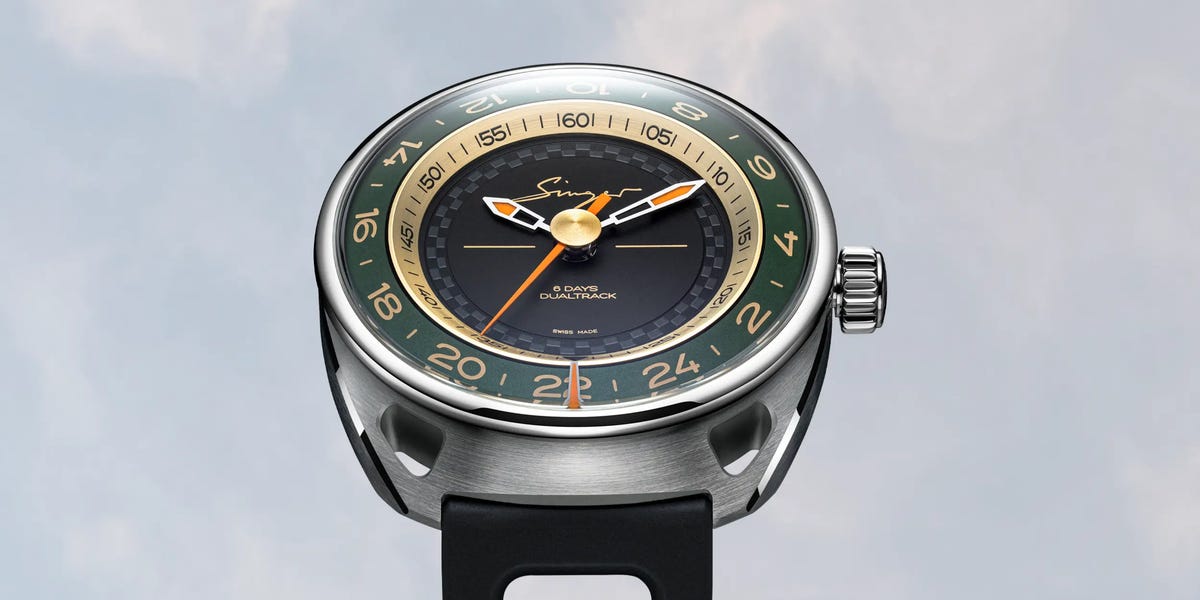
Every product was carefully curated by an Esquire editor. We may earn a commission from these links. Here’s how we test products and why you should trust us.Singer Reimagined8 min readYou may have noticed a shift on the red carpet recently. Some of the most stylish male celebrities have traded timepieces from the big brands for models that take a keen eye—and maybe a little Googling—to identify. We’re talking about Timothée Chalamet stepping out with an Urban Jürgensen, Ed Sheeran wearing a design from Vanguart, and noted watch hound John Mayer rocking F.P. Journe on the regular. That’s not to say that the juggernauts are losing a step—just that it’s a very good time, if you haven’t already, to set your sights on the independent watchmakers turning “if you know, you know” wristwear into a bona fide horological flex.But even if you’ve been a certified Watch Guy for years, delving into the indie world can be a little intimidating. There are so many names and so many new and exciting concepts to wrap your head around that it might feel overwhelming. It’s a good idea, then, to consult with an expert. Which is exactly what I did.Asher Rapkin is the CEO of Collective Horology, a retailer specializing in independent watchmakers that he cofounded with longtime friend and fellow watch nut Gabe Reilly in 2018. The company currently carries 20 brands, ranging from some of the better-known indies to makers that even dedicated collectors may not have heard of.“Our goal is to bring in people that we believe have a really strong creative point of view,” he explains over a video call from his California office. “We ask anybody that we work with, Why does this watch need to exist? Which is a question that not everybody has a clear answer to. The ones that do are the ones that we get most excited about.”I asked Rapkin a different question: If you had to give a crash course on independent watchmaking to a relative newbie who’s looking to get into the game, which brands would you recommend, and what specific watches would you tell them to keep on their radar? It’s a pretty big request. Luckily, he was only too happy to oblige. Here’s what you need to know.MingMing“I think Ming is a great entry point for a lot of independent collectors because they operate at different price points, but their design language is present across all of them,” Rapkin explains. The idea, at its core, is marrying classical watchmaking with 21st-century design, something that’s been at the forefront since Ming Tian started the brand.Rapkin points to the 37.02 Minimalist as a standout.“It’s a $5,000, time-only, 100-meter-water-resistant stainless-steel watch. So it checks every box as a daily wear, but it has their core design language, and it has their white polar lume, which is something nobody else currently offers.”He notes that it runs on a 300 series Sellita movement, which some fans of in-house calibers might find vexing, but it’s been upgraded with rhodium plating and skeletonized, “so it’s completely unique to them.” Overall, he says, it’s “not cheap, per se, but a lot of really interesting creative watchmaking for $5,000 and something you can wear at any time.”SHOP MINGDominique RenaudDominique Renaud“Dominique Renaud is very famous because he founded a company called Renaud & Papi in 1986,” says Rapkin. That venture was so successful that it was acquired by Audemars Piguet. Now Renaud is back at it on his own. “Dominique himself is primarily an engineer, and he likes to create incredibly difficult, complex movements that tend to solve horological problems.”Case in point: the Pulse 60, which functions at one hertz—the lowest frequency used in contemporary mechanical watchmaking. That means the balance wheel oscillates just 60 times per minute. There’s a practical component: The lower frequency means fewer shocks and impulses can disrupt the balance wheel. But there’s also an emotional element: The watch beats at about the same rate as a resting human heart.“So it’s a very dramatic watch,” Rapkin continues. “And they did this in a watch that isn’t a dress watch, isn’t a sports watch. It’s its own very modernist thing.”SHOP DOMINIQUE RENAUDNitonCollective Horology“Niton is a resurrection of a brand that was fairly popular around the turn of the last century, so early 1900s,” Rapkin says. “It came back about a year ago with the Prima, which references the original Niton jump hour and is available in either platinum or rose gold.” Unlike a traditional three-hand watch, this watch has you read the hours in the top window, the minutes on a rotating disc below, and the seconds on a small sub-dial under that.Rapkin also points out the “highly reductive” movement visible through the case back. It might not look like much at first—the intricacies are hidden beneath rhodium bridges—but is remarkable in its own right.“Right over here,” Rapkin says, indicating the bottom right corner with his cursor, “you have something that you don’t generally see on independent watches: the Geneva Seal. What it means is you have to meet very, very high standards that a third party audits. The watch’s finishing exceeds the vast majority of what you’d find on basically anything other than a Vacheron or a Patek.”SHOP NITONBarrelhandBarrelhand“Barrelhand is owned by a guy named Karel Bachand. When his hair is grown out, he kind of looks like a thin version of the Dude from The Big Lebowski,” says Rapkin. “He’s got a vibe, but he’s an aerospace engineer and he designed this watch, the Monolith, for space travel.”It uses a modified Sellita movement that’s designed to withstand the intense temperature swings you might encounter on a space walk. And it has a distinct advantage over a quartz movement, which uses circuitry and batteries that can’t be repaired as easily as the Monolith’s mechanical movement.The Monolith, after all, is a study in durability and longevity. “The alloy, Scalmalloy, is unique to aerospace engineering and has never been used in watchmaking,” Rapkin says. “It’s very strong and lightweight without being at risk to the elements. The second is the nano-engraved Memory Disc, which has about a thousand pages of information encoded on the case back. So if every system went to hell in space, you’d have a data archive on your wrist.”It’s exactly the sort of disaster-proof design you’d expect from a designer who used to work at NASA.“It’s not just marketing; it’s legit design. It’s really cool stuff.”SHOP BARRELHANDHolthinrichsHolthinrichs“Holthinrichs is founded by Michiel Holthinrichs, a Dutch guy who was an architect and then decided to become a watchmaker,” says Rapkin. “He became very famous for his use of 3D printing in cases, which you can see on the insanely dramatic lugs on watches like the Lab Series 1.S or the Lab Series 1.GMT. Those lugs could only be achieved with 3D printing.”Holthinrichs references different elements and different eras of Dutch architecture, but one thing that’s impossible to miss is the influence of art nouveau.“You can see it in the waves, the curves—it’s fascinating to see Dutch architecture come to life in this particular way,” Rapkin says.Those same aesthetic cues play out, albeit a little less dramatically, in pieces like the Signature Ornament, a stock offering that’s less expensive because it can use more traditional machining techniques. Regardless of what tier you opt for, though, Rapkin believes there’s something special happening.“These are really awesome, very unusual, very creative pieces,” he says.SHOP HOLTHINRICHSBerneronBerneron“Sylvain Berneron, the guy behind this brand, is a really interesting young man,” says Rapkin. “He’s French, he’s in his mid-30s, and he gave up a lucrative job as the chief creative officer at Breitling to start his own company. He’s most famous for the Mirage, which is what he first launched. The thing that was so cool about the Mirage, aside from just the overall aesthetic on it, is the movement in it, which is designed completely to fit the shape of that watch.”But Rapkin has another pick he thinks folks should pay attention to from Berneron: the Quantième Annuel, an annual calendar.“There are a number of things that are hidden in plain sight and are really cool. One of them is the retrograde date wheel. You see that sometimes in other brands, but the higher numbers are all jammed together. That design drove Sylvain crazy because there’s no symmetry to it, so he sorted it out. It takes a lot of engineering and a lot of power, and Berneron managed that in a 38mm watch,” he says, “It’s about $160,000, but it’s really a good example of what true high-end engineering can achieve at that rate.”SHOP BERNERONDavid CandauxDavid Candaux“David is in his early 40s, but he’s been at it since he was an apprentice at Jaeger-LeCoultre,” Rapkin says. “He’s very famous for making tourbillons, but the watch I want to talk about—the DC12—is his only one that’s not a tourbillon. It’s a wild watch.”The biggest thing, he explains, is a movement that uses two balance wheels. Without getting too deep in the weeds, the dual balance wheels basically feed into a differential that averages out the power and feeds it into the gear train. But that’s not the only technical innovation at play here.There’s also a telescoping “magic crown,” a David Candaux innovation. “When you tap it, it pops out,” Rapkin explains. “You move it into one position to set and another position to wind it. And when you are done, you depress it all the way back in, making it the only watch you can set on your wrist without bending the winding stem. And not that I would advocate that you should swim with a $125,000 watch, but you can with the crown out because it is waterproof in all positions, which is pretty cool.”SHOP DAVID CANDAUXSinger ReimaginedSinger Reimagined“Singer Reimagined is very famous for its chronographs like the Track1,” says Rapkin. “The grand innovation of the Track1 was a realization by a guy named Marco Borraccino, who’s the CEO and the designer. He was the head of design at Panerai for ten years during the big Paneristi phase, about 20 years ago.”Borraccino’s big idea was to essentially invert the design of the chronograph, putting the stopwatch function front and center while maintaining an easy, legible way to tell the time of day.“So what you’re looking at here,” Rapkin says, pointing to the edge of the Track1’s case, “is these two outer discs. They tell you the time. And then you have a center-mounted chronograph which is tracking running seconds, minutes, and hours.”But Rapkin’s personal pick from Singer Reimagined is a different complication altogether: a GMT.“The watch I want to show you is this one, which I loved so much I bought for myself: the Singer DualTrack.”The model uses a peripheral disc to show a second time zone, with a pusher on the side to advance hour by hour and a four-barrel movement for consistent power and accuracy.“It’s hand wound, but it’s a six-day power reserve,” he says. “So as long as you give it a couple of twists every day, it’s never going to stop.”SHOP SINGER REIMAGINED
8 Independent Watchmakers You Need to Know, According to an Expert
Full Article
Original Source
Read the full article at Esquire →KhanList aggregates and links to publicly available news content. We do not host full articles from third-party sources. Always verify important information with original sources.