
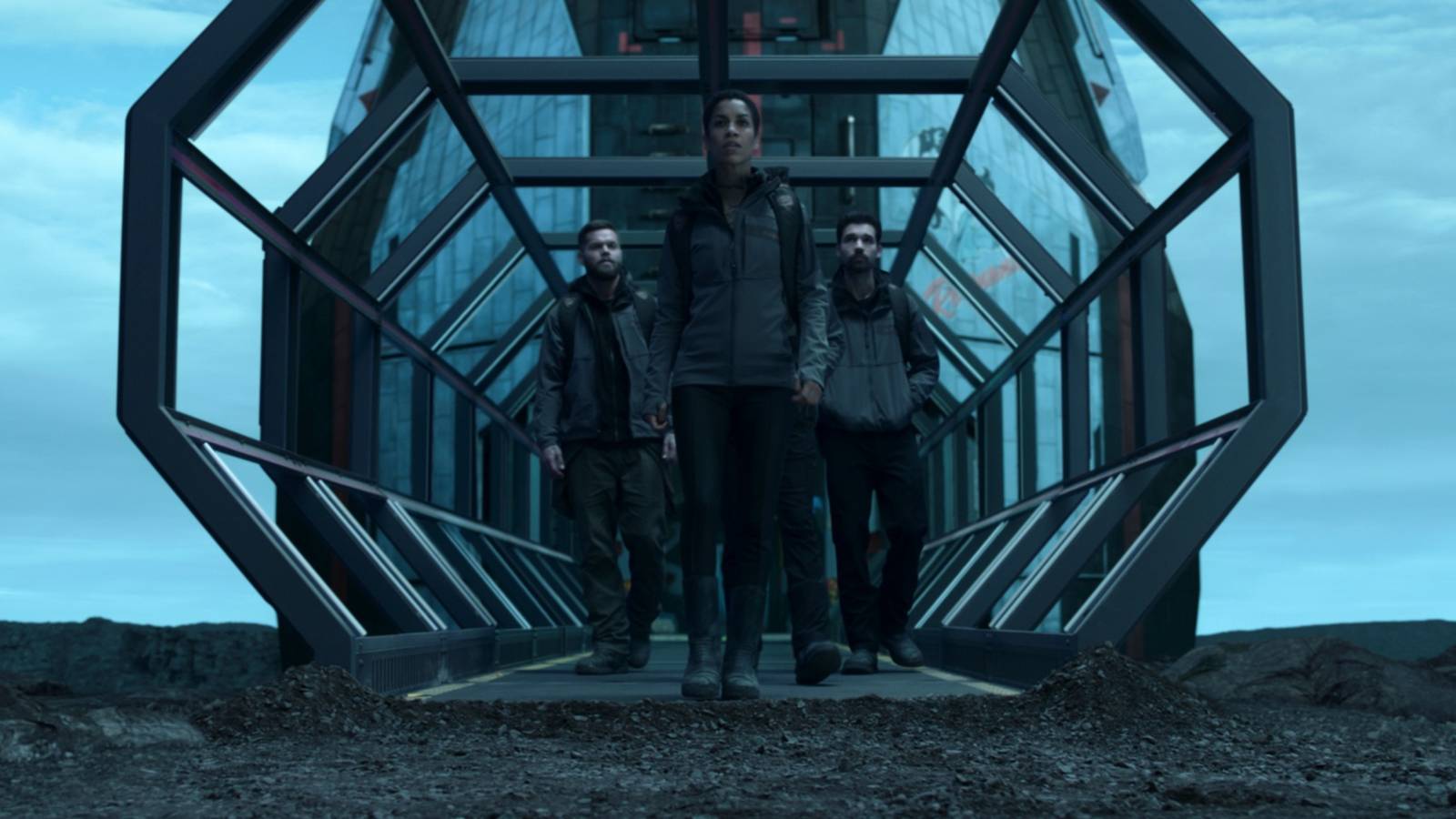
Published Nov 15, 2026, 5:00 PM EST Tom is a Senior Staff Writer at Screen Rant, with expertise covering everything from hilarious sitcoms to jaw-dropping sci-fi epics. Initially he was an Updates writer, though before long he found his way to the TV team. He now spends his days keeping Screen Rant readers informed about the best shows available to stream, whether it's recommending hidden gems that may have been missed or deep diving into ways your favorite shows have (or haven't) stood the test of time. Tom is based in the UK and when he's not writing about TV shows, he's watching them. He's also an avid horror fiction writer, gamer, and has a Dungeons and Dragons habit that he tries (and fails) to keep in check. When it comes to hard sci-fi shows for the true genre aficionado, The Expanse is hard to beat. Its attention to scientific principles like gravity, acceleration, and the practical difficulties of interstellar society gives its futuristic setting a remarkably grounded foundation. However, while it’s difficult to argue against The Expanse being the definitive modern space opera series, its position as TV’s best hard sci-fi show isn’t so clear-cut. Several hard sci-fi TV shows bring their fiction with just as much science, if not more, than The Expanse. True, they don’t all focus on life among the stars or deliver storytelling as consistently compelling as the Rocinante crew’s saga, but they definitely match and even beat Prime Video’s series when it comes to their sci-fi being cerebral, complex, and rooted in real scientific principals. 8 Defying Gravity (2009) Eight Astronauts Embark On A Six-Year Journey Through The Solar System The Expanse makes space travel much more interesting because it remembers that the challenges of traversing the void last long after liftoff. The short-lived 2009 hard sci-fi series Defying Gravity leads into this even harder, making the daily struggles of its eight astronauts the central attraction. The show focuses on an international crew on an extended expedition through the solar system, with the central drama and tension all stemming from the day-to-day difficulties of simply continuing the mission. Their spacecraft, the Antares, feels genuinely claustrophobic and fraught with danger even when things are going smoothly. For viewers who appreciated when The Expanse focused on the Rocinante as a home and shared workplace and the interpersonal difficulties this caused, Defying Gravity is ideal. As far as hard sci-fi goes, it does a fantastic job at bringing to light the practical problems of making a spacecraft habitable. Power, temperature regulation, and the crew’s ability to function belong to the same fragile system. That approach makes real-life engineering dramatically meaningful, because keeping people alive requires several things to keep working simultaneously. It’s a much more intimate account of life aboard a spacecraft than The Expanse usually has room for, accurately portraying interplanetary travel as difficult, exhausting daily work. 7 Another Life (2019-2021) An Interstellar Expedition Searches For The Origins Of A Mysterious Alien Artifact That Appears On Earth Dangers to humanity after first contact is the focus of many great action-heavy sci-fi TV shows, but in both The Expanse and Another Life it creates problems that firepower can’t solve. In the two-season Netflix show, Niko Breckinridge (Katee Sackhoff) commands the Salvare on a mission to investigate a civilization responsible for an alien artifact discovered on Earth. That premise already gives both series a connected scientific challenge: reaching an unknown intelligence and understanding what humanity has encountered. Just like in The Expanse, exploration in Another Life is an exercise in interpreting incomplete evidence while keeping the expedition alive. Where Another Life beats The Expanse is that it explores concepts like extraterrestrial biology and technology with much more depth. Where The Expanse left its protomolecule and Ring Gates a mystery, Another Life explores the science behind understanding unfamiliar organisms in great detail. It takes The Expanse’s alien intrigue and turns it into a central drip-feed of discoveries that undermine the Salvare crew and the audience's existing assumptions. As a bonus, the Netflix show also handles existential questions around AI incredibly well through the ship’s on-board intelligence, William (Samuel Anderson), and his emergent emotional capabilities. 6 Orphan Black (2013-2017) A Woman Discovers She Is One Of Several Human Clones Caught In A Dangerous Conspiracy Orphan Black doesn’t look to space for its hard sci-fi, but to human cloning and the age-old debate around how much genetics and circumstances shape who we are. Thanks to Tatiana Maslany’s incredible performance as over a dozen different clones, the relationship between inherited biology and lived experience become apparent long before the show dives into scenes that discuss it in a laboratory. The mystery begins when Sarah Manning discovers another woman who looks exactly like her. From there, the series turns cutting-edge genetic science into something personal, raising fascinating debates around scientific ownership when “experiments” have been in the real world long enough to start families, have ambitions, and, most importantly, forge their own identities. The hard sci-fi dive into biology in Orphan Black explores contemporary concerns around genetic manipulation and the ethics of the institutions controlling these areas of research. It’s this foundation that gives the central conspiracy significant weight and makes it feel much more grounded than many other TV shows and movies about cloning. Fans of The Expanse who are drawn to the exploitation surrounding protomolecule research specifically will find similar material in Orphan Black. However, this show focuses much more on the human consequences of biotechnological research than The Expanse ever did, especially when it comes to treating people as experiments. 5 Altered Carbon (2019-2020) A Murder Investigation In A Society Where Human Consciousness Can Move Between Bodies A continued presence after death is something The Expanse explores through the protomolecule reconstruction of Miller (Thomas Jane), but in Netflix’s hard sci-fi cyberpunk series Altered Carbon it’s treated as a society-wide economic issue. Human consciousness can be stored in devices called cortical stacks and transferred into replacement bodies, creating a civilization where wealth can literally buy immortality. Former soldier Takeshi Kovacs (Joel Kinnaman, Anthony Mackie, and Will Yun Lee) enters this world’s privileged superhumanly-long-lived circles through a murder investigation. The detective story is incredibly gripping, but it’s the worldbuilding surrounding it that makes Altered Carbon so great when it comes to hard sci-fi specifically. Altered Carbon explores the natural ramifications of technologies that allow new bodies to be purchased, identities to outlast their original appearance, and the wealthy being able to protect themselves against consequences that remain permanent for everyone else. This becomes especially harrowing and fascinating when it comes to the implications of the human mind as transferable information. Backups introduce gaps between a person’s remembered experience and what happened to their body, while replacement bodies complicate intimacy, punishment, and recognition. These consequences create an authentic-feeling picture of everyday life where the show’s speculative neuroscience technology is real. 4 Person Of Interest (2011-2016) A Surveillance AI Helps A Covert Team Identify Elusive Criminals Artificial Intelligence exists in the world of The Expanse, but it’s not a central focus. The implications of civilization-changing technologies, however, is. Another hard sci-fi show also focuses on this specific idea only with man-made AI instead of alien-created space portals. That show is Person of Interest, which starts as a straightforward crime procedural but ends over a struggle to reclaim humankind control of its own destiny from the grasp of unplanned rapid technological progress. In the show, scientist Harold Finch (Michael Emerson) builds a system capable of identifying potential violence through surveillance data, then recruits John Reese (Jim Caviezel) to investigate the people it flags. Of course, over time this system becomes so advanced that it’s dangerous, especially when rival equally powerful artificial intelligences begin to emerge. For The Expanse fans, Person of Interest’s escalating struggle over a technology powerful enough to reorder society is incredibly satisfying, despite the specifics of both plots being worlds apart. 3 For All Mankind (2019-Present) An Alternate History Imagines How Humanity Changes If The Soviet Union Won The Space Race A huge part of the hard sci-fi appeal of The Expanse is its grounded depiction of the space technologies of the future and the political frictions facing a humanity spread out across multiple planets. Any fans who want a story that focuses more on this than it does on mysteries like the ring gates and protomolecule will find Apple TV’s For All Mankind much more satisfying. The show begins with the USSR beating NASA to the Moon Landing, then explores how this impacts technological and social progress. It especially focuses on space travel, which takes a drastically different turn. The result resembles a history that could conceivably lead to the 24th century solar system of The Expanse. For All Mankind’s attention to spacecraft operations and the demands of maintaining distant settlements gives its ideas an intellectual weight that makes it one of the 21st century’s best hard sci-fi shows. As the series reaches humanity's attempts to colonize Mars, it moves from practical concerns to societal disputes over political authority. This should feel instantly familiar to fans of The Expanse, and it’s hard to recommend a show that feels like a better companion piece. 2 Foundation (2021-Present) A Mathematician Develops A Plan To Preserve Civilization As A Galaxy-Spanning Empire Approaches Collapse Interplanetary politics are complicated and detailed enough in The Expanse, but Apple TV’s Foundation expands that challenge across an entire galaxy to make it the core of one of television’s most ambitious space operas. Its hard sci-fi focuses on how a civilization spread across hundreds of stars would function, particularly when its worlds all have different priorities and relationships with the central authority of humanity’s galactic empire. Mathematician Hari Seldon (Jared Harris) approaches this society through psychohistory, a predictive science combining mathematics with the statistical behavior of vast populations. His forecast of total societal collapse across the galaxy forms the center of a narrative exploring what the forces that shape civilizations truly are, and whether humankind really will ever have control over them. Essentially, Foundation is a much more focused dive into one of the most satisfying themes of The Expanse. Both shows understand that humanity’s expansion into space creates political problems that a unified central government alone can’t seem to solve. Foundation also stretches this exploration problems across generations too, examining how knowledge survives, political power fades, and long-term plans are never immune to chaos. Its scale makes the difficulties of governing an interplanetary society in The Expanse feel like the earliest stage of a much greater challenge. 1 Battlestar Galactica (2003-2009) Humanity’s Survivors Seek A New Home After Their Civilization Is All-But-Obliterated Keeping thousands of people alive in space requires more than winning the next battle, which Battlestar Galactica understands with brutal clarity. The Expanse understands this too, but it’s Battlestar’s commitment to making problems like exhaustion, water, food, and fuel central to its survival story make it much more satisfying in this arena. After the Cylons devastate human civilization, a surviving fleet must keep moving while preserving the systems that sustain its remaining population. This fascination with realism even extends into the fleet’s technology. Computer networks create vulnerabilities and maintenance becomes harder as equipment deteriorates. At the same time, Battlestar Galactica also focuses on its wilder elements through an incredibly hard sci-fi perspective. Through the Cylons, the series rigorously examines ideas like artificial consciousness and the relationship between memory and identity. Not only that, but it also manages to have an incredibly plausible depiction of the complex political intricacies of a humanity spread out across multiple starships too. While both shows are brilliant, Battlestar Galactica feels like it surpasses many of the hard sci-fi strengths of The Expanse, even when it veers into more fantastical or conceptual territory like Cylon prophecies or cyclical time loops. Release Date 2015 - 2022-00-00 Network SyFy, Prime Video Showrunner Naren Shankar, Mark Fergus, Hawk Ostby Cast Dominique Tipper Naomi Nagata Directors Breck Eisner, Jeff Woolnough, David Grossman, Kenneth Fink, Rob Lieberman, Terry McDonough, Thor Freudenthal, Bill Johnson, David Petrarca, Jennifer Phang, Mikael Salomon, Sarah Harding, Marisol Adler, Anya Adams, Nick Gomez, Simon Cellan Jones Writers Georgia Lee, Robin Veith, Hallie Lambert, Matthew Rasmussen, Ty Franck, Naren Shankar, Mark Fergus, Hawk Ostby, Daniel Abraham, Dan Nowak Franchise(s) The Expanse
8 Hard Sci-Fi Shows Even Better Than The Expanse
Full Article
Original Source
Read the full article at Screenrant →KhanList aggregates and links to publicly available news content. We do not host full articles from third-party sources. Always verify important information with original sources.