
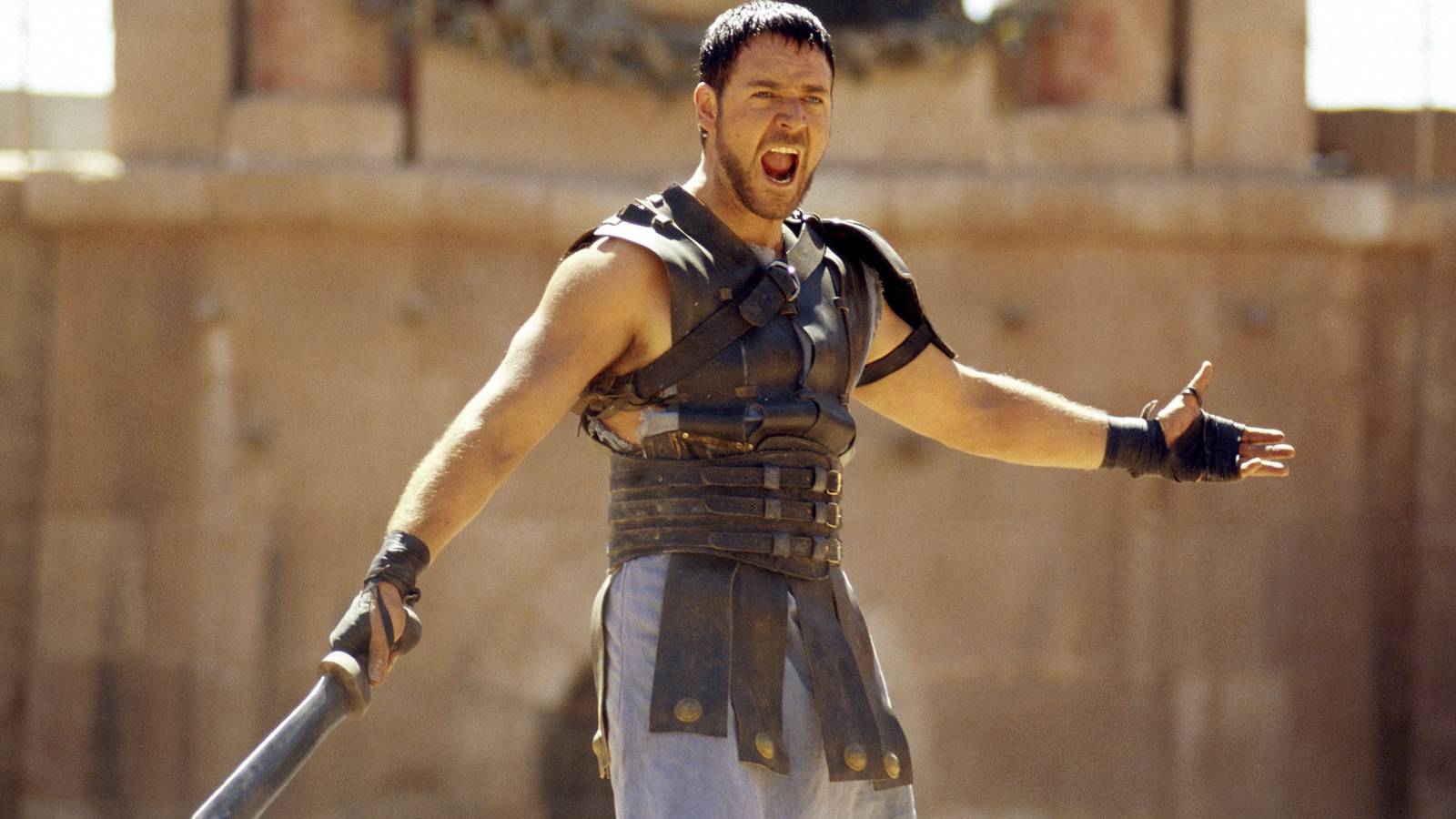
Published Sep 8, 2026, 9:01 AM EDT Richard Craig is a Senior Author at Screen Rant covering film and TV. Richard has also written extensively about horror and film soundtracks, contributing a chapter to the first major academic collection on the folk horror genre, The Routledge Companion to Folk Horror. Richard is also a performing musician and holds an MA in Music and Sound Art. There is no ancient Rome movie more synonymous with the genre than Gladiator, but there are several other classics also worth a watch. Ridley Scott's 2000 epic Gladiator revitalized the historical blockbuster, won five Academy Awards and turned Russell Crowe's Maximus into one of cinema's defining heroes. Its combination of political intrigue, spectacular action, practical sets, and emotional storytelling established a benchmark that every Roman epic released since has inevitably been compared against. The success of Gladiator can sometimes overshadow just how rich the cinematic history of ancient Rome really is. Long before Maximus entered the Colosseum, Hollywood and European filmmakers were using the Roman Empire as the backdrop for stories about political corruption, religious persecution, military conquest, slavery, and social upheaval. Some approached the era with serious historical drama, while others used Rome for comedy, satire, or outright spectacle. The results range from lavish Biblical epics and Shakespeare adaptations to cult curiosities and classic comedies. Several helped define entire genres, while others remain fascinating snapshots of how different generations imagined the ancient world. For viewers who have already watched Gladiator countless times and want to explore more stories from the Roman era, these films offer some of the best alternatives ever put on screen. Quo Vadis (1951) Mervyn LeRoy's Quo Vadis was one of the movies that helped establish the modern Hollywood Roman epic. Adapted from Henryk Sienkiewicz's novel, it takes place during the reign of Emperor Nero and follows Roman commander Marcus Vinicius, played by Robert Taylor, as he falls in love with the Christian Lygia. Quo Vadis’ greatest strength is its scale. MGM spared little expense recreating Imperial Rome, constructing enormous sets and filling them with thousands of extras. This produced one of the most expensive productions of its era and a major box office success. Peter Ustinov's performance as Nero is the Quo Vadis’ standout element. Rather than portraying the emperor as a straightforward tyrant, Ustinov presents him as a vain, insecure artist whose delusions of grandeur gradually become dangerous. The famous sequence depicting the Great Fire of Rome is particularly impressive for a production made decades before digital effects. While later epics would surpass it in realism, Quo Vadis remains one of the foundational ancient Rome movies. Carry On Cleo (1964) The Roman Empire rarely receives the full comedy treatment, which makes Carry On Cleo such an unusual entry in the genre. Part of the long-running Carry On series, the film spoofs the story of Cleopatra, Julius Caesar, and Mark Antony through the franchise's trademark blend of wordplay, innuendo, and British farce. Sid James plays Mark Antony, Kenneth Williams appears as Julius Caesar, and Amanda Barrie takes on the role of Cleopatra. Rather than attempting historical accuracy, the film focuses entirely on comic chaos, with Caesar's military campaigns and Egyptian politics becoming vehicles for jokes. One of the production's most interesting pieces of trivia is that it reused sets originally constructed for the troubled production of Cleopatra starring Elizabeth Taylor. The lavish Roman backdrops therefore look considerably more expensive and grand than a typical Carry On movie. Many historical comedies feel dated because they rely heavily on contemporary references. Carry On Cleo works because most of its humor comes from performances and absurd situations. The Sign Of The Cross (1932) Released during Hollywood's pre-Code era, Cecil B. DeMille's The Sign of the Cross combines Roman spectacle with religious drama. Set during Nero's persecution of Christians, it depicts Roman prefect Marcus Superbus and his growing conflict between duty, desire, and conscience. The Sign of the Cross is particularly fascinating today because of how much it reflects the freedoms of pre-Code filmmaking. DeMille includes scenes of violence, sexuality, and decadence that would have been heavily restricted only a few years later under the Production Code. Charles Laughton's Nero is one of cinema's most memorable interpretations of the emperor, emphasizing his cruelty and instability without losing sight of his theatricality. The Sign of the Cross also contains elaborate arena sequences featuring gladiators, exotic animals, and public executions. Although later Roman epics would benefit from larger budgets and technological advancements, The Sign of the Cross remains remarkably ambitious. It helped establish many of the visual and narrative conventions that subsequent Hollywood films about ancient Rome would follow. Caligula: The Ultimate Cut (2023) Few Roman films have a reputation as notorious as Caligula. The original 1979 production became infamous for its troubled creation, with producer Bob Guccione incorporating explicit footage that dramatically altered the final movie. For decades, the film's reputation often overshadowed its ambitions. Caligula: The Ultimate Cut attempts to change that conversation. Released in 2023, the reconstruction uses previously unseen footage and removes much of the material added after principal photography. The result is closer to the historical drama envisioned by writer Gore Vidal and director Tinto Brass. Malcolm McDowell's performance as Caligula benefits enormously from this restoration. Rather than appearing solely as a symbol of excess, the emperor emerges as a more complex figure whose paranoia and megalomania gradually consume him. Caligula also features an impressive supporting cast including Peter O'Toole as Tiberius, John Gielgud as Nerva, and Helen Mirren as Caesonia. While still controversial, The Ultimate Cut allows viewers to appreciate the production's artistry and performances more clearly than ever before. Julius Caesar (1953) Joseph L. Mankiewicz's adaptation of Shakespeare's Julius Caesar is one of the finest screen versions of the playwright's work. Rather than focusing on battlefield spectacle, it instead examines the political tensions surrounding Caesar's assassination and its aftermath. Louis Calhern plays Caesar, while James Mason appears as Brutus and John Gielgud portrays Cassius. The standout performance, however, belongs to Marlon Brando as Mark Antony. At the time, some critics questioned whether Brando could handle Shakespeare's dialogue, but his famous funeral oration quickly silenced those concerns. Julius Ceasar benefits from Mankiewicz's understanding of political drama. The assassination itself occupies only part of the runtime. The real focus is how power vacuums emerge and how public opinion can be manipulated. Unlike many Roman epics that emphasize grand spectacles, Julius Caesar thrives on conversation, rhetoric, and strategy. Its depiction of political maneuvering is surprisingly modern, making it one of the most enduring films ever set in ancient Rome. Ben-Hur (1959) Although remembered primarily as a Biblical epic, William Wyler's Ben-Hur is deeply rooted in the Roman world. Charlton Heston stars as Judah Ben-Hur, a Jewish nobleman whose life is destroyed after a conflict with his childhood friend Messala, now an officer in the Roman army. Ben-Hur's depiction of Roman authority is central to the narrative. Messala represents the empire's increasingly oppressive influence, while Judah's struggle becomes both personal and political. Of course, Ben-Hur is most famous for its chariot race. The sequence is still one of cinema's greatest action scenes, achieved through startling practical stunt work, massive sets, and meticulous editing. More than six decades later, it still surpasses many modern blockbusters for sheer excitement. Ben-Hur won a then-record 11 Academy Awards and remains one of Hollywood's most celebrated productions. Its blend of historical drama, action, and spiritual themes helped define the epic filmmaking tradition at its peak. Monty Python’s Life Of Brian (1979) Ancient Rome provides the backdrop for one of the sharpest comedies ever made in Monty Python's Life of Brian. Graham Chapman stars as Brian, an ordinary man born on the same day as Jesus who repeatedly finds himself mistaken for a religious figure. While Life of Brian’s satire is often associated with religion, many of its funniest moments target Roman-occupied Judea. The People's Front of Judea, the Judean People's Front, and various other factions spend more time arguing among themselves than resisting Roman rule. John Cleese's Roman centurion also features in one of the movie's most famous sequences, forcing Brian to repeatedly correct his Latin grammar while attempting to write anti-Roman graffiti. Life of Brian's depiction of Roman bureaucracy and imperial authority is surprisingly detailed beneath the comedy. Combined with the Pythons' absurdist humor, it creates a Roman-era movie unlike any other. More than forty years later, its observations about politics, ideology, and groupthink remain as sharp as ever. Spartacus (1960) Stanley Kubrick's Spartacus remains one of the defining Roman epics and arguably the closest rival to Gladiator as the genre's most iconic film. Kirk Douglas stars as Spartacus, the historical slave who led a massive uprising against the Roman Republic. It follows Spartacus from slavery and gladiatorial training to military leadership, charting the growth of a rebellion that eventually threatened Roman authority itself. Douglas gives the character tremendous charisma, while Laurence Olivier's Crassus offers a formidable political and military opponent. Beyond its impressive battle sequences, Spartacus distinguishes itself through its examination of freedom, class, and power. The conflict is not simply military; it is ideological. Spartacus represents the possibility of liberation, while Rome embodies institutional control. The famous "I'm Spartacus" scene has become one of the most recognizable moments in film history, but the movie's legacy extends much further. Spartacus's combination of political themes, emotional storytelling, and epic scale helped establish the template that later films, including Gladiator, would follow. Release Date May 5, 2000 Runtime 155 minutes Director Ridley Scott Gladiator follows Maximus, a Roman general betrayed by the new emperor Commodus. After escaping execution, he is enslaved and becomes a gladiator. Set in ancient Rome, the story portrays his struggle for survival and quest for vengeance as he battles for his freedom in the arena. Writers David Franzoni, John Logan, William Nicholson Sequel(s) Gladiator II Main Genre Adventure Budget $103 million Story By David Franzoni Studio(s) DreamWorks Distribution, Universal Pictures, Scott Free Productions, Red Wagon Entertainment Distributor(s) DreamWorks Distribution, Universal Pictures
8 Great Movies Set In Ancient Rome That Aren't Gladiator
Full Article
Original Source
Read the full article at Screenrant →KhanList aggregates and links to publicly available news content. We do not host full articles from third-party sources. Always verify important information with original sources.