
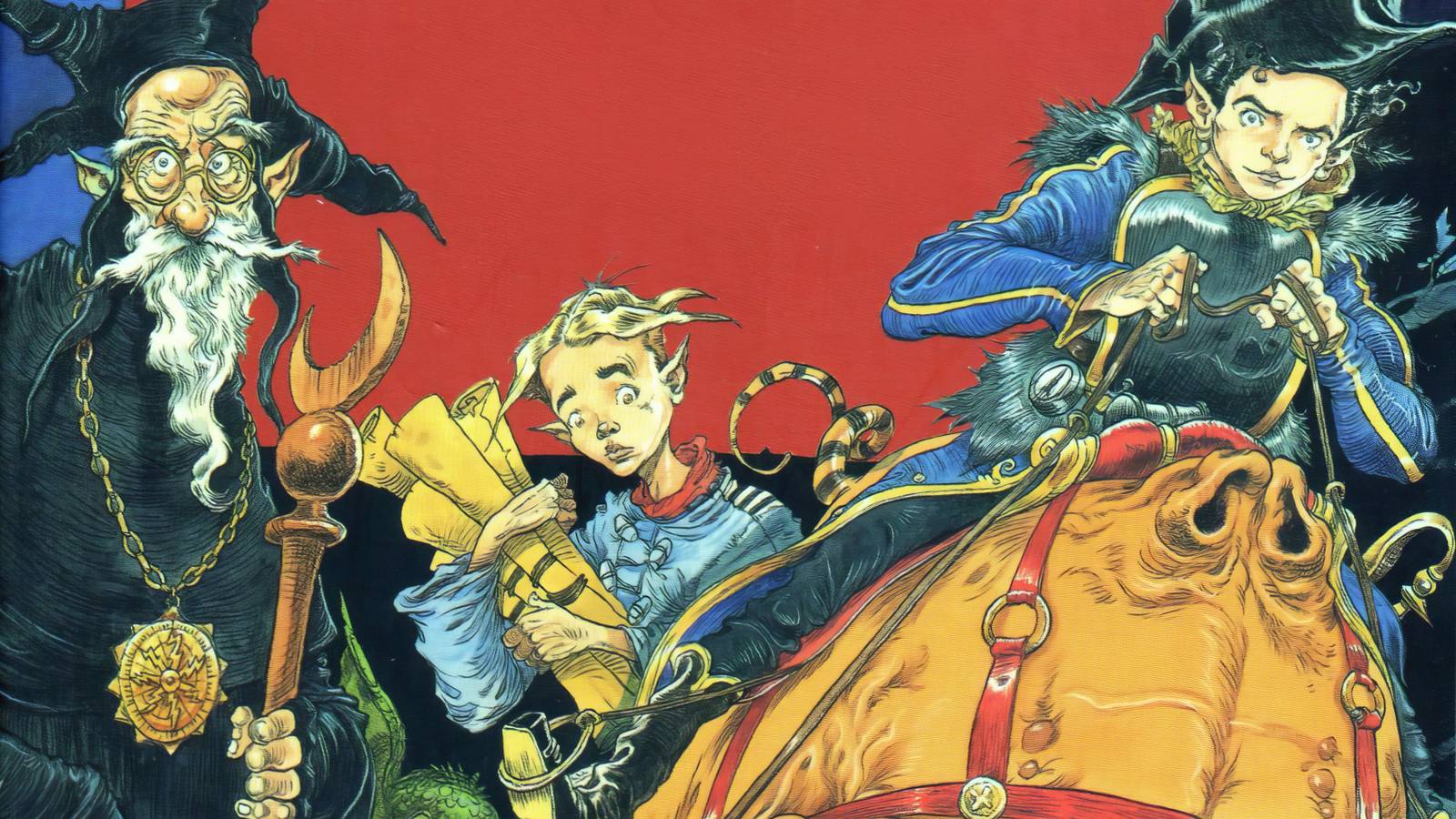
Image via Corgi Childrens Published Sep 30, 2026, 5:51 PM EDT Luc Haasbroek is a writer and videographer from Durban, South Africa. He has been writing professionally about pop culture for eight years. Luc's areas of interest are broad: he's just as passionate about psychology and history as he is about movies and TV. He's especially drawn to the places where these topics overlap. Luc is also an avid producer of video essays and looks forward to expanding his writing career. When not writing, he can be found hiking, playing Dungeons & Dragons, hanging out with his cats, and doing deep dives on whatever topic happens to have captured his interest that week. Sign in to your Collider account High fantasy has produced some of literature's greatest classics, but the subgenre also contains lots of cult novels, forgotten gems, and unsung masterpieces. Some were overshadowed by bigger series, while others were popular for a while but no longer come up that often in the wider fantasy conversation. With all that in mind, this list looks at some high fantasy books that may not be super popular right now, but which have aged well since their release. All are worth checking out if you're a fan of magic and monsters. More importantly, they exemplify how a fantasy book can keep improving with age, even if audiences are still not catching up to their quality. 'The Stone and the Flute' (1983) Image via Penguin Books "There is no road back." This sprawling standalone story from German writer Hans Bemmann centers on Listener, a young man who acquires magical objects but repeatedly discovers that possessing extraordinary powers doesn't mean knowing how to use them wisely. What initially resembles a traditional fantasy quest gradually expands into something stranger and more contemplative, following its protagonist through years of mistakes, encounters, relationships, and hard-earned personal growth. That patient approach is precisely why the novel has aged so well. The plot is a surreal, slow-burn journey across a fairytale land. Along the way, The Stone and the Flute actively subverts lots of "chosen one" tropes. Listener is not inherently wise or heroic; he is realistic, deeply naive, and frequently self-centered, and his greatest struggles are really internal. His three-dimensionality and genuine character arc help him stand apart from most 1980s fantasy protagonists. 'The Forgotten Beasts of Eld' (1974) Image via Tachyon Publications "Love is an excuse to be stupid." Long before morally complicated sorceresses became commonplace in fantasy, this book gave readers Sybel. Fiercely independent, she lives apart from humanity alongside a collection of legendary creatures she has summoned through magic. However, Sybel's isolation is disrupted when she is entrusted with an infant named Tamlorn, dragging her into the politics of a human world she had deliberately avoided. When the outside world betrays Sybel’s trust, the story takes a surprisingly dark, psychological turn into revenge territory. More than 50 years later, surprisingly little about The Forgotten Beasts of Eld feels dated. Sybel is powerful without being reduced to a generic warrior heroine, and the themes are genuinely hard-hitting, with a lot to say about love, vengeance, autonomy, and the ease with which a person can become the very thing they despise. Not to mention, author Patricia A. McKillip fits all this into a lean, economical 200-odd pages. 'Midnight Over Sanctaphrax' (2000) Image via Corgi "Storms are coming." This might be the finest of the Edge Chronicles books, though it doesn't come up that often in discussions of the best children's fantasy books. Midnight Over Sanctaphrax takes place in a colorful world of floating rocks, sky pirates, monstrous creatures, sentient forests, and bizarre civilizations. There, our hero Twig sets out on a journey to find his missing father, while an approaching Mother Storm threatens the entire Edge. Along the way, he encounters all manner of odd characters and creations, while also wrestling with loss and the realities of growing up. In other words, this book represents something of an emotional high point for the series. Ultimately, while selling well in its time, the Edge Chronicles saga never became a mainstream pop culture phenomenon. Nevertheless, its boundless narrative imagination and wonderfully grotesque creatures (all illustrated by the great Chris Riddell) have aged beautifully, especially by today's fantasy standards. 'The Farthest Shore' (1972) Image via Gateway "Try to choose carefully, Arren, when the great choices must be made." The original Earthsea trilogy is hardly forgotten, but its concluding volume has always existed somewhat in the shadow of A Wizard of Earthsea. In it, author Ursula K. Le Guin returns to the wizard Ged years after his youthful adventures, now an older and vastly more experienced Archmage. When magic begins mysteriously disappearing from Earthsea, he journeys alongside the young prince Arren to discover what is disturbing the world's equilibrium. That sounds like a classic fantasy setup, but the tale that follows is less a conventional battle against evil than a meditation on mortality. Ged is no longer a reckless boy but a man approaching the point where even his extraordinary power must eventually be surrendered. The desire to escape death is thus the book's central concern, and Le Guin treats the acceptance of life's limits as essential to living meaningfully. 'Lord Foul's Bane' (1977) Image via Del Rey "Be true, Unbeliever." The main character in this one is Thomas Covenant, a novelist suffering from leprosy who has become alienated from society and obsessed with the routines necessary to manage his condition. After an accident transports him to a beautiful fantasy realm, Covenant refuses to believe any of it is real. His resulting behavior includes an appalling act early in the novel that has made the book controversial ever since. Yet that ugliness is also part of what makes Lord Foul's Bane such an unusual artifact of 1970s high fantasy. It was a major break with the genre conventions of its time. While classic story elements are at play here, including looming supernatural evil and plenty of magical artifacts, the book places a terrible protagonist at its center. Decades before the grimdark subgenre became popular, Lord Foul's Bane was asking what happens when the person transported to an enchanted world might be catastrophically unsuited to saving it. 'The Worm Ouroboros' (1922) Image via Jonathan Cape "Surely time hath no end, nor the world." Published more than a century ago, The Worm Ouroboros comes from a period when the conventions of modern high fantasy had barely begun to take shape. Set largely on Mercury, it chronicles an enormous conflict between the heroic lords of Demonland and the ambitious King Gorice of Witchland. There are quests, monsters, sorcery, feasts, battles, and kingdoms with names that sound as though they've been plucked directly from some forgotten medieval romance. The book is an idealized, roaring celebration of chivalry, combat prowess, beauty, and honor. Author E.R. Eddison isn't interested in realism or relatable protagonists. Instead, everything here is grand, romantic, strange, and proudly excessive, high fantasy at its most stereotypical. Likewise, he deliberately wrote it in an elaborate style inspired by Elizabethan and Jacobean English, making this a challenging read but a rewarding one for a certain kind of fantasy stan. Collider Exclusive · 8 Questions · 2 Minutes What Fantasy World Do You Belong To? Middle-earth · Grand Line · The Continent · Camp Half-Blood Pick your magic, your crew, where you want to wake up and who you would rather be fighting, and we will tell you which world you actually belong in. Four are open to you: an ancient kingdom living through its last good age, an endless sea full of pirates, a continent that pays people to kill monsters, and a summer camp where the Greek gods are extremely real and mostly a nuisance. 💍Middle-earth(Rings of Power) 👒Grand Line(One Piece) 🐺The Continent(The Witcher) 🔱Camp Half-Blood(Percy Jackson) FIND YOUR WORLD → 01 What kind of power do you want? Every one of these worlds runs on a completely different sort of magic. ASomething ancient and half forgotten that came down through my family. BSomething completely ridiculous that works in a fight and gets a laugh. CNo magic at all, just training, potions and a very sharp sword. DSomething I inherited from a parent I have barely met. NEXT QUESTION → 02 Who is travelling with you? Nobody gets through any of these stories entirely on their own. AA fellowship drawn from every corner of the world who barely trust each other. BA crew I picked up one at a time, all of whom would die for me. CTwo or three people I would never describe out loud as friends. DTwo mates from school who are exactly as out of their depth as I am. NEXT QUESTION → 03 Where do you want to wake up tomorrow? The best fantasy is usually just somewhere you would genuinely like to live. AA high city of white stone with the sea somewhere far below. BA ship under sail, with an island ahead that nobody has mapped. CA rented room over a tavern, in a town I am leaving in the morning. DA cabin at a summer camp with everybody else already awake outside. NEXT QUESTION → 04 How are you making a living out there? Even in fantasy somebody has to pay for the horse. AI am not, because somebody far older than me decided this was my duty. BTreasure, and I am not always careful about whose it used to be. CI take contracts, since people will pay well for what they will not touch. DI am fifteen and this is all technically a school trip. NEXT QUESTION → 05 There is something in the woods. What do you do about it? All four of these worlds keep something unpleasant out there in the dark. ASend word to somebody who has seen this before, then hold the line. BWalk straight in, because it is interesting and possibly edible. CAsk what it has been eating and what the village is willing to pay. DWork out which myth it escaped from, then improvise very badly. NEXT QUESTION → 06 Who is the villain of your story? The enemy tells you far more about a world than the hero ever does. AAn ancient evil that has been patient for several thousand years. BA government that has spent a long time calling itself the good guys. CA man who turns out to be far worse than anything I hunt for money. DA god, or possibly my own family, and quite likely both at once. NEXT QUESTION → 07 What do you actually believe in out there? Every world hands its heroes one rule and asks them to hold onto it. ASome things are worth defending even when the odds are hopeless. BNobody gets to tell me where I can go or what I am allowed to want. CPick the lesser evil, and never pretend afterwards that it was not evil. DMy friends come before anything a prophecy has to say about it. NEXT QUESTION → 08 A thousand years from now, how are you remembered? Eight questions in, this is the one that decides your world. AIn a song, in a language hardly anybody still speaks. BAs the one who got there first and proved the whole thing was possible. CBarely, and mostly wrongly, in ballads I would absolutely hate. DOn a plaque at a camp, read by kids about to do the same thing. REVEAL MY WORLD → The Map Is Drawn Your World Is…Four worlds and four completely different ideas of what a good life looks like. This is where you belong, what it would ask of you, and what you would get back in return. Middle-earthYou belong somewhere old enough that the mountains have names and somebody can still tell you who gave them. Middle-earth is for people who think the right thing is worth doing even when it will not be finished in their lifetime. This is the only world on the list where doing good is understood as a very long defeat, fought anyway, by people who will never see how it ends. You are drawn to grandeur, to white cities and deep forges and the sense that almost everything you touch is older than your entire family line. The Rings of Power is set in the last good age before it all goes wrong, which gives every quiet scene in it a slightly unbearable weight. You would take the hard road, and you would take it on foot. The Grand LineYou want the sea, a crew, and absolutely nobody telling you where you are allowed to go. The Grand Line is the world for people whose main ambition in life is finding out what is over there. One Piece has run for decades on one very simple engine, which is a group of people who each want something impossible and have decided to go and get it together. You collect people. Your ideal crew is a set of misfits who were each written off somewhere else before you turned up and offered them a better idea. The world is enormous and deliberately ridiculous, and the emotional gut punches land harder because of that rather than in spite of it. You would set sail knowing the map runs out, which is more or less the entire point of it. The ContinentYou would rather be feared and useful than liked and useless. The Continent is a world where the monsters are the straightforward part of the job and the people are where it all gets complicated. Witchers get paid to do what nobody else will and resented for existing at all, which is a trade most people would refuse and you would probably accept. You have no real illusions about which side is the good one, largely because on the Continent that question tends to have a disappointing answer. The best of these stories are not about the fighting. They are about somebody with a rigid code being repeatedly cornered into caring about people. You would take the coin, finish the job properly, and be out of town before the story got told wrong. Camp Half-BloodYou want the myths to be real and loose in the actual world, and you want to find out at about thirteen that you were never anywhere near as ordinary as everybody kept telling you. Percy Jackson takes the oldest stories we have and drops them into car parks and diners, which makes the gods considerably funnier and a great deal worse. You would be the kid every school gave up on, who turns out to have been built for something nobody thought to test for. The series is genuinely about friendship rather than destiny, and it says so out loud every time a prophecy tries to get in the way. Camp Half-Blood is the real fantasy here: a place where the thing that made you difficult everywhere else is the thing that makes you belong. ↻ RETAKE THE QUIZ 'Iron Council' (2004) Image via Del Rey "Time does not pass. It accumulates." This brilliantly bizarre book was penned by China Miéville, one of the leading lights of the movement known as weird fiction. The third book set in the same world as Perdido Street Station and The Scar, Iron Council returns readers to New Crobuzon, a grotesque industrial metropolis populated by humans and numerous bizarre species. This time, however, Miéville turns his attention toward revolution, labor, imperialism, and the legend of a runaway train whose workers rebelled against the people exploiting them. In the process, he throws together a ridiculously diverse array of ideas and images. Here, you'll find Western elements, steampunk, horror, industrial high fantasy, romance, and a surprisingly realistic critique of revolutionary politics. The world itself is populated by Cactus-people, insect-headed Khepri, and the horrific "Remade," criminals whose bodies are surgically and magically grafted with animal parts or steam-machinery as punishment. 'The Book of Three' (1964) Image via Usborne Publishing Ltd "Is there not glory enough in living the days given to us?" This gem focuses on Taran, an Assistant Pig-Keeper who dreams of becoming a glorious hero and soon finds himself pursuing the escaped prophetic pig Hen Wen across a dangerous landscape. Along the way, he encounters Princess Eilonwy, the bard Fflewddur Fflam, the creature Gurgi, and the heroic Prince Gwydion, beginning an adventure shot through with danger, like the dread realm of Annuvin and the terrifying, antler-helmed Horned King. The enduring charm of the book lies in its vibrant, eccentric cast of misfits. Each character has a distinct, memorable voice, and most of them have a real emotional arc. Plus, while modern fantasy frequently draws from Celtic traditions, The Book of Three was one of the very first secondary-world high fantasy novels to directly bypass Norse and Anglo-Saxon tropes in favor of Welsh folklore, quickly influencing other writers to follow suit. And yes, it's the basis for the Disney cult classic The Black Cauldron.
8 Forgotten High Fantasy Books That Have Aged Like Fine Wine
Full Article
Original Source
Read the full article at Collider →KhanList aggregates and links to publicly available news content. We do not host full articles from third-party sources. Always verify important information with original sources.