
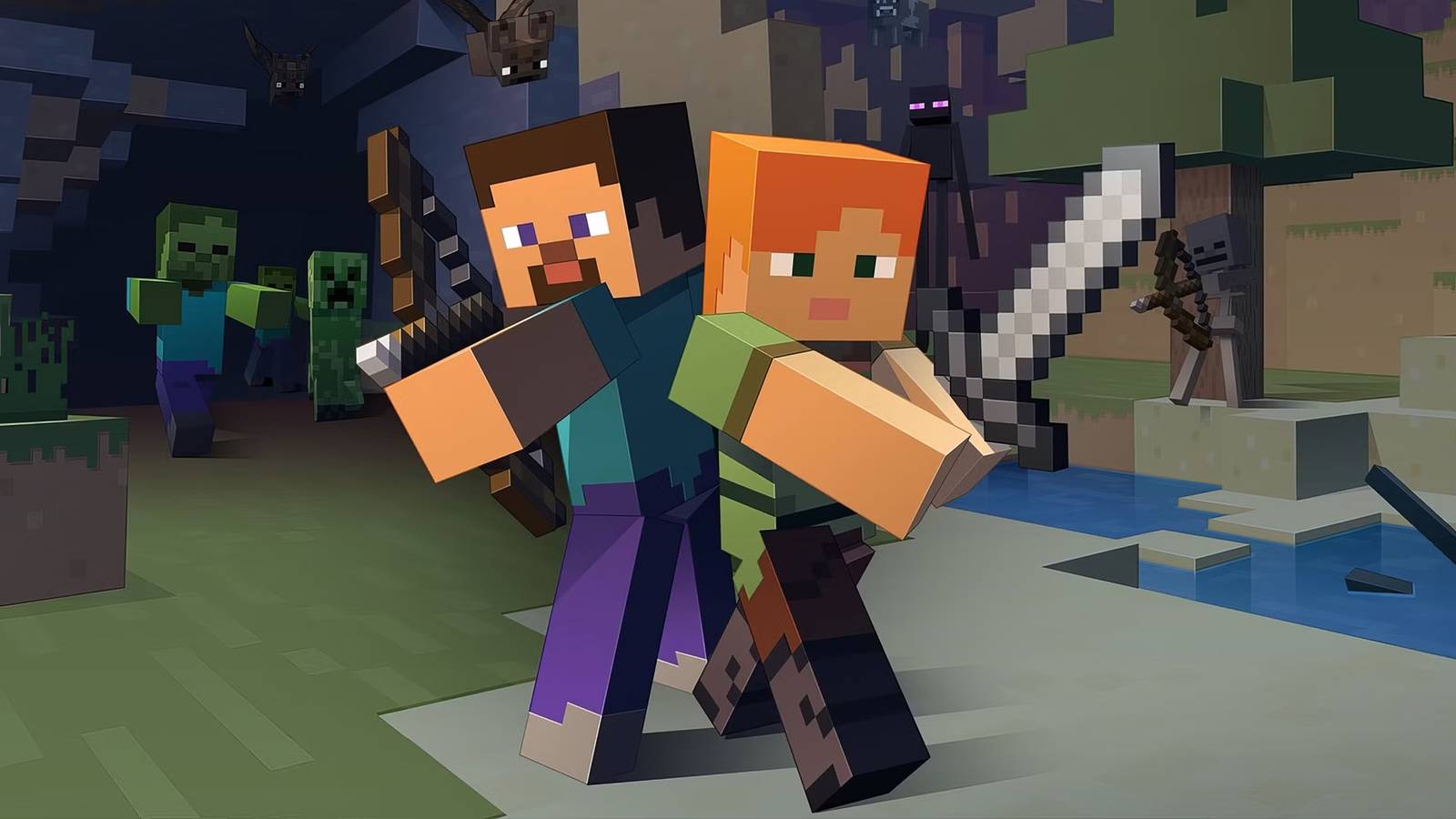
Image via Mojang Studios Published Aug 15, 2026, 9:41 AM EDT Sign in to your Collider account A truly great children’s game respects the child holding the controller. It teaches through play, rewards curiosity, and provides enough flexibility for different ages to enjoy the same world. Easy entry helps. Lasting depth is even better. Parents should also know where cooperation is equal, where reading support may be needed, and where online features deserve supervision. These eight games cover mischief, platforming, racing, building, exploration, and peaceful daily routines. Some help children learn movement and timing. Others develop planning, creativity, patience, or problem-solving. Every choice can entertain adults too, which is important when the same game occupies the television for the hundredth time. 8 'Untitled Goose Game' (2019) Image via House House A quiet English village becomes a playground for one deeply committed troublemaker in Untitled Goose Game. Children control a goose and complete small objectives by observing routines, stealing objects, distracting residents, and combining simple actions into elaborate pranks. Nobody gets seriously hurt, failure carries little punishment, and the dedicated honk button communicates everything a goose could possibly need to say. The whole campaign also supports two-player cooperation, allowing a pair of geese to ruin everyone’s afternoon together. The ESRB rates it E for Everyone with no content descriptors. Innocence has feathers. Its puzzle design encourages experimentation rather than demanding fast reflexes. A child may need help reading the task list or understanding a less obvious chain of actions, though solving those problems together becomes part of the fun. The compact village also makes navigation manageable for inexperienced players. Older children can chase faster solutions while younger ones enjoy carrying boots into ponds and honking at gardeners. It is short compared with the larger games below, which limits its staying power. For a first taste of stealth, cause and effect, and cooperative chaos, few games are this welcoming. 7 'Sackboy: A Big Adventure' (2020) Image via Sumo Digital PlayStation families looking for a proper couch adventure should begin with Sackboy: A Big Adventure. The fabric hero travels across Craftworld to rescue the Sackfolk from Vex, moving through handcrafted mountains, jungles, underwater areas, and space colonies. Up to four players can join locally or online, and the colorful 3D stages mix jumping, grabbing, throwing, collecting, and light combat. The ESRB gives it an E rating for mild cartoon violence and mild lyrics. Soft materials. Serious platforming. The early worlds teach their ideas clearly, then later stages ask for sharper timing and better teamwork. That progression makes Sackboy useful for families with children at different skill levels since stronger players can help carry the group through difficult sections. Musical stages synchronize platforms and obstacles with licensed songs, while costumes provide a constant stream of rewards that children can actually use. Some multiplayer situations become gloriously disorganized when everyone grabs the wrong person. That is family bonding. The campaign is substantial, visually readable, and varied enough to avoid feeling like an extended tutorial for adults trapped on the second controller. 6 'LEGO Star Wars: The Skywalker Saga' (2022) Image via Traveller's Tales All nine central Star Wars films become one enormous toy box in LEGO Star Wars: The Skywalker Saga. Children can begin with any trilogy, revisit major movie scenes, explore more than 20 planets, fly spacecraft, solve environmental puzzles, and unlock over 300 characters. Jedi, droids, bounty hunters, villains, and heroes use different abilities, giving players reasons to return to completed locations after gaining new characters. Combat includes lightsabers, blasters, explosions, and LEGO figures breaking into pieces, which earned the game an E10+ rating for cartoon violence and comic mischief. Very dramatic. Still plastic. Its greatest strength for children is freedom. The main missions provide direction, while open areas allow wandering, collecting Kyber Bricks, testing vehicles, and completing short side activities without heavy consequences. Local cooperative play lets an adult or sibling handle trickier combat and puzzles, although split-screen exploration can become visually busy. The amount of content may also overwhelm children who need a clearer objective, so selecting one film and progressing steadily usually works better than chasing every icon. Star Wars knowledge adds pleasure without becoming an entry requirement. The jokes explain the mood. The lightsabers handle the rest. Collider Exclusive · Star Wars Quiz Which Force UserAre You? Light Side · Dark Side · Or Somewhere Between The Force is not a binary. It is a spectrum — from the serene halls of the Jedi Temple to the shadowed corridors of Sith space. Ten questions will reveal where you truly fall. The Force has always known. Now you will too. 🔵Jedi Master 🟡Padawan 🔴Sith Lord ⚫Inquisitor ⚪Grey Jedi IGNITE YOUR SABER → 01 What is the Force to you? Your relationship with the Force defines everything else. AA living energy I must be worthy of — it is not mine to control. BSomething vast and mysterious I'm only beginning to understand. CNeither light nor dark — just a current I choose to ride. DPower. Pure and simple. The strong take it; the weak don't. NEXT QUESTION → 02 When you feel strong emotions — anger, grief, love — what do you do? The Jedi suppress. The Sith feed. Others choose differently. AAcknowledge them, then release them. Attachment leads to suffering. BFeel them fully, then decide what to do — they're not the enemy. CBury them. Emotion is a liability I can't afford to indulge. DUse them. Passion is the engine of the dark side for good reason. NEXT QUESTION → 03 The Jedi Council gives you an order you disagree with. You: How you handle authority reveals your alignment. AFollow it. The Council's wisdom surpasses my own perspective. BVoice my objection clearly, then defer to the decision. CComply outwardly while doing what I think is right. DIgnore it. The strong don't answer to committees. NEXT QUESTION → 04 You are offered forbidden knowledge that could give you enormous power. The cost is crossing a moral line. You: The dark side's pull is never more than a choice away. ARefuse without hesitation. There is no cost worth that price. BWeigh it carefully — sometimes darkness holds real answers. CFeel the pull but walk away — for now. DAccept it. Power justifies the method used to obtain it. NEXT QUESTION → 05 Your approach to training and learning is: A student's habits become a master's character. ADedicated but humble. There is always more to learn from my masters. BRigorous and patient. Mastery is earned through years of discipline. CEclectic — I draw from every tradition, not just one. DRelentless and brutal. Pain accelerates growth. Rest is weakness. NEXT QUESTION → 06 In a duel, your lightsaber fighting style reflects: Combat is the purest expression of a Force user's philosophy. ADefense and composure — I wait for my opponent to overcommit. BFast and instinctive — I trust the Force to guide my movements. CUnpredictable — I blend styles to keep enemies off-balance. DOverwhelming aggression — I end fights before they begin. NEXT QUESTION → 07 A defeated enemy lies at your feet, powerless. You: Mercy — or its absence — is the truest test of alignment. AStrike them down — compassion toward enemies is naïve and costly. BNeutralize them permanently. I can't afford loose ends. CSpare them if I can — but stay clear-eyed about the risks. DOffer them a chance to surrender. Every being deserves that. NEXT QUESTION → 08 The Jedi Code forbids attachment. Your honest view on love and bonds: The source of the greatest falls in the galaxy. AThe Code is right. Attachment clouds judgment and invites suffering. BLove is not a weakness — the Jedi Code got this one wrong. CI have no attachment — only loyalty to my master's mission. DI feel it deeply but struggle to reconcile it with my training. NEXT QUESTION → 09 Why do you use the Force at all? What's the point? Purpose is the difference between a knight and a weapon. ATo learn. I'm still figuring out what I'm capable of. BTo protect and serve. The Force is a responsibility, not a gift. CTo survive — and maybe carve out something worth having. DTo dominate. Strength demands to be expressed, not contained. NEXT QUESTION → 10 At the final moment — light side or dark side pulling at you — what wins? In the end, every Force user faces this moment. What does yours look like? AThe light. I choose peace, even when darkness would be easier. BNeither fully — I carve my own path through the middle. CWhoever I serve — my loyalty defines me more than my morality. DThe dark. Power is the only thing that's ever actually been real. REVEAL MY ALIGNMENT → Your Alignment Has Been Determined Your Place in the ForceThe scores below reveal how the Force sees you. Your highest number is your true alignment. Read on to understand what that means — and what it will cost you. 🔵 Jedi Master 🟡 Padawan 🔴 Sith Lord ⚫ Inquisitor ⚪ Grey Jedi Disciplined, compassionate, and deeply attuned to the living Force, you have walked the path long enough to understand its demands — and accept them. You lead not through authority alone, but through example. You have felt the pull of the dark side and chosen otherwise, every time. That is not certainty. That is courage. You are earnest, powerful, and brimming with potential — and you know it, which is both your greatest asset and your most dangerous flaw. You act before you think, trust your gut over your training, and sometimes confuse impatience for bravery. The Masters see something in you, though. The question isn't whether you have what it takes — it's whether you'll be patient enough to find out. You are not simply dangerous — you are certain, and that is worse. You have decided what the galaxy needs, and you have decided you are the one to deliver it. Your power is genuine and formidable, earned through sacrifice that would have broken lesser beings. But examine your victories carefully. Every Sith believed their cause was righteous. The dark side's cruelest trick is that it agrees with you. You were forged in fire and reshaped by those who found you at your lowest. You serve, because service gave you structure when you had none. Your allegiance is not to an ideology — it is to survival and to the master who gave you purpose. But there is something buried beneath the conditioning. The Jedi you hunt? You recognize them. Because you remember what it felt like before the choice was taken from you. You have looked at the Jedi Code and the Sith Code and found both of them incomplete. You walk the line not out of indecision but out of conviction — you genuinely believe both extremes miss something essential. The Jedi don't fully trust you. The Sith think you're wasting your potential. They're both partially right. But so are you. ↻ RETAKE THE QUIZ 5 'Kirby and the Forgotten Land' (2022) Image via Nintendo Kirby enters a fully three-dimensional adventure in Kirby and the Forgotten Land, exploring the abandoned remains of a mysterious civilization while rescuing captured Waddle Dees. His traditional Copy Abilities return, allowing him to gain powers by inhaling enemies, while Mouthful Mode lets him transform around cars, vending machines, traffic cones, and other oversized objects. It sounds ridiculous. It works beautifully. A second local player can control Bandana Waddle Dee throughout the journey. Nintendo built two difficulty settings into the game. Spring-Breeze Mode gives Kirby more health and makes enemies easier, while Wild Mode increases danger and rewards, letting a player choose the appropriate pressure without changing the adventure itself. Copy Abilities can also be evolved into stronger forms, adding progression for children who enjoy upgrading favorite powers. Player two has fewer abilities than Kirby, so the cooperative roles are unequal, though that can help when a younger sibling wants to participate without managing every system. The stages are cheerful, clearly designed, and packed with optional objectives for confident players. Then the bosses start getting surprisingly intense. Kirby contains multitudes. 4 'Animal Crossing: New Horizons' (2020) Image via Nintendo Animal Crossing: New Horizons gives children a deserted island and asks them to build a life at their own pace. There are no enemies to defeat or races to win. Players gather materials, craft furniture, catch insects, fish, dig up fossils, decorate homes, plant flowers, and form friendships with animal residents. Days follow a real-time clock, while seasons change the wildlife and activities available across the year. The ESRB rates it E for comic mischief and mild fantasy violence. The game quietly exercises planning, reading, organization, and creative decision-making. Children learn that resources take time to gather and that large projects are completed gradually. Families should understand its shared-island structure before buying it. Up to eight residents can live on one island, and as many as four can play together on one system, though later residents join a community initially established by the first player. Online visits expand the social side and should be limited to trusted people for younger children. Animal Crossing feels gentle without becoming empty. A child may spend an hour designing a bedroom, donating fossils, or trying to catch one stubborn fish. Productive? Debatable. Peaceful? Absolutely. 3 'Minecraft' (2011) Image via Mojang Minecraft gives children a procedurally generated world made of blocks and lets them decide what kind of experience it becomes. Creative Mode offers unlimited materials, flight, instant block removal, and freedom from death. Survival Mode requires gathering resources, crafting tools, building shelter, managing health and hunger, and defending against creatures. Four difficulty options allow parents to reduce or increase pressure, including Peaceful Mode for a calmer introduction to Survival. Its educational value comes from systems rather than lessons. A simple house introduces shape and spatial planning. Redstone machinery encourages logic. Large collaborative builds demand communication and task division. Survival teaches preparation after the first avoidable disaster. Every Minecraft player has one. The ESRB rates the game E10+ for fantasy violence, and official guidance notes that multiplayer can include interaction with other users, so private family worlds or approved friends are the sensible starting point for younger children. Few games grow with a child this effectively. They may begin by stacking blocks into a crooked tower and eventually construct a working city. 2 'Super Mario Odyssey' (2017) Image via Nintendo Mario travels across a chain of wildly different kingdoms in Super Mario Odyssey, chasing Bowser and collecting Power Moons with help from a living cap named Cappy. Throwing Cappy lets Mario attack enemies, extend jumps, and capture creatures or objects with useful abilities. A frog can leap high. A Bullet Bill can cross gaps. A Tyrannosaurus rex can destroy almost everything in sight. Childhood improves immediately. The game marked Mario’s return to sandbox-style 3D exploration and received an E10+ rating for cartoon violence and comic mischief. Its kingdoms provide obvious objectives for beginners and deeper movement challenges for experienced players. A child can gather enough Moons to continue by completing straightforward tasks, while optional races, hidden areas, and precision jumps keep older players occupied. The controls also reward gradual mastery since Mario’s basic run and jump are easy to understand while Cappy combinations create advanced possibilities. Two-player mode allows another person to control Cappy, though the supporting role offers less independence than controlling Mario. Super Mario Odyssey is generous, inventive, and almost constantly introducing a new idea. Let children wander. They will probably discover something before you do. 1 'Mario Kart 8 Deluxe' (2017) Image via Nintendo No game on this list brings children, parents, siblings, casual guests, and competitive players together as quickly as Mario Kart 8 Deluxe. Up to four people can race on one system, eight can connect through local wireless, and online races support as many as 12 players. Tracks move underwater, through the air, and across anti-gravity sections, while items keep weaker racers involved and prevent the leader from becoming too comfortable. It earns first place because the assistance options solve one of family gaming’s hardest problems. Smart Steering helps novice racers stay on the course, while Auto-Accelerate removes the need to hold the gas button constantly. Young children can finish races instead of spending three laps facing the wrong wall, then disable those aids as their control improves. The ESRB rates it E for comic mischief, with its shells, fireballs, bombs, and explosions presented as colorful racing interference. Grand Prix events provide progression, Battle Mode changes the competition, and faster classes give practiced players years of room to improve. One race takes minutes. “One more” can consume the evening. That is the family-game gold standard but also kid-friendly foundation, if need be.
8 Essential Kid-Friendly Video Games
Full Article
Original Source
Read the full article at Collider →KhanList aggregates and links to publicly available news content. We do not host full articles from third-party sources. Always verify important information with original sources.