
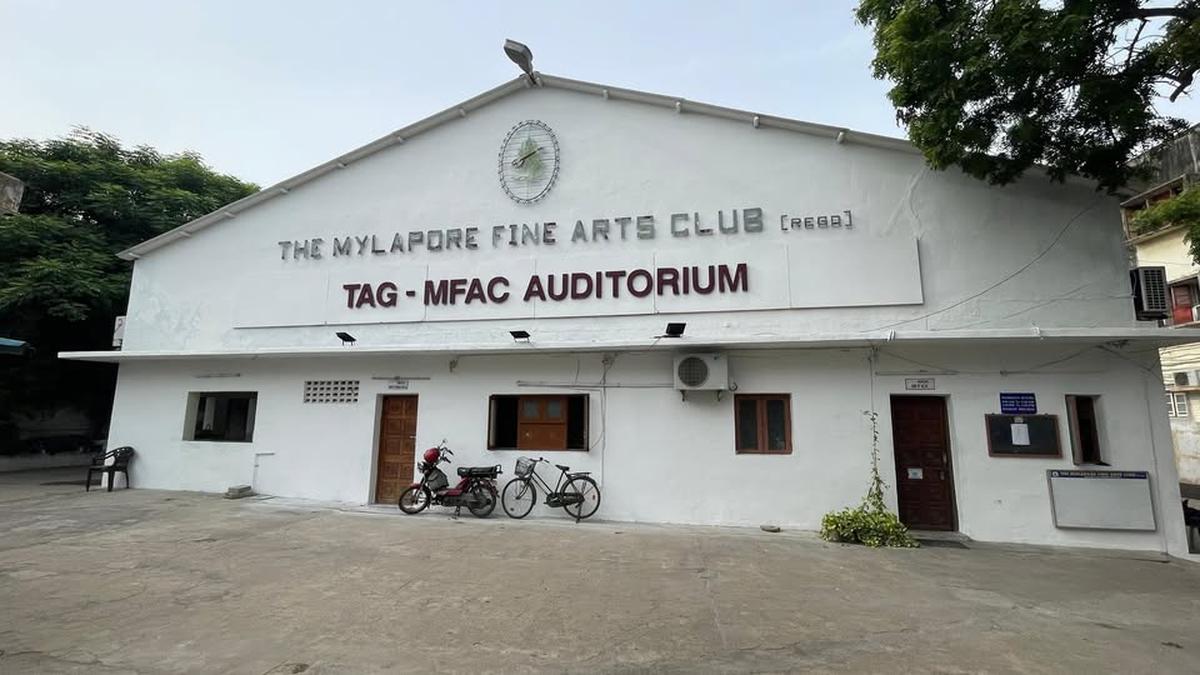
Located in a street named after legendary vocalist Musiri Subramania Iyer, Mylapore Fine Arts Club or MFAC, celebrates 75 years of cultural stewardship. Founded in 1951 by K.N. Visweshwaran and R. Rajagopal, MFAC’s programmes were initially held in the open-air auditorium in Vivekananda College.“The present venue was later taken on lease, and the auditorium, which had a thatched roof, was inaugurated by Jayachamaraja Wadiyar, the then Maharaja of Mysore. Since 1959, programmes have taken place here. Chairs, hired from C. Nataraja Pillai & Sons and Balakrishna Pillay & Sons, used to be arranged by members of the committee and a few volunteers,” says D.N. Varadarajan, who has been secretary of MFAC since 2010. From 1975 to 2010, K.S. Venkatraman was the secretary. Nalli Kuppuswami Chettiar has been the president of the sabha since 2004. Jayachamaraja Wadiyar, the then Maharaja of Mysore, inaugurated the new premises of Mylapore Fine Arts Club, in Madras on February 10, 1959. | Photo Credit: The Hindu Archives In 1971, the auditorium transitioned to fixed seating. “It was around that time that the thatched roof was replaced with an asbestos one, which still remains intact. In 2017, TAG Chari helped turn the auditorium into an air-conditioned one.” The auditorium has a fixed capacity of 900. Before air conditioning, they would erect a pandal, so that around 1500 people could be accommodated. Madurai T. N. Seshagopalan performing at the Mylapore Fine Arts Club in December 1995. | Photo Credit: The Hindu Archvies For many years, MFAC used to pack the day with back-to-back concerts, during the music season. “There was a time when we used to have five concerts a day. Only the 6 p.m. to 9 p.m. concerts were ticketed. Until 2010, our evening concerts were of three hours duration. Often, artistes such as T.N. Seshagopalan and K.J. Yesudas sang well beyond three hours to take in requests from the audience,” says Varadarajan. A section of the audience enjoying K.J. Yesudas’ concert at the 51st Year Art Festival of the Mylapore Fine Arts Club on January 1, 2003. | Photo Credit: The Hindu Archivesn For more than 40 years, the evening concert on New Year’s day was by Yesudas. People would throng the auditorium, hoping he would sing ‘Harivarasanam’. Lalgudi Jayaraman with Vijayalakshmi and G.J.R. Krishnan performing at the Mylapore Fine Arts in 1996. | Photo Credit: The Hindu Archives Violinist Lalgudi G.J.R. Krishnan reminisces about his family’s association with MFAC. “I began playing with appa at MFAC from 1976. In 1978, our concert was moved to the morning of January 1, and since then, the stage has been ours every New Year’s day. These concerts would often run to four hours. N. Murali, now president of The Music Academy, his wife Tara Murali, his mother-in-law Sulochana Pattabhiraman, Spencer Venugopal and many senior vidwans often attended our concert. Appa, my sister Viji and I played as a trio after some years. In 2006, appa became unwell, and could not perform, but he would be there in the audience. One of appa’s rasikas, S.S. Venkatraman, used to wait outside for appa with a garland. Even now, Viji and I play in MFAC on January 1. Since 1979, the Lalgudi Trust has been organising youth concerts in MFAC.”Sudha Ragunathan remembers the overflowing crowd for her 3 p.m. concerts, with people sitting on the compound walls to have a peek. “I was later elevated to the 6 p.m. slot, and sang till 9.45 p.m. In fact, in 2004, the day the tsunami hit Chennai, I had a concert in MFAC!Many well-known Bharatanatyam artistes such as Jayanthi Subramaniam began their journey at this sabha. She had her arangetram here, aged eight, in 1969. Years later, her daughter Sumithra also had her arangetram there. “Every one of my group productions has been presented in MFAC,” shares the dancer.While many sabhas had music and dance as their focus, MFAC always gave equal importance to theatre. “From 1951 to 1974, all new plays, except R.S. Manohar’s, were inaugurated in MFAC. In 1975, Rajagopal parted ways and established Kartik Fine Arts, and after that, inaugurals moved there,” says Varadarajan.Varadarajan recalls that the opening night of a play drew members from other drama troupes, who would critique the performance and suggest changes. Because troupes readily tweaked their scripts based on this feedback, the second staging of a play sometimes differed significantly from the first.Veteran theatre personality Kathadi Ramamurthy has a special association with the sabha. His wedding reception was in MFAC! “I think it was the only reception to take place there. The office bearers would not allow me to pay any rent. The concert for my reception was by T.M. Thiagarajan, accompanied by Kandadevi Alagirisamy and Umayalpuram Sivaraman. Every morning, on my way to the office, I would drop in at MFAC for a chat with R. Rajagopal, secretary M.R. Krishnamurthy and treasurer Sankara Subramaniam, whom we used to call Sangu. After I left, they would go to Udupi Suganivas for a cup of coffee,” says Ramamurthy.“The 1970s play Run Away Husband, scripted by K.K. Raman, was revived in the 1990s, and was to be staged in MFAC. S.N. Parvathi, who had a major role in the play, was delayed because of a film shoot. Such was audience involvement that a woman from the audience was ready to play the role! Luckily, Parvathi arrived just in the nick of time,” recalls playwright S.L. Naanu. Rudrapatnam Brothers, R. N. Thiagarajan and R. N. Taranathan performing at Mylapore Fine Arts Club on the occasion of its 46th Art Festival. | Photo Credit: The Hindu Archives Varadarajan speaks of how the sabha sometimes has to deal with unexpected situations. “One year, an artiste called at 9 p.m. and said he would not be able to sing the next day. Varadarajan and a colleague rushed to the Academy, where a concert by the Rudrapatnam Brothers was about to end. They asked if they could perform the next evening at MFAC. They agreed, but with a rider — they wanted the sabha’s advertisement in the next day’s edition of The Hindu!”The sabha gives three titles — Sangeetha Kala Nipuna (for music), Nrithya Kala Nipuna (for dance) and Nataka Kala Nipuna (for theatre).Although there are fewer members now, and sponsorship isn’t easy to come by, the sabha continues its legacy of fostering creative excellence, and remains one of the cultural cornerstones of Mylapore.
75 years of Mylapore Fine Arts Club: Looking back at how the cultural association has nurtured the fine arts
Full Article
Original Source
Read the full article at Thehindu →KhanList aggregates and links to publicly available news content. We do not host full articles from third-party sources. Always verify important information with original sources.