
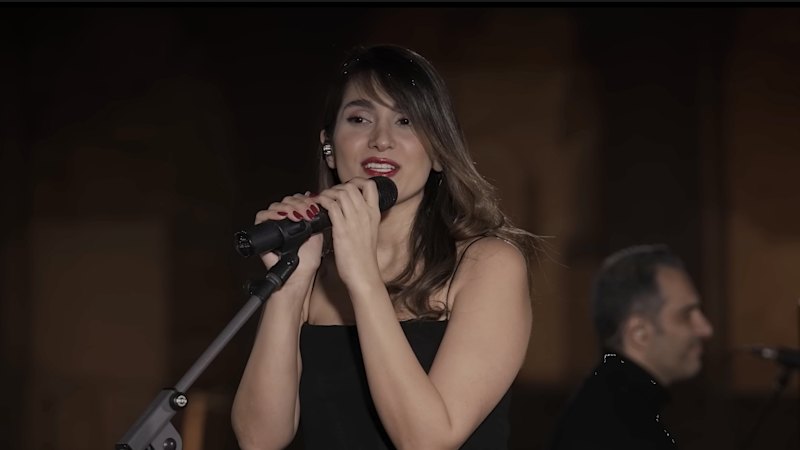
Ephrat Livni and Leily NikounazarNovember 25, 2026 — 7:45pmAn Iranian woman received 74 lashes this week for singing publicly in 2024 without a mandatory hijab, according to her lawyer in comments to an Iranian news outlet.The singer, Parastoo Ahmadi, 29, had performed without her hair or shoulders covered in a video that spread quickly online and drew the ire of Iranian authorities, who mandate that women must wear a veil in public. Singing by women is also highly restricted in Iran, and they are banned from singing solo in public.A screenshot from YouTube of a performance by Parastoo Ahmadi.InternetAhmadi and four others connected with the performance appeared at the prosecutor’s office in the city of Qom, where they were lashed, Ahmadi’s lawyer, Mostafa Nili, told the news outlet, Emtedad, on Monday. They were also banned from performing for two years and from leaving Iran during that time.A person in Tehran familiar with Ahmadi’s case, speaking on the condition of anonymity out of fear of reprisal from the Iranian government, confirmed that she had received the lashes.Ahmadi’s performance in 2024 was at a historic site in Qom. There was no audience, but it was shown live online in what she called an “imaginary concert” in the post of the livestream. The video of the event reached 3.3 million viewers.Wearing a long, black gown, Ahmadi sang Iranian folk songs. “I am Parastoo, a girl who wants to sing for the people I love,” she wrote in a caption with the post. “This is a right I could not ignore, singing for the land I love passionately.”The initial ruling, issued in June, sentenced Ahmadi and eight others involved with the concert to flogging. It was unclear if the others would be flogged at a later date or had already received their penalties.News outlets affiliated with the government have reported that Ahmadi and her colleagues were accused of “offending public decency” and of failing to adhere to legal and cultural norms.Ahmadi’s punishment, nearly two years after her performance, comes amid an ongoing government crackdown against dissent.“What used to lead to international outrage, now it barely registers because of attention on the war.”Mahmood Amiry-Moghaddam, director of Iran Human Rights.Authorities brutally suppressed mass protests in January, killing thousands of demonstrators, according to human rights groups. Iran has continued to execute and arrest dissidents in the months since the United States and Israel attacked Iran in February.The war has reduced the political cost of repression for the Islamic Republic, said Mahmood Amiry-Moghaddam, director of Iran Human Rights, a nonprofit in Norway. “What used to lead to international outrage, now it barely registers because of attention on the war,” he said.Women in Iran can be arrested or whipped for not donning the hijab, as Ahmadi’s case showed, but unveiled women are nonetheless seen throughout the country. In 2022, Mahsa Amini, a 22-year-old Kurdish woman, died in police custody after being arrested on grounds of breaking modesty laws involving the hijab.Her death prompted nationwide protests that were called the “Woman, Life, Freedom” movement. Since then, many more women have chosen to ignore the hijab rule. Unveiled women have even been seen on Iranian state media and at pro-government rallies amid the war.But Amiry-Moghaddam said that Ahmadi had pushed the boundaries, going further than just flouting the hijab rules, by demanding recognition of fundamental rights. He said that her punishment was part of a broader campaign to spread fear and deter others who were tempted to follow in her footsteps.“The main threat to the Islamic Republic doesn’t come from the United States or Israel,” he said. “It comes from young Iranians who want fundamental change, and that’s why what Parastoo does, as peaceful as it seems, it’s regarded as dangerous.”Suppression of cultural expression has escalated in recent months, according to the Centre for Human Rights in Iran, a nonprofit in New York.The group last month called on governments and the United Nations to pressure Iran by demanding the release of cultural figures being held for their expression and urging an end to corporal punishment such as flogging.The group highlighted the cases of about eight cultural figures in Iran who had been arrested, detained incommunicado, prosecuted or imprisoned for songs, poems, paintings, books or social media posts in September and October alone.The group also noted that Ahmadi’s conviction, and those of eight musicians and crew members who participated in the virtual concert with her, were upheld by an appeals court in Qom in September.“These arrests must be understood as part of the broader and increasingly violent campaign of repression in Iran, aimed at silencing dissent and intimidating entire communities,” said Esfandiar Aban, director of research at the centre.From our partners
74 lashes for a woman in Iran who dared to sing without a hijab
Full Article
Original Source
Read the full article at Smh →KhanList aggregates and links to publicly available news content. We do not host full articles from third-party sources. Always verify important information with original sources.