
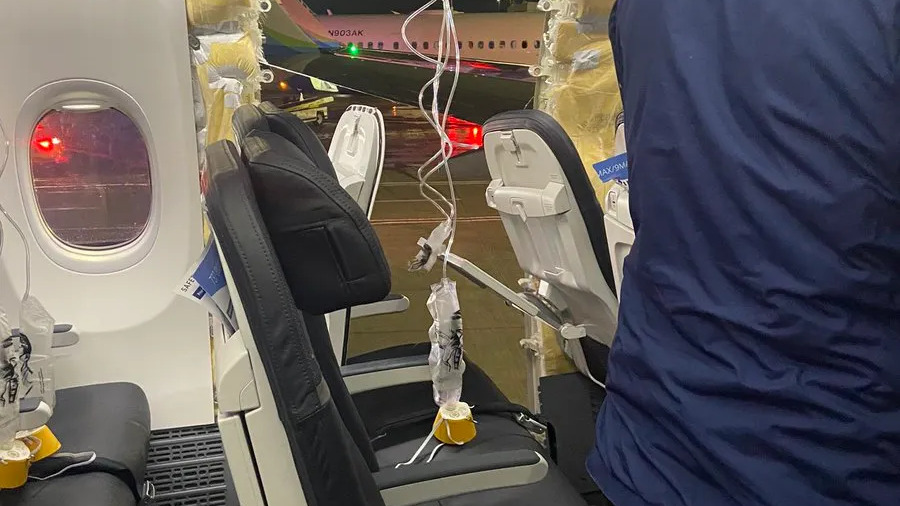
On January 5, 2024, Alaska Airlines flight 1282 was climbing out of Portland for Ontario, California when its Boeing 737 MAX 9 lost a door plug at nearly 15,000 feet. Cynthia Tisher’s son was seated beside the opening. His seat pitched toward the hole and his shirt was sucked off his body. She clutched him, afraid he’d be pulled out, too. 15-year-old Alaska Airlines passenger who was seated closest to the door plug that flew off mid-flight, sucking the shirt right off his back, fled to a different aisle and took a selfie. https://t.co/24khYw4goV — Breaking Aviation News & Videos (@aviationbrk) January 9, 2024 Other passengers helped Tisher and her son move away from the opening. Oxygen masks dropped. Insulation and paneling were coming loose. The pilots brought the plane safely back to Portland. The U.S. District Court judge in their lawsuit has thrown out their attempt to gain punitive damages from Boeing and Spirit AeroSystems. They can pursue compensation for actual injuries, but punishing the companies is off the table. The door plug that failed on the Alaska Airlines 737 Max flight is now being inspected across fleets. Boeings subcontractor, Spirit Aerosystems, installed these door plugs and have had issues with out of tolerance manufacturing in the past. Those are pretty hefty attachments, very curious as to what caused them to fail. Boeing still looking for the missing door plug in the Portland — Brian Mac Mághnais (@TheBrianMcManus) January 7, 2024 Spirit built the fuselage in Kansas and shipped it to Boeing. At Boeing’s Renton, Washington factory, the plug was opened so Spirit workers could repair defective rivets. The plug was closed again, but the four bolts that kept it from moving upward weren’t put back. The whistleblower’s account of the missing bolts became known right away before the NTSB’s preliminary report even confirmed it. The agency’s eventual findings added Boeing’s training, instructions and oversight problems. The work wasn’t properly documented, so the required inspection never happened. The FAA’s oversight failed here, too. This all came down to which state’s law controlled. Oregon law, where the incident happened, would have allowed punitive damages Washington law, where the assembly occurred, doesn’t The incident occurred in Oregon, but the misconduct occurred in Washington Washington State generally doesn’t allow punitive damages unless a statute expressly authorizes them. Oregon permits punitive damages for sufficiently serious misconduct, so Oregon law would have given the family an opportunity to prove they deserved punitive damages. Washington’s choice of law rules allow another state’s law to govern punitive damages when that state has the strongest connection to the issue. Courts consider where the injury happened, where the conduct happened, and the parties’ connections to each state. Punitive damages are about punishing and deterring misconduct, so the location of the conduct matters. Here, that means no punitive damages are available because Washington law applies. Boeing and Spirit also succeeded with that argument in the lawsuit filed by the captain at the controls of the plane. In August, a judge dismissed pilot Brandon Fisher’s request for punitive damages for his physical and emotional injuries. Topics on this page
737 MAX Door Plug Blowout Sucked A Teen’s Shirt Off—Now Boeing Gets Punitive Damages Thrown Out
Full Article
Original Source
Read the full article at Viewfromthewing →KhanList aggregates and links to publicly available news content. We do not host full articles from third-party sources. Always verify important information with original sources.