
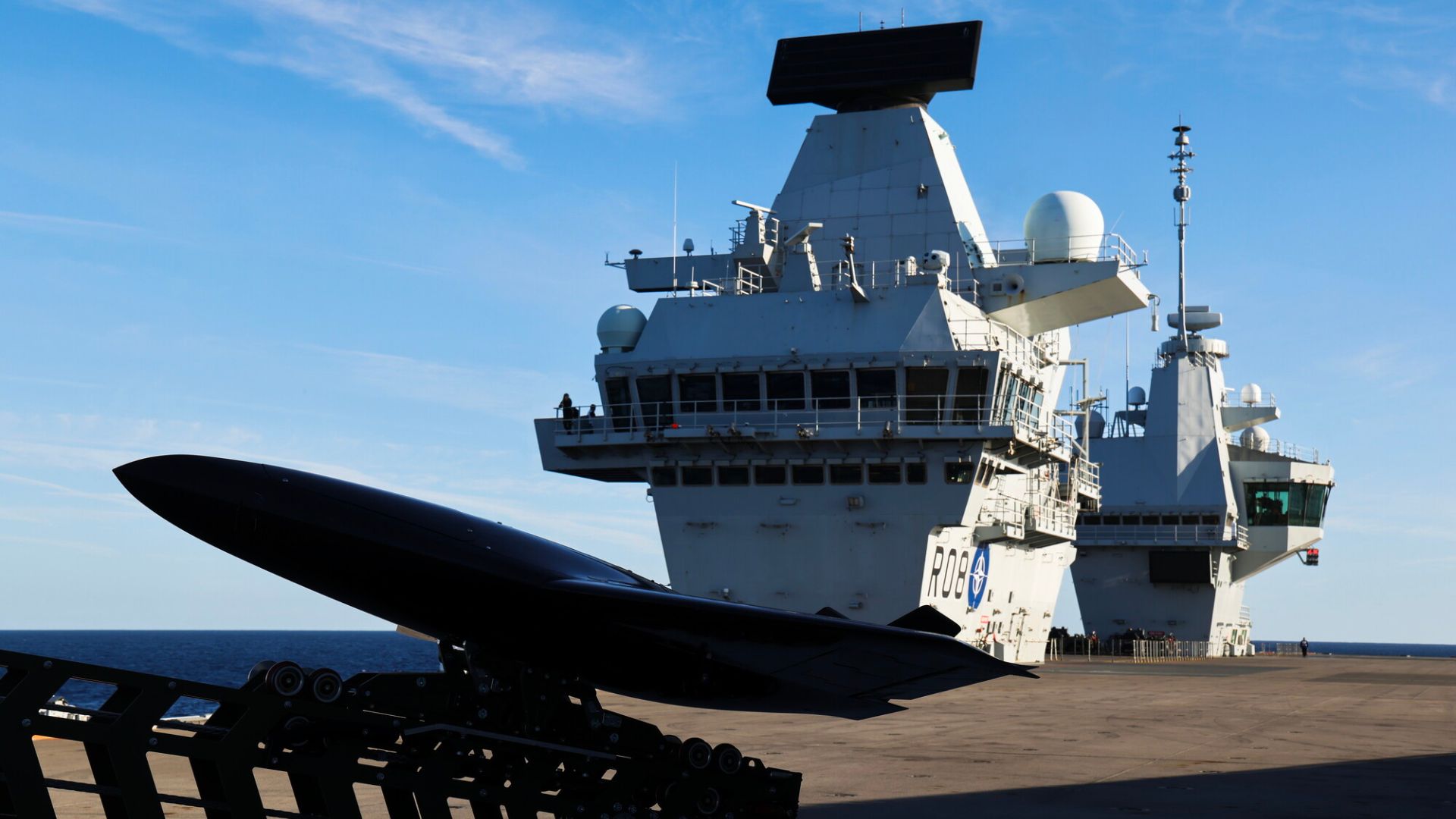
The Royal Navy has tested a new ship-launched strike drone aboard its largest aircraft carrier, HMS Queen Elizabeth. The Nyan One-Way Effector (OWE) completed four launches in the North Atlantic, hitting its designated targets in every attempt. HMS Queen Elizabeth displaces approximately 71,650 tons, making it the largest warship ever built for the Royal Navy. Operating Nyan from a carrier of this scale gives the service valuable insight into integrating uncrewed strike aircraft into major maritime operations. Developed by Callen-Lenz, a BAE Systems subsidiary, Nyan is designed to deliver precision strikes using an uncrewed aircraft. Its successful carrier trials mark another step toward operating expendable strike drones alongside crewed aircraft and other naval platforms. The tests took place during Exercise Neptune Reach B, which explores how uncrewed weapons could support future British carrier strike operations. The Royal Navy now has evidence that Nyan can launch from a major aircraft carrier and execute its assigned strike profile. Testing drones aboard carriers Operating an uncrewed strike aircraft from an aircraft carrier presents challenges beyond simply launching it from a runway. The system must function within a complex maritime environment and integrate with the ship’s aviation operations. Nyan completed four separate launches from HMS Queen Elizabeth during the North Atlantic exercise. All four aircraft reached their designated strike points, according to BAE Systems. The drone has a wingspan of 2.9 meters and offers a relatively compact design for maritime operations. Its one-way configuration focuses on delivering a precision strike rather than returning to the launch platform. The carrier demonstrations follow an earlier maritime launch from the Royal Navy’s experimental vessel XV Patrick Blackett. That test took place during Exercise Neptune Reach A earlier this year. HMS Queen Elizabeth also hosted the Heavy Lift Challenge 3 trials, which saw a Tekever AR5 fixed-wing drone operate from an aircraft carrier for the first time. The aircraft has a 23-foot wingspan and can carry payloads weighing up to 176 pounds. Its potential roles include logistics and intelligence, surveillance, target acquisition, and reconnaissance (ISTAR). Together, the trials give British defense planners more information about launching uncrewed strike systems from different naval platforms. Britain’s hybrid navy ambitions The Royal Navy is exploring how uncrewed aircraft could increase the number of available strike assets without relying entirely on conventional crewed platforms. Project Vantage coordinates these efforts across the Royal Navy, British Army and Royal Air Force. The initiative aims to accelerate testing and inform decisions about future maritime one-way effectors. Lieutenant Commander David Burton, the Royal Navy’s capability sponsor, said Neptune Reach B provided important insight into future carrier strike operations. He added that the trials would help determine how uncrewed strike drones could operate alongside other capabilities within maritime task groups. The findings will also inform Britain’s Maritime Aviation Transformation program. Its broader objective involves developing a hybrid navy with more operational options. Matt Foster, CEO of Callen-Lenz, described the carrier launches as another demonstration of Nyan’s potential. He said affordable, scalable combat mass could increase the effectiveness of existing military capabilities. Expanding uncrewed strike capabilities BAE Systems is developing Nyan within a wider portfolio of uncrewed aircraft. Its FalconWorks research and technology hub supports work on emerging aviation systems and autonomous platforms. The company brings more than 25 years of experience in uncrewed and autonomous technology. Its current strategy focuses on systems that can complement existing frontline aircraft and future platforms. Nyan’s carrier trials provide an early indication of how relatively small strike drones could fit into naval aviation. The four successful launches establish a foundation for further testing. The Royal Navy has not announced an operational deployment date for the system. Future evaluations will help determine how these aircraft could support carrier operations and Britain’s wider maritime strike capabilities. Get the latest in engineering, tech, space & science - delivered daily to your inbox.Aamir is a seasoned tech journalist with experience at Exhibit Magazine, Republic World, and PR Newswire. With a deep love for all things tech and science, he has spent years decoding the latest innovations and exploring how they shape industries, lifestyles, and the future of humanity.
72,000-ton British aircraft carrier launches attack drones in historic naval first
Full Article
Original Source
Read the full article at Interestingengineering →KhanList aggregates and links to publicly available news content. We do not host full articles from third-party sources. Always verify important information with original sources.