
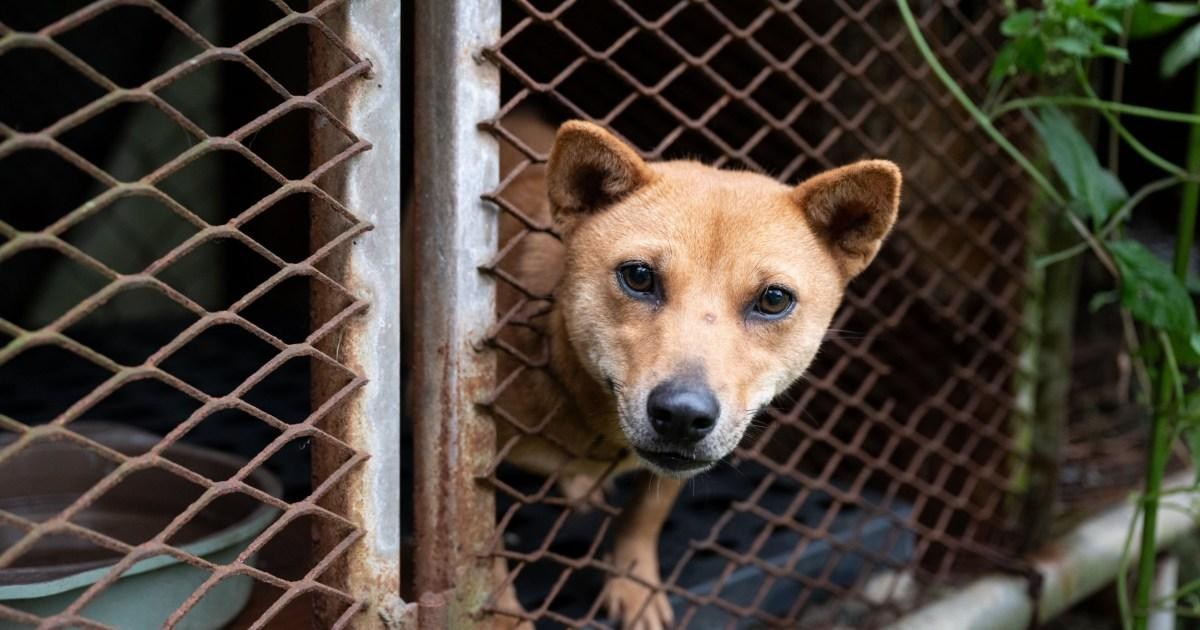
Sorry, the video was not found For Sangkyung Lee, nothing beats opening the rusted, filthy cages at dog meat farms and watching the nervous canines sniff his hand. And in recent months, he’s been doing it a lot. A ban on breeding, slaughtering and selling dogs for human consumption will come into effect in South Korea next February. Sangkyung, the campaign manager at Humane World for Animals Korea, took part in the animal welfare organisation’s final large-scale dog meat farm rescue mission in September. ‘It was an amazing feeling to get these dogs out of their filthy cages, never to be confined ever again,’ he tells Metro. ‘At the same time, it’s heartbreaking to know that these dogs are among the last survivors rescued from this cruel industry.’ Sign up for all of the latest stories Start your day informed with Metro's News Updates newsletter or get Breaking News alerts the moment it happens. The 70 dogs at the dog meat farm in Gangjin have been rescued (Picture: Meredith Lee/Humane World for Animals) Many were malnourished and had sore paws from balancing on the metal wires (Picture: Meredith Lee/Humane World for Animals) The farm has since closed (Picture: Meredith Lee/Humane World for Animals) The farm in Gangjin, which sits between rice paddies on the southwestern tip of South Korea’s coast, has been running for 20 years and once reared 1,000 dogs. The farm owner drove around the area shouting through a loudspeaker, asking locals to sell him their unwanted pets. Hundreds would be sold to the slaughterhouse every year for electrocution, then flogged to restaurants and markets. ‘No one would ever have guessed that if you drove down a track a little way, it opened up into a scene of utter hell for dogs,’ says Wendy Higgins, director of international media relations at Humane World for Animals. Higgins says the owner agreed to relinquish the remaining dogs to Humane World for Animals and vow not to sell dog meat again. A German shepherd, corgi mixes, a husky mix, spitz mixes and Korean Jindos greeted rescuers, barking and pawing from their cages. Dog meat goes for tens of pounds (Picture: Meredith Lee/Humane World for Animals) At the end of one row of rusted cages was a dog skeleton, Higgins says, the floor littered with collars, syringes and jaw bones. They also found large vats of rotting duck heads to be fed to the dogs. The animals taken from the Gangjin farm will be flown to the US and Canada to be put up for adoption. ‘You can’t help but think, I wish we had discovered this place sooner and we could have saved more lives,’ Higgins adds. ‘That thought always haunts me.’ Dog meat farms will be illegal from 2027 Eating dog is part of South Korea’s culinary history (Picture: Meredith Lee/Humane World for Animals) Dog meat has long been on the menu in South Korea. Bosintang, or ‘soup good for your body’, is made from shredded canine meat and became a common dish after the Korean War made meat scarce. Summer is peak dog-eating season, when sweaty, typically elderly, diners seek out the restorative effects of the soup. Dog meat cost £45 per kilogram in July, up from £17 in December, according to The Korea JoongAng Daily. In 2024, there were 5,898 dog meat businesses, including 1,537 farms, 221 slaughterhouses, 1,788 traders and 2,352 restaurants. But the practice has fallen out of favour; more than nine in 10 adults say they have no hankering for dog meat. South Korea’s parliament, the National Assembly, passed a dog meat ban in 2024, joining Hong Kong, India and Thailand. Most South Koreans aren’t in favour of eating dogs (Picture: Meredith Lee/Humane World for Animals) Eight in 10 dog farms have since closed, yet only 0.3% of dogs on meat farms have been rescued since the ban was passed. Under the law, anyone who butchers a dog will face three years in prison or be fined about £16,000. Julie Sanders, director of End Dog and Cat Meat at Humane World for Animals, expects a few dog meat farms will remain even after the ban comes into effect. ‘But I feel confident in the authorities’ commitment to finding them and shutting them down,’ she says. ‘There is a real sense of momentum to get rid of this industry and embrace dogs as friends, not food.’ None of the campaigners blame people in South Korea for eating dog meat. Higgins compares it to how the average Brit has never set foot inside a factory farm, yet most of us still eat meat, dairy and eggs. Dog meat farming will be illegal from next year (Picture: Meredith Lee/Humane World for Animals) Millions of dogs are killed each year for their meat in Cambodia, Vietnam and Indonesia, according to the animal welfare group Four Paws. Higgins hopes governments elsewhere will follow South Korea’s lead. Until then, the dog meat industry will still see the canines as produce, like the Gangjin dogs once were. ‘But to us they are everything,’ Higgins says. ‘They are Prince and Coco, Nara, Lola, Ranger, Julie, Patches, Oreo; their lives matter. ‘It makes me cry to think of the awful deaths they would have had if we had not saved them.’ Get in touch with our news team by emailing us at webnews@metro.co.uk. For more stories like this, check our news page. Arrow MORE: Man, 24, arrested for suspected false £90,000 insurance claim for 650 stolen sheep Arrow MORE: Man in 70s and his dog die after being hit by bus Arrow MORE: Fears of Christmas turkey shortage after bird flu outbreak leads to mass cull News Updates Stay on top of the headlines with daily email updates.
70 dogs saved from ‘utter hell’ at one of South Korea’s last canine meat farms
Full Article
Original Source
Read the full article at Metro →KhanList aggregates and links to publicly available news content. We do not host full articles from third-party sources. Always verify important information with original sources.