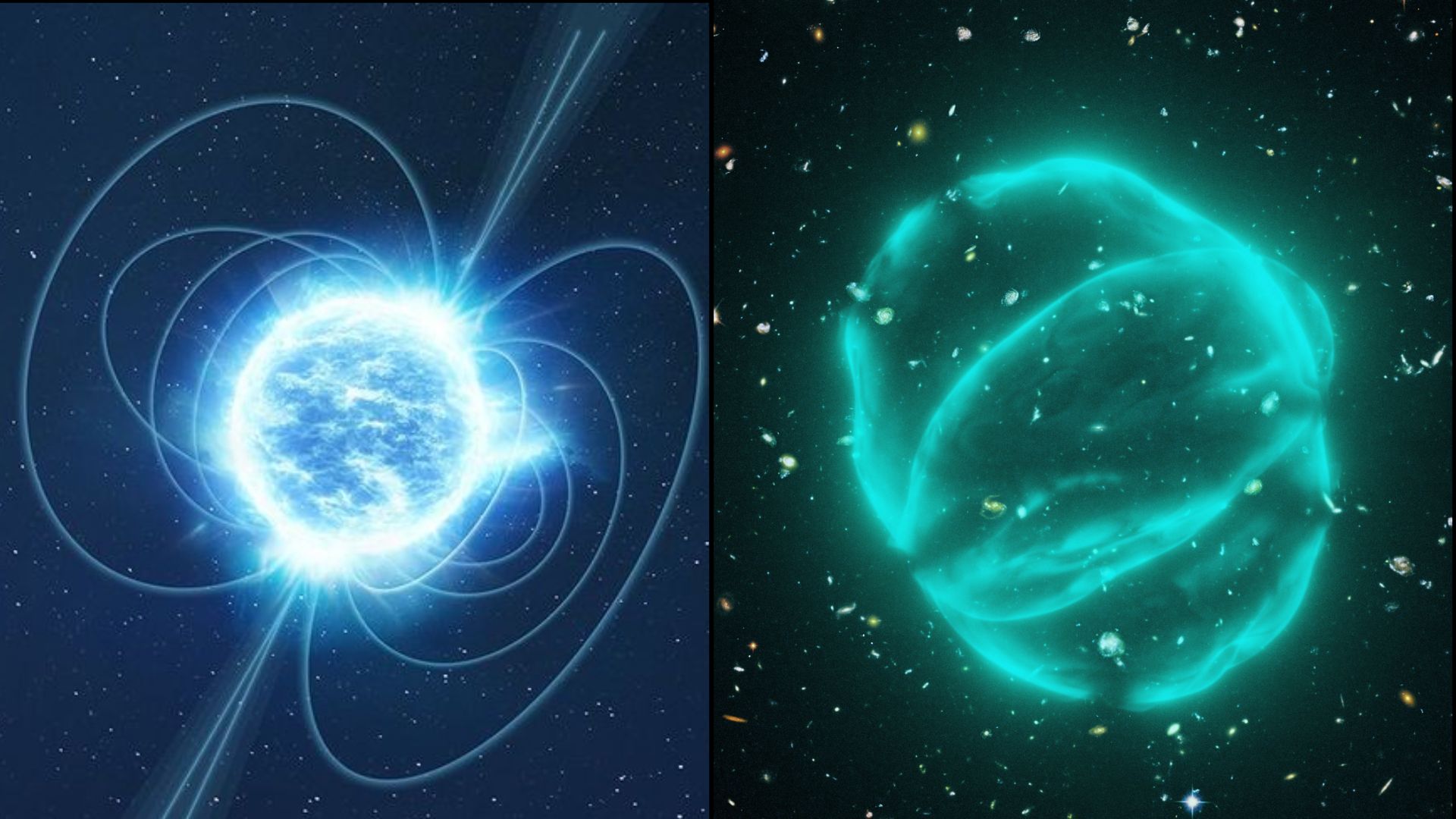
The Universe is full of things that seem to ignore common sense. Some are so dense that a teaspoonful would outweigh a mountain. Others are colder than the empty vacuum of space, while a few wander the galaxy without orbiting a single star. And then there are cosmic objects so bizarre that astronomers still cannot agree on what they actually are. Here are seven of the strangest known objects in the Universe and why they continue to fascinate scientists. 1. Magnetars: Stars with magnetic fields beyond imagination Imagine a star whose magnetic field is so powerful that it could erase the data on a credit card from halfway to the moon. That’s essentially what a magnetar is. A rare type of neutron star with the strongest known magnetic fields in the Universe, reaching around 1,000 trillion times stronger than Earth’s. These ultra-dense stellar remnants occasionally release enormous bursts of X-rays and gamma rays, making them some of the most energetic objects ever observed. Even today, astronomers are still trying to understand exactly how these extraordinary objects form, with recent observations continuing to challenge existing theories about their evolution. 2. Odd Radio Circles (ORCs): The cosmic mystery nobody has solved Discovered only in 2019, Odd Radio Circles, or ORCs, remain one of astronomy’s biggest unsolved puzzles. Visible only through radio telescopes, these enormous circular structures can span hundreds of thousands to more than a million light-years across. Entire galaxies often sit near their centers, yet scientists still debate whether they are the remnants of colossal explosions, ancient black hole activity, galactic collisions, or something entirely different. As more radio surveys discover new ORCs, astronomers are getting closer to understanding them, but no single explanation has yet emerged. 3. Rogue planets: Worlds with no sun Every planet in our Solar System orbits the sun, but not all planets are so fortunate. Rogue planets drift alone through interstellar space after either being ejected from their original planetary systems or forming independently without ever orbiting a star. Because they receive virtually no starlight, many are incredibly cold and difficult to detect. Recent observations using the European Southern Observatory’s Very Large Telescope have even found rogue planets actively growing by pulling in surrounding gas and dust, showing that these lonely worlds can remain surprisingly dynamic long after their formation. 4. The Boomerang Nebula: Colder than outer space Most people assume outer space is the coldest place imaginable. Surprisingly, that’s not true. The Boomerang Nebula, located about 5,000 light-years away, is the coldest known natural object in the Universe, with temperatures around 1 kelvin (-272°C). Actually colder than the cosmic microwave background, the faint afterglow of the Big Bang itself. It achieves this remarkable feat by ejecting gas at extremely high speeds. As the gas expands rapidly, it cools dramatically, much like air escaping from a compressed gas cylinder. 5. Quasars: The brightest persistent objects ever discovered Some galaxies hide monsters at their centers. Quasars are powered by supermassive black holes consuming enormous quantities of matter. As gas spirals inward, it heats to extraordinary temperatures, producing more light than entire galaxies containing hundreds of billions of stars. Despite being powered by black holes, which themselves emit no light, quasars are among the brightest persistent objects in the Universe. Recent surveys have continued discovering quasars that formed less than a billion years after the Big Bang, helping astronomers understand how the earliest supermassive black holes grew so quickly. 6. Brown dwarfs that blur the line between stars and planets Not every object fits neatly into astronomy’s categories. Brown dwarfs are often described as “failed stars” because they are too small to sustain the hydrogen fusion that powers ordinary stars, yet too massive to be considered planets. In 2026, astronomers using the Very Large Telescope reported evidence of what could become the first known moon orbiting a brown dwarf, further blurring the already confusing distinction between stars, planets, and moons. Discoveries like these continue to challenge long-held definitions of celestial objects. 7. Blazars: Black holes pointing directly at Earth Black holes are strange enough but blazars take things even further. A blazar is an active supermassive black hole whose enormous jets of high-energy particles happen to be aimed almost directly toward Earth. Because these jets travel at speeds close to the speed of light, relativistic effects make them appear extraordinarily bright. Some blazars can outshine every star in their host galaxy combined and produce powerful bursts of gamma rays detectable across billions of light-years, making them invaluable laboratories for studying some of the most extreme physics in the cosmos. The Universe keeps getting stranger One of the most fascinating things about astronomy is that every answer often leads to even more questions. Just a decade ago, few people had heard of Odd Radio Circles, while discoveries involving rogue planets, brown dwarfs, and other unusual objects continue to reshape scientists’ understanding of how the Universe works. As observatories such as the James Webb Space Telescope, the Very Large Telescope, and the upcoming Square Kilometer Array continue exploring the cosmos, it’s entirely possible that tomorrow’s strangest object hasn’t been discovered yet. Recommended ArticlesGet the latest in engineering, tech, space & science - delivered daily to your inbox.Kaif Shaikh is a journalist and writer passionate about turning complex information into clear, impactful stories. His writing covers technology, sustainability, geopolitics, and occasionally fiction. A graduate in Journalism and Mass Communication, his work has appeared in the Times of India and beyond. After a near-fatal experience, Kaif began seeing both stories and silences differently. Outside work, he juggles far too many projects and passions, but always makes time to read, reflect, and hold onto the thread of wonder.
7 strangest objects discovered in the Universe that prove reality is weirder than fiction
Full Article
Original Source
Read the full article at Interestingengineering →KhanList aggregates and links to publicly available news content. We do not host full articles from third-party sources. Always verify important information with original sources.