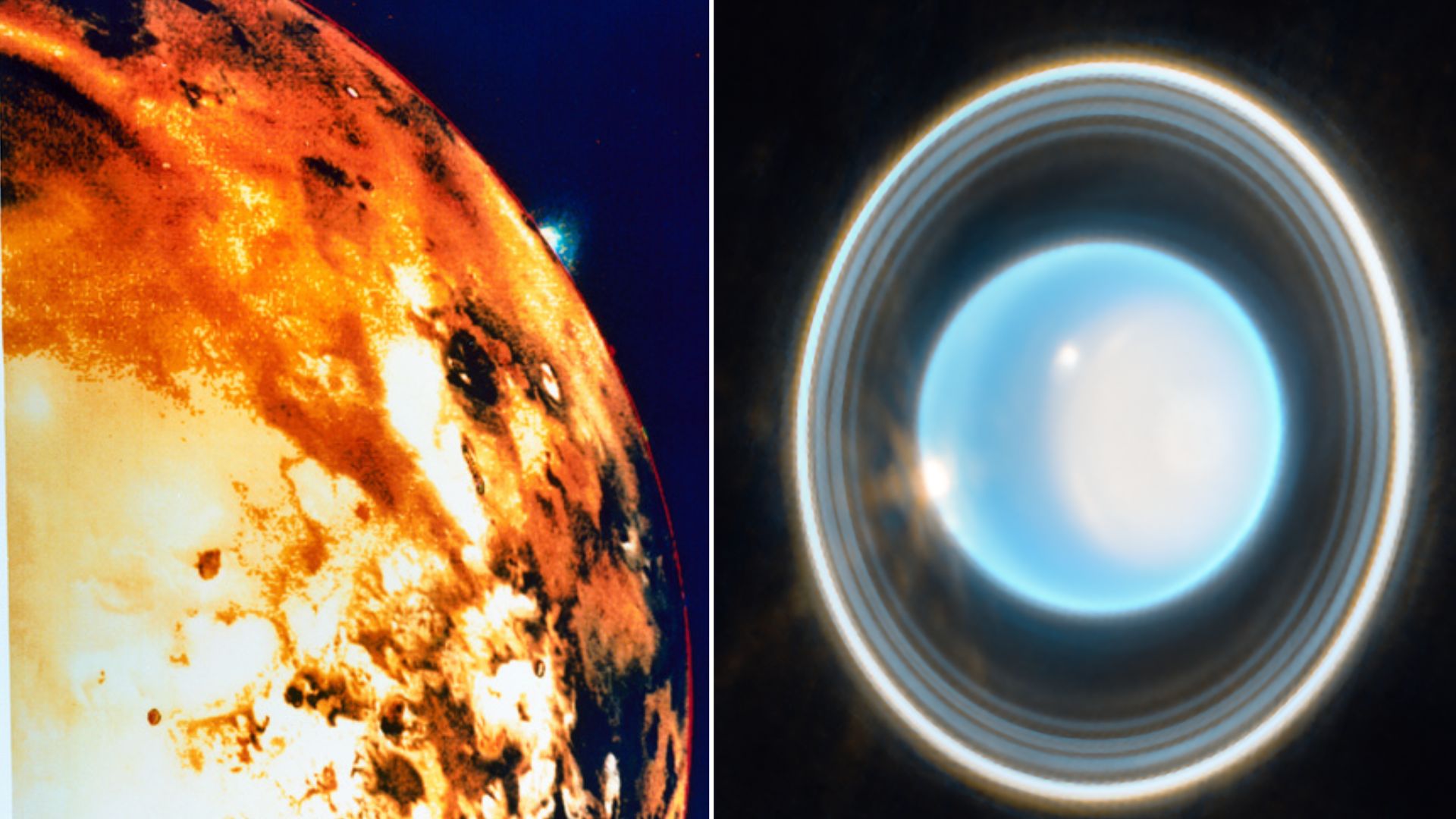
The Solar System may look orderly from a distance. Eight planets orbiting one star, with everything apparently following the rules. Get closer, however, and things become considerably stranger. One planet spins almost on its side, another is hotter than the world closest to the Sun, and a moon is being continuously reshaped by volcanic eruptions. Here are seven of the Solar System’s strangest features. 1. Uranus basically rolls around the Sun Uranus has an axial tilt of 97.77 degrees, meaning its rotation axis is almost perpendicular to the plane in which it orbits the Sun. The result is a planet that appears to travel around the Sun on its side, rather like a rolling ball. The extreme tilt also produces bizarre seasons. Each pole can experience roughly 21 years of continuous darkness, followed by about 21 years of sunlight. Scientists think a massive collision early in Uranus’ history may have produced its unusual orientation, although the details remain uncertain. 2. Venus is hotter than Mercury Mercury is the closest planet to the Sun, but Venus is the Solar System’s hottest planet. Its average surface temperature is about 464°C, hot enough to melt lead. The reason is Venus’ extraordinarily thick atmosphere, composed mostly of carbon dioxide. It traps heat through an intense greenhouse effect, keeping the planet’s surface hotter than Mercury’s despite receiving less sunlight. Venus also has surface pressure roughly 93 times that of Earth. 3. Mercury is literally shrinking Mercury has been cooling for billions of years, and its interior has contracted as it loses heat. That contraction has compressed the planet’s crust, producing enormous cliffs and ridges known as lobate scarps. NASA’s MESSENGER mission mapped thousands of these structures and found evidence that Mercury had contracted substantially more than earlier estimates suggested. So while Mercury isn’t visibly getting smaller from year to year, geological evidence shows that the planet has shrunk as its interior cooled. 4. Jupiter’s moon Io is almost constantly erupting Io is only slightly larger than Earth’s Moon, yet it is the most volcanically active world in the Solar System. Hundreds of volcanoes cover its surface, with some erupting lava fountains dozens of miles high. The culprit is Jupiter’s gravity. Io is repeatedly squeezed and stretched by Jupiter and the gravitational pulls of neighboring moons Europa and Ganymede. That tidal flexing generates enormous internal heat, keeping parts of Io’s interior molten and driving its extraordinary volcanism. 5. Saturn has a giant hexagon at its north pole Saturn’s north pole hosts one of the strangest weather systems ever observed: a hexagon-shaped jet stream roughly 30,000 kilometers across. First spotted by Voyager and studied extensively by Cassini, the enormous pattern contains winds moving at roughly 322 km/h. The hexagon isn’t a solid structure or a giant storm wall. It is a persistent atmospheric jet stream forming a six-sided pattern around the pole, with a rotating storm at its center. NASA notes that there is no known weather feature quite like it elsewhere in the Solar System. 6. Titan has rivers and lakes, but they’re not water Saturn’s moon Titan looks surprisingly Earth-like, complete with clouds, rainfall, rivers, channels and lakes. The strange part is what flows through them. Titan’s surface is so cold that methane and ethane can exist as liquids, creating a hydrological cycle remarkably similar to Earth’s water cycle. Methane evaporates, forms clouds, falls as rain, and collects in lakes and seas. Cassini radar observations even found northern lakes more than 100 meters deep, filled largely with liquid methane. Titan is the only world besides Earth known to have stable bodies of liquid on its surface. 7. Neptune has winds faster than 2,000 km/h Despite receiving only a tiny fraction of the sunlight Earth gets, Neptune has the fastest winds known on any planet in the Solar System. NASA says clouds of frozen methane can be driven across the planet at speeds exceeding 2,000 km/h. That’s roughly nine times faster than Earth’s most powerful winds. Neptune has also produced enormous storms: when Voyager 2 flew past in 1989, it observed the Great Dark Spot, a storm large enough to contain Earth. That particular storm later disappeared, demonstrating how dramatically Neptune’s atmosphere can change. The strangest thing about the Solar System may be that these aren’t exotic worlds orbiting some distant star. They’re our neighbors. And even after decades of spacecraft exploration, the planets and moons around us continue to behave in ways that challenge our expectations.Recommended ArticlesGet the latest in engineering, tech, space & science - delivered daily to your inbox.Kaif Shaikh is a journalist and writer passionate about turning complex information into clear, impactful stories. His writing covers technology, sustainability, geopolitics, and occasionally fiction. A graduate in Journalism and Mass Communication, his work has appeared in the Times of India and beyond. After a near-fatal experience, Kaif began seeing both stories and silences differently. Outside work, he juggles far too many projects and passions, but always makes time to read, reflect, and hold onto the thread of wonder.
7 strange things that make our Solar System surprisingly weird
Full Article
Original Source
Read the full article at Interestingengineering →KhanList aggregates and links to publicly available news content. We do not host full articles from third-party sources. Always verify important information with original sources.