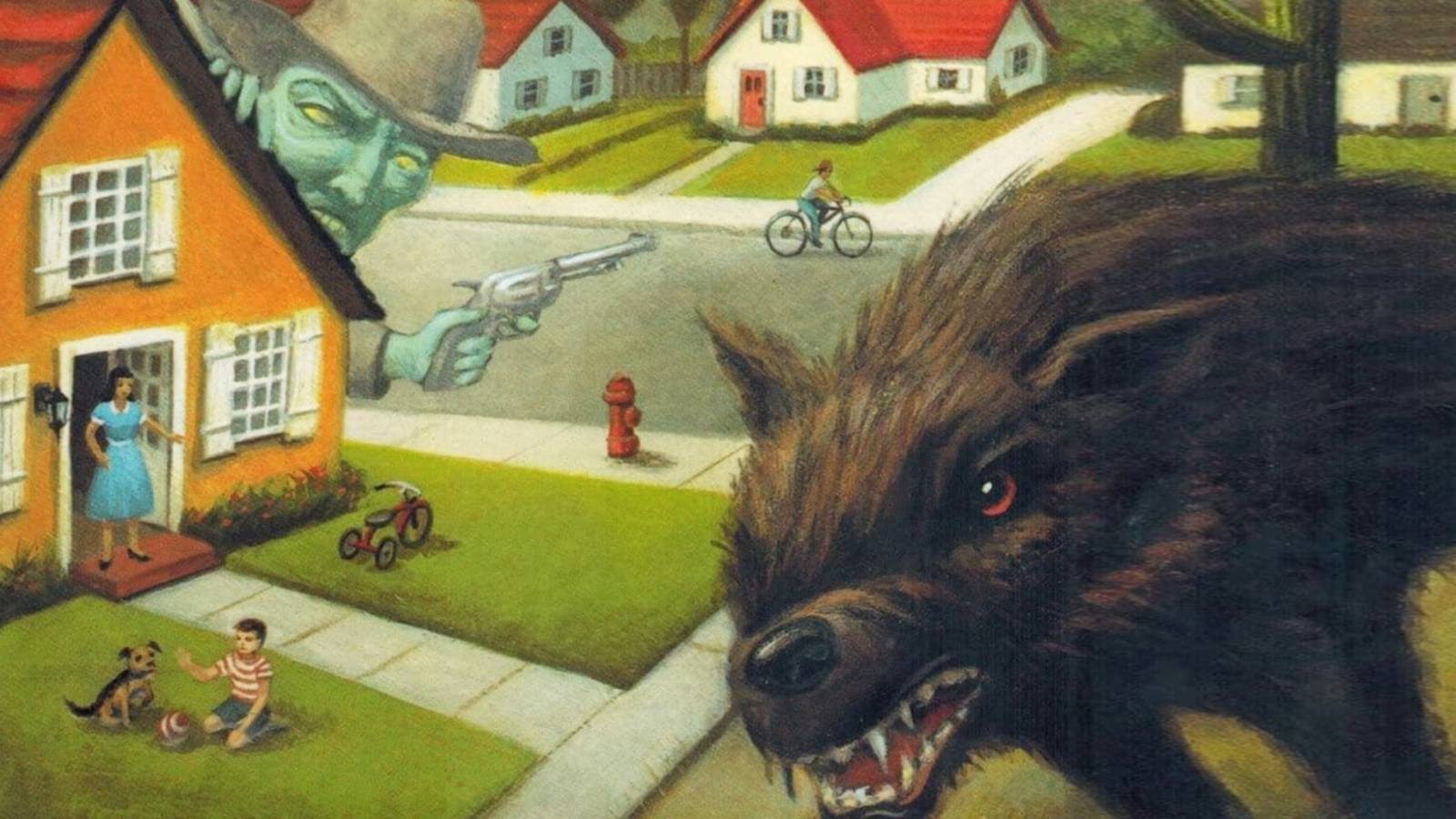
Image via E. P. Dutton Published Aug 12, 2026, 4:54 PM EDT Jeremy has more than 2700 published articles on Collider to his name, and has been writing for the site since February 2022. He's an omnivore when it comes to his movie-watching diet, so will gladly watch and write about almost anything, from old Godzilla films to gangster flicks to samurai movies to classic musicals to the French New Wave to the MCU... well, maybe not the Disney+ shows. His favorite directors include Martin Scorsese, Sergio Leone, Akira Kurosawa, Quentin Tarantino, Werner Herzog, John Woo, Bob Fosse, Fritz Lang, Guillermo del Toro, and Yoji Yamada. He's also very proud of the fact that he's seen every single Nicolas Cage movie released before 2022, even though doing so often felt like a tremendous waste of time. He's plagued by the question of whether or not The Room is genuinely terrible or some kind of accidental masterpiece, and has been for more than 12 years (and a similar number of viewings). When he's not writing lists - and the occasional feature article - for Collider, he also likes to upload film reviews to his Letterboxd profile (username: Jeremy Urquhart) and Instagram account. He has achieved his 2025 goal of reading all 13,467 novels written by Stephen King, and plans to spend the next year or two getting through the author's 82,756 short stories and 105,433 novellas. Sign in to your Collider account Even if you're a big Stephen King fan, you might well have to admit that he’s big on quantity at the same time as he’s honestly been pretty good with the whole quality thing. This is said not with malice, but more with the acknowledgment that he has written so much, pumping out almost 70 novels and then being prolific as a writer of short stories and novellas, too. Like, to stay positive, you're missing out if you don’t read the likes of Different Seasons, Skeleton Crew, and Night Shift, even though they're not technically counted among his novels, due to being short fiction collections. He’s prolific in a mostly good way, but if you dig through everything he’s written, you will inevitably come across a few books that aren’t the most seamless of reads. The following books might well even test some mega fans, although maybe not the most mega of all the mega fans, because just about every Stephen King book has at least some defenders. So, if you're a defender of one of the following, sorry about that. Maybe take it as another positive: you're an even bigger fan, somehow, than some of his hypothetical biggest fans being talked about here. 7 'Dreamcatcher' (2001) Image via Hodder & Stoughton There are some IT vibes with Dreamcatcher, but it’s not nearly as good, and it’s also more of a trek to get through, even though it’s quite a bit shorter. You get some of the childhoods of the main characters, yet most of the time is spent with the characters as adults, which is a big difference from IT. But hey, Derry is important to both, though Dreamcatcher mostly takes place near Derry rather than directly in it. Still, that Derry weirdness clearly spreads, and here, it’s extraterrestrial stuff that ends up being the main threat. Stephen King does aliens sometimes, and the one big novel of his that really works, while featuring aliens to some extent, you can’t really say, because the aliens are kind of a twist. They're revealed sooner with Dreamcatcher, and also, aliens are pretty blatantly at the center of another King novel that’s a bit of an endurance test… that one’s from 1987, and more on it later. 6 'Nightmares & Dreamscapes' (1993) Image via Viking Press The most controversial selection here is probably going to be Nightmares & Dreamscapes, so best to get it over with. There are parts of this collection that are very good, but not enough that’s great. The best short story here isn't as good as, say, the five or six best stories found in either Night Shift or Skeleton Crew (the latter had a couple of novellas, but was mostly made up of short stories), and there are also so many short stories here, so the whole thing gets a bit tiring, at a point. Nightmares & Dreamscapes is the longest collection of Stephen King short fiction, and at least there’s variety. Maybe that’s also a factor in some stories really missing the mark, or feeling like King a little too far out of his comfort zone. Also, Nightmares & Dreamscapes concludes on a pretty weak final few notes, with a non-fiction essay, a very short poem, and then a retelling of a fable. See, eclectic? Points for effort, and some points for variety, but Nightmares & Dreamscapes needed a few more outright winners and a couple fewer experiments that didn’t really work out. 5 'Cell' (2006) Image via Hodder & Stoughton Unlike Dreamcatcher, Nightmares & Dreamscapes, and a few other soon-to-be-mentioned books, Cell doesn’t go on for way too long, instead perhaps going on for a little too long. Its biggest problems aren’t really related to length, though, since this is more just a high-concept premise that runs out of steam a little too soon, and then meanders a bit toward an ending. Small mercies are something, though. It could've meandered for longer. There’s some pulpy fun – and even a little by way of effective horror – early on, yet not for much longer than the first third or so of the book. As for that high-concept premise, Cell sees Stephen King putting his spin on the zombie genre, with it being a post-apocalyptic novel about a signal that turns cell phone users into mindless monsters that aren’t literal zombies, nor zombies in the traditional sense, but they might as well be. They're graduates from the 28 Days Later school of “Pretty Much Zombies.” There’s some pulpy fun – and even a little by way of effective horror – early on, yet not for much longer than the first third or so of the book. It’s hard to shake the feeling that Cell might've been a solid novella, but couldn’t quite cut it when stretched to a (short by King standards) novel. 4 'Lisey's Story' (2006) Image via Charles Scribner's Sons The 2000s was a strange decade for Stephen King. There was Dreamcatcher being there alongside the conclusion of The Dark Tower, and then Under the Dome was good, albeit not loved by everyone, plus Duma Key… maybe divisive? Not too drastically. Lisey’s Story, though… look, this much can be said about Lisey’s Story: Stephen King himself loves it. It’s very personal and an admirable attempt at King doing something a bit more romantic – or at least romance-focused – than he’d done before. Still, he told a better and more moving love story in 11/22/63, a few years later, which got his whole 2010s off to a pretty great start. Lisey’s Story is a good deal sappier and frustrating with its style, and the way many of its characters speak. He wrote it for himself, and for his wife (it’s dedicated “To Tabby”), so it can be admired as something personal and probably heartfelt. It’s long and kind of frustrating to actually get through in many ways as a reader on the outside, though, and the book was published for public consumption and all. 3 'Sleeping Beauties' (2017) Image via Scribner There’s a family aspect to Sleeping Beauties, too, because King co-wrote it with his son, Owen. It’s one of the better books being mentioned here, or maybe it’s more accurate to say it’s a book with some good parts. It’s an epic, and it probably didn’t need to be, because it’s another that doesn’t sustain itself for the hundreds upon hundreds of pages it goes on for. The resulting book is a bit frustrating, stacking up what works against what doesn’t really. You get almost a small town’s worth of characters in Sleeping Beauties, Under the Dome-style, but (once again, to the point where it probably goes without saying) not as good. The premise is also interesting at first, Cell-style, with it being about women mysteriously falling asleep and all the men, still very much conscious, having to work out what to do. It’s got some dark fantasy and horror elements mixed in with a few other genres, or sub-genres, and that speaks to the chaos of it all, and the messiness. It’s not the fun or vintage kind of Stephen King sprawling, which you get at its arguable peak in something like The Stand. Sleeping Beauties wanders off and gets lost, so to speak, rather than darting from place to place with some sense of genuinely welcome intensity or unpredictability. 2 'The Regulators' (1996) Image via Dutton/Stephen King Desperation is not an absolutely top-tier Stephen King book, but it’s one half of a pretty darn good Stephen King book, collapsing at more or less the halfway mark and then stumbling on for the remaining few hundred pages. For the time that it’s mystery-heavy and sort of a neo-Western, it’s cool. And it’s only worth bringing up right here and right now because it’s a mirror novel to The Regulators, which was published on the same day, with Desperation being attributed to King, and The Regulators technically being a Richard Bachman novel. Whatever kind of worked in Desperation is not found in The Regulators. It’s shorter than Desperation, and you might be intrigued to read it if you liked (or even liked half of) Desperation, what with the characters all sharing names and a few other connections being there, but it ends up being quite a bit harder to hack your way through than Desperation. It’s really only for Stephen King completionists. Actually, even then, be careful about trying to throw your way into this one. It’s borderline incomprehensible (hence no plot summary being given here, because plot? In The Regulators? Ha). 1 'The Tommyknockers' (1987) Image via G. P. Putnam's Sons When Dreamcatcher was being talked about, and there was mention of another lengthy Stephen King novel about extraterrestrials, it’s The Tommyknockers. It’s the problem; it’s it. This feels like a more chaotic and frenzied Dreamcatcher, yet it finds even fewer places to go, and it takes a bit longer to get there, because The Tommyknockers really does end up being one of King’s longest single books. It doesn’t deserve to have all those pages, but it does in any event. Unlike with Lisey’s Story, where it feels kind of bad to be negative about something King’s happy with, the author’s talked about The Tommyknockers being a mess of characters, subplots, and a general lack of focus. It’s always risky to suggest that the world needs more Stephen King adaptations, but if someone were to take The Tommyknockers, streamline it, and make it all work somehow as another TV show – or anything that’s not a book – that honestly might be something to see/experience. The Tommyknockers Release Date 1993 - 1993-00-00 Network ABC Directors John Power Cast Allyce Beasley Becka Paulson
7 Stephen King Books Even His Biggest Fans Might Struggle to Finish
Full Article
Original Source
Read the full article at Collider →KhanList aggregates and links to publicly available news content. We do not host full articles from third-party sources. Always verify important information with original sources.