
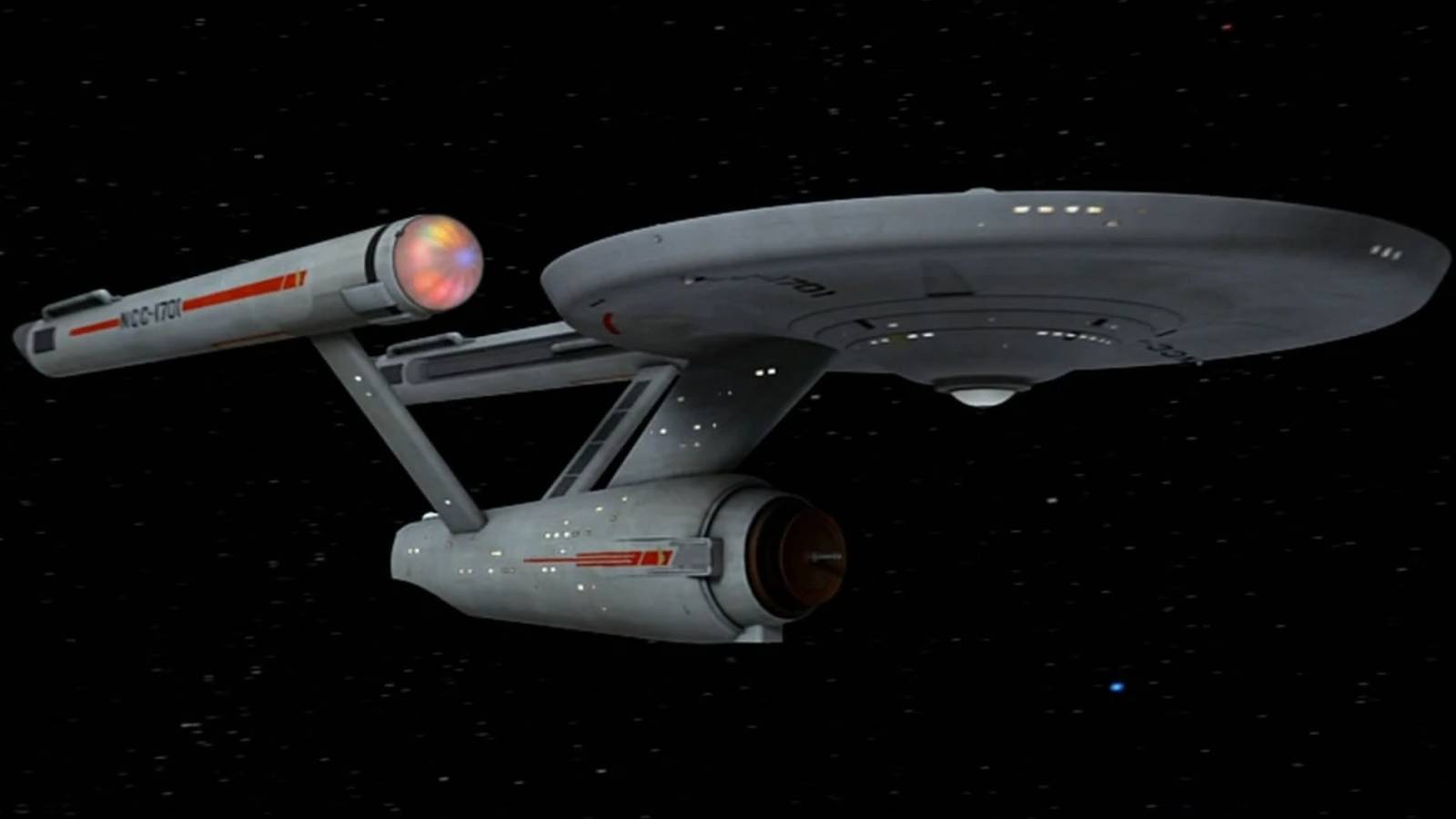
Published Nov 28, 2026, 9:45 AM EST Once head of Screen Rant's Star Wars coverage, Tom's career began as a fan of the fantasy and sci-fi genres, and his love of major franchises has ultimately led to a decade-long career. He'd had the privilege of interviewing writers, authors, directors, actors, stunt coordinators, and VFX artists on a staggering number of his favorite franchises, including Star Wars, the MCU, Stranger Things, Halo, Foundation, and more. He's conducted set visits in the UK, attending major comic cons in New York and London, and reported at Star Wars Celebration 2023 as press. You can find him on Twitter @TomABacon, on LinkedIn @tabacon, or on Muckrack under tombacon. Tom has a wide range of interests, and he continues to serve his university as a volunteer chaplain. He's heavily involved with his local church, and anyone who checks him out on Twitter will swiftly learn he's into British politics too. Sign in to your ScreenRant account Star Trek may have begun on the small screen, but the movies have had an incredible impact. The last few years have seen many franchises try to embrace transmedia, with mixed success; but Star Trek is pretty much unique, a major TV franchise that somehow reinvented itself for theaters. Gene Roddenberry's initial attempts to create a movie floundered, but executives were won over after the success of Star Wars and Close Encounters of the Third Kind. Roddenberry and his team initially recycled a lot of abandoned story ideas (and even sets). It didn't take long for the Star Trek movies to develop their own visual identity, though, and they've since gone from strength to strength. Now, in the wake of multiple mergers, Skydance is reportedly pushing the movies once again. That makes this the perfect time to look back at one of the films' greatest contributions to Star Trek lore: the ship designs, many of which have endured for decades. Here are seven of the best. 7 The Constitution Class First Appeared in Star Trek: The Motion Picture Matthew Jefferies had designed the Enterprise for the original TV series, and created a new version for the abandoned Phase II sequel. He established a strict Art Deco rule, insisting the hull should be as plain as possible; anything human-made is liable to break down, so Starfleet would be wiser to put it inside the ship so repairs were easier. But Jefferies' existing models had to be abandoned for Star Trek: The Motion Picture, which demanded a lot more detail. Richard Taylor, The Motion Picture's art director, chose to follow Jefferies' basic ideas. That said, he still adapted it a little, creating the now-famous Constitution class Enterprise; more elongated, a little more elegant, clearly inspired by Art Deco. He commissioned Andrew Probert to redesign the nacelles from the ground up, and the front end was inspired by a 1940 Ford grille. The two subtly redesigned how proton torpedoes were launched, but were careful not to make the Enterprise look too militaristic or aggressive. 6 The Sovereign Class Star Trek: First Contact The Enterprise crashed in Generations, meaning it was always clear the next movie would require a replacement. Production designer Herman Zimmerman started work before First Contact even had a title, hiring John Eaves for the job. "I wanted a sleek, very fast ship with favorite elements from the starships that had gone before," he told Star Trek Magazine in 1993. The result was what Eaves called the Porsche of Star Trek starships, and Eaves was pleased to see Voyager's team heading in the same direction. The Sovereign-class is pretty distinctive, abandoning the traditional "neck" that connects the saucer section to the ship's main body. It's designed to look smaller but more sleek, implying there's more speed; Eaves also added a control tower on top of the shuttlebay, which he figured made sense. He even took the trouble to figure out how saucer separation could happen, even though it wasn't in the scripts. ILM's Alex Jeager designed the escape pods, which were specified in the script. 5 The Klingon Bird Of Prey Star Trek III: The Search For Spock Star Trek III: The Search for Spock is noted for its remarkable visuals and phenomenal ship designs, courtesy of visual effects supervisor Ken Ralston and ILM. The Klingon Bird of Prey was the hardest ship to design, in part because ILM also had to pioneer the now-famous cloaking system as well. Optical photography supervisor Ken Smith came up with the idea of using ripple glass, creating an effect that's become seen as truly iconic. The first Klingon Bird of Prey was a carefully-constructed model, and the prototype even had movable wings. Later scale models proved a little problematic in The Voyage Home (specifically when shown flying under the Golden Gate Bridge), forcing the creative team to adapt it a little. Still, although the modern Bird of Prey is of course CGI rather than a physical model, the basic design will always be honored. For so many viewers, this is simply what a Klingon ship looks like. 4 The Kelvin Enterprise Star Trek Star Trek was reinvented with style when J.J. Abrams launched the Kelvin timeline in 2009. He reached out to ILM once again to work on the ship models, and the harder space movie required significant changes to the Enterprise (especially the bridge). Speaking to VFXWorld, ILM's Roger Guyett described this as a more "muscular" Enterprise; "We didn't want it to feel too retro, but more contemporary to our time now in terms of the design lines and the way that the lines across the whole thing worked." The original TV shows were the main reference, with the creative team working hard to match the silhouette. Designers drew on Eero Saarinen's futurist art, all angles and flat discs, and applied this to the superstructure. Interior sets were deliberately designed to evoke the sense of a brand new car, with Tiffen Black Pro-Mists giving more of a sparkle, and abundant use of reflections. Lighting was careful designed to create an Enterprise signature lens flare, making the ship even more distinctive. 3 The Excelsior Class Star Trek III: The Search For Spock The Excelsior class was originally designed for The Search for Spock, but became a mainstay thanks to The Voyage Home and The Undiscovered Country; it was then reused in the first seasons of The Next Generation, making its way to the small screen. Designers Nilo Rodis and Bill George took inspiration from the script, which described it as "a super starship. Her lines are similar to Enterprise, but she is clearly bigger, sleeker, and very new.” George took inspiration from popular Japanese designs, and director Leonard Nimoy loved the approach. New models were created for Voyager, but it didn't take long for the modern shows and movies to shift to CGI. John Eaves always loved the ship, but flashbacks for Generations called for something fresh and new, so he worked hard to create what the script called a "refit" of this iconic ship that has become just as famous as the original. 2 K't'inga Class Battle Cruiser Star Trek: The Motion Picture The Klingon Battle Cruiser had already appeared in the original series episode "Elaan of Troyius," but it was updated for Star Trek: The Motion Picture. The original version was designed by Matt Jefferies, and it was modeled on a manta ray in both shape and color. According to Jefferies, the American Model Toy Corporation then offered some adjustments. But this had to be adapted a little for the big screen, simply because the design didn't quite look right. "We attempted to stay as close to the TV series version as possible," Andrew Probert told Starlog. "But after running some camera tests we discovered that an additional level of detail was needed for widescreen photography." The result was the new K't'inga Class Battle Cruiser, painted darker (but not black, because that wouldn't have worked on the screen). Ron Gress revised the Klingon symbol, painting it on the ship's underbelly in an artistic touch. 1 USS Reliant Star Trek II: The Wrath Of Khan The USS Reliant was the Enterprise's sister ship in early drafts, but production designer Joseph Jennings worried viewers would struggle to differentiate between the starships in the dogfight. Jennings worked with Lee Cole and Mike Minor to design the first ever new Federation ship, and they worked hard to differentiate the Reliant from the Enterprise. As he explained to StarTrek.com: "She was supposed to be a coastal and geodetic survey ship, like a buoy tender. She would be armed, perhaps, but only lightly. She wasn’t a lion ship like the Enterprise. Also, remember the Enterprise was always supposed to be an exploratory vessel where the armament was secondary. That was even more true for the Reliant. She was supposed to just stick around in the known universe and take care of things that everybody already knew about." They stuck with the saucer, deciding that was the distinctive "Starfleet Navy" design. Hilariously, the first design had the nacelles over the hull; but producer Harve Bennett opened the package upside-down when it arrived in the mail, and approved the design that way instead. Yes, that's actually the reason an entire class of Star Trek starship took its shape. TV Show(s) Star Trek: The Original Series, Star Trek: The Animated Series, Star Trek: The Next Generation, Star Trek: Deep Space Nine, Star Trek: Voyager, Star Trek: Enterprise, Star Trek: Discovery, Star Trek: Short Treks, Star Trek: Picard, Star Trek Lower Decks, Star Trek: Prodigy, Star Trek: Strange New Worlds, Star Trek: Starfleet Academy Video Game(s) Star Trek Online, Star Trek: Resurgence, Star Trek: Bridge Crew First Film Star Trek: The Motion Picture First TV Show Star Trek: The Original Series Cast William Shatner, Leonard Nimoy, George Takei, Nichelle Nichols, Deforest Kelley, James Doohan, Walter Koenig, Jonathan Frakes, Patrick Stewart, Michael Dorn, Marina Sirtis, Gates McFadden, Brent Spiner, LeVar Burton, Wil Wheaton, Avery Brooks, Nana Visitor, Rene Auberjonois, Alexander Siddig, Cirroc Lofton, Armin Shimerman, Colm Meaney, Terry Farrell, Kate Mulgrew, Robert Beltran, Roxann Dawson, Jeri Ryan, Robert Duncan McNeill, Robert Picardo, Ethan Phillips, Garrett Wang, Jolene Blalock, Connor Trinneer, Dominic Keating, Scott Bakula, Linda Park, John Billingsley, Anthony Montgomery, Chris Pine, Zachary Quinto, Simon Pegg, Zoe Saldana, Karl Urban, John Cho, Chris Hemsworth, Benedict Cumberbatch, Anton Yelchin, Idris Elba, Sonequa Martin-Green, Mary Wiseman, Doug Jones, Anthony Rapp, Wilson Cruz, Oyin Oladejo, Emily Coutts, Jess Bush, Christina Chong, Anson Mount, Ethan Peck, Rebecca Romijn, Michelle Yeoh Created by Gene Roddenberry
7 Star Trek Movie Ship Designs That Are 10/10 Perfect
Full Article
Original Source
Read the full article at Screenrant →KhanList aggregates and links to publicly available news content. We do not host full articles from third-party sources. Always verify important information with original sources.