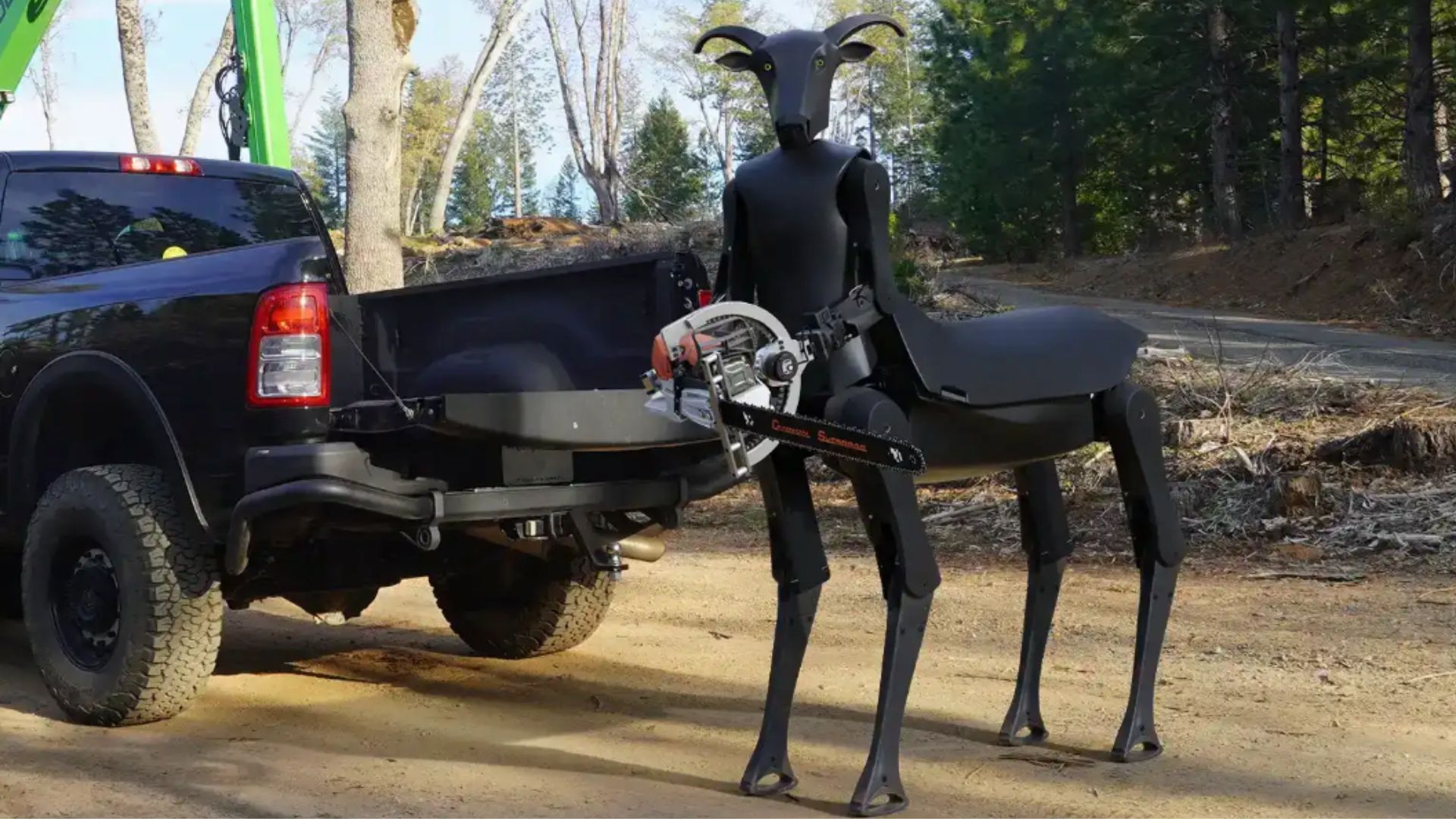
Humanoid upper body enables natural control, while a friction-braked quadruped base delivers stable, power-free standing.Satyress A nearly seven-foot-tall centaur-like robot called Threehalves has gone viral after striking images of the horned, four-legged machine spread across social media. Built by Northern California engineer Beau G. and a small team working from a garage, the steel robot is designed to perform dangerous tasks in hazardous environments to keep people out of harm’s way. The machine features a humanoid upper body, four-legged mobility, and modular arm mounts that can carry tools such as a chainsaw. Recently, Shanghai-based Run Robotics has unveiled what it calls the world’s first AI-powered centaur wheel-leg hybrid robot, combining wheeled speed with legged mobility for complex terrain. Modular centaur machine Threehalves uses a four-legged centaur configuration to improve stability on terrain where conventional robots struggle. Unlike bipedal humanoids that can lose balance during power failures or on unstable ground, the quadruped design lowers the robot’s center of gravity, allowing it to traverse rubble, steep slopes, soft ash, and other uneven surfaces. Each joint incorporates passive friction that holds its position without consuming power when stationary. The pneumatic actuation system also includes fail-safe mechanisms: if air pressure is lost, automatic brakes engage, and pin locks secure the limbs to prevent collapse. Exposed air reservoirs on the chest double as an emergency shutdown point, enabling anyone nearby to turn off the robot without remote commands or access codes. The robot features a humanoid upper body designed for intuitive teleoperation, allowing operators to control its movements using a standard game controller or joystick from a safe distance, even when the robot is out of sight. Cameras integrated into the horn assembly provide multiple viewpoints, including feeds from the arms, tools, and legs, while also serving as backup vision if joint sensors fail. Instead of dexterous hands, Threehalves uses quick-connect tool interfaces that supply 12-volt, 18-volt, or 48-volt electrical power along with pressurized air directly to attached equipment. This modular system enables rapid tool changes in minutes, allowing the robot to switch between chainsaws, drills, impact guns, and industrial screwdrivers. Its arms and tool assemblies are built from three interchangeable sections, allowing damaged components to be replaced quickly in the field without requiring specialized repair facilities. has not announced pricing, availability, or whether Threehalves will meet regulatory requirements for widespread emergency service deployment. AI hybrid centaur Chinese firm Run Robotics recently unveiled what it describes as the world’s first AI-powered “centaur” wheel-leg hybrid robot, combining a four-wheel all-terrain chassis with a humanoid upper body for high-speed mobility and complex manipulation tasks. Unveiled at WAIC 2026 in Shanghai, the robot is designed to operate in challenging environments where conventional mobile or humanoid robots face limitations. Its wheeled lower body enables rapid travel across uneven terrain and hazardous sites. In contrast, the upper body, equipped with robotic arms, performs tasks such as operating equipment, clearing obstacles and assisting rescue teams. The modular platform can be configured with dual robotic arms, dexterous hands and multidimensional force sensors to suit different industrial applications. The robot integrates a self-developed perception system combining LiDAR, binocular vision and depth cameras. According to the company, the sensor suite can detect pipelines, valves, gauges, obstacles and people, assess their status, autonomously plan routes, avoid obstacles and accurately position itself for operational tasks, creating a closed perception-to-decision loop. Run Robotics said the platform is engineered to meet explosion-proof standards while remaining lightweight and reliable. It can carry a typical payload of 220–265 pounds (100–120 kg) and support a maximum static load of 463 pounds (210 kg). The company added that more than 95 percent of the robot’s core components are domestically produced and that an automated production line is scheduled to begin operations in the fourth quarter of 2026. Recommended ArticlesGet the latest in engineering, tech, space & science - delivered daily to your inbox.Jijo is an automotive and business journalist based in India. Armed with a BA in History (Honors) from St. Stephen's College, Delhi University, and a PG diploma in Journalism from the Indian Institute of Mass Communication, Delhi, he has worked for news agencies, national newspapers, and automotive magazines. In his spare time, he likes to go off-roading, engage in political discourse, travel, and teach languages.
7-foot centaur robot with chainsaw arms built for dangerous rescue missions
Full Article
Original Source
Read the full article at Interestingengineering →KhanList aggregates and links to publicly available news content. We do not host full articles from third-party sources. Always verify important information with original sources.