
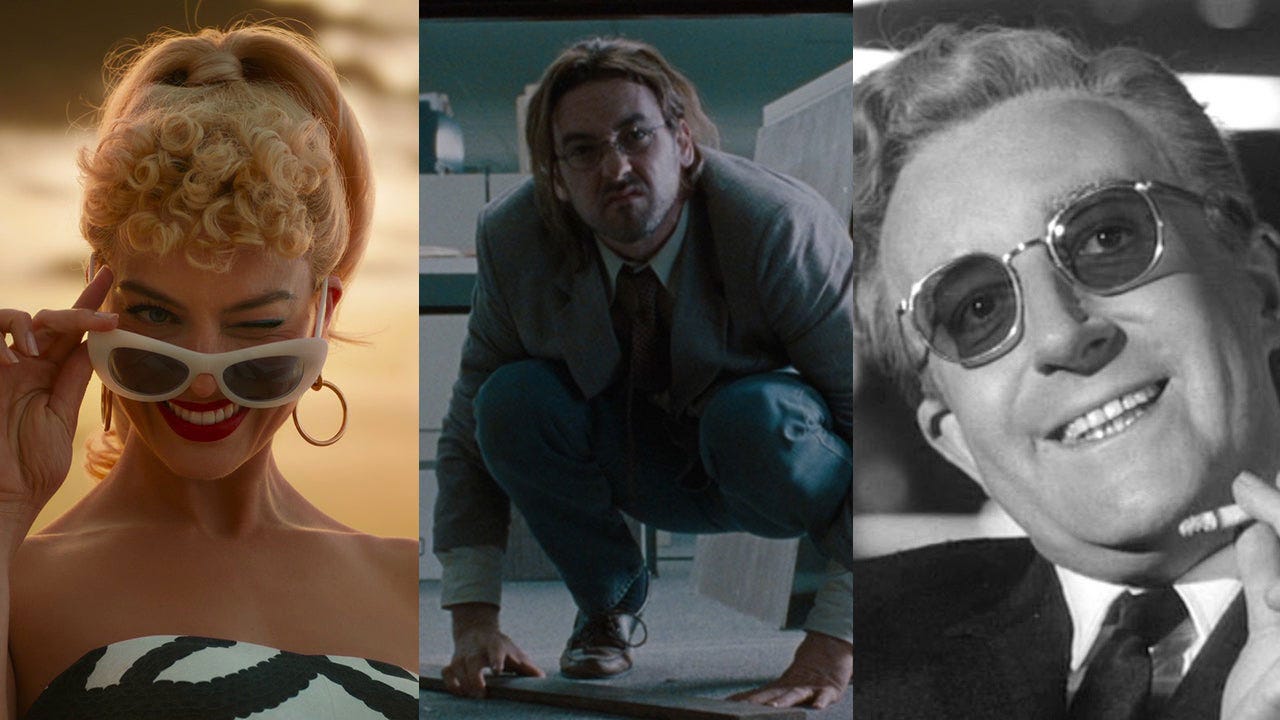
“A young man is swallowed by a whale while searching for his father’s remains deep in the ocean.”That is the elevator pitch for Whalefall, starring Austin Abrams (Resident Evil) and co-written by Daniel Kraus and director Brian Duffield (No One Will Save You). Set for release on October 16, the film is based on Kraus’ 2023 novel, inspired by a viral video of kayakers seemingly being swallowed by a whale. Whalefall’s central conceit is one writers and directors are challenged by, and often dream of, because it raises the questions: Can I pull this off? And how can I make this work? In other words, the absolutely bonkers premise is fertile ground for real creative risk and opportunity.Of course, Whalefall isn’t the first or only film to take a big leap. Throughout cinema history, bold filmmakers have swung for the fences and connected. Too many for just one list, in fact. Children of Men, Groundhog Day, Parasite, The Truman Show, Tie Me Up! Tie Me Down!, Spirited Away, The City of Lost Children, The Stepford Wives, Inside Out, Poor Things, Everything Everywhere All at Once, and many more could easily have made this list. The following is a small sample of films that successfully stepped out of standard storytelling boxes. Dr. Strangelove or: How I Learned to Stop Worrying and Love the Bomb (1964)“Gentlemen, you can’t fight in here! This is the War Room!”Positive that communists are poisoning the “precious bodily fluids” of the American populace, General Jack D. Ripper launches an unauthorized nuclear attack on the U.S.S.R., triggering an increasingly farcical crisis which culminates in a dunce's doomsday, an apocalypse driven by insane idiots and a Nazi.One of cinema’s great political satires, Dr. Strangelove opened in 1964, about a year and a half after the Cuban Missile Crisis, when the world held its breath, wondering if we really were going to self-destruct. Stripping away the reasoned tones that politicians of the day used to discuss nightmare scenarios, Dr. Strangelove captures the powerless fear of a populace, and exposes geopolitics for what it so often is: utterly unhinged and stupid (possibly drunk), and treating mass casualty as if it is a child’s game to win or lose. The film cost $1.8 million to make and earned more than $9 million at the domestic box office. Though it was shut out at the Academy Awards with four nominations and zero wins, it earned several nominations and four wins at the BAFTAs, including Best British Film and Best Film from Any Source. Upon release, reviewers were polarized: some found genius in the dark comedy, while others were disturbed by its treatment of the very real threat of nuclear war. Over time, it has become director Stanley Kubrick’s highest-rated film on Rotten Tomatoes, at 98%, and was deemed so influential that the National Film Registry selected it as one of its first 25 films in 1989. Director Michael Mann went so far as to say he wasn’t really interested in movies until he saw Dr. Strangelove. It remains a standard-bearer for satire. It captures essential truth, if not (necessarily) objective reality. As for reality, military officials criticized the film upon release, yet, coincidentally or not, made internal changes that mapped to the vulnerabilities Dr. Strangelove exposed. Who Framed Roger Rabbit (1988)In a world where sentient cartoons live alongside humans, Eddie Valiant – an alcoholic private detective with a vendetta against toons – is hired to investigate a sultry cartoon femme fatale, Jessica Rabbit, who may be cuckolding her stuttering rabbit husband, Roger. When her alleged lover is found dead, Valiant is forced to protect the unruly rabbit and drawn into a sinister toon conspiracy. Roger Rabbit was a hit with audiences and critics alike right out of the gate, and stands at 96% on Rotten Tomatoes. Praised for its visionary storytelling, which mixes zany cartoon comedy with classic noir tropes, and for its revolutionary technical achievement, the film left viewers spellbound. Though live action and animation had been integrated before, audiences had never seen anything quite like Roger Rabbit. Bob Hoskins’ emotional performance as the detective on a redemption arc was lauded, particularly in that he was acting, essentially, with empty space for much of the film. Kathleen Turner’s rich voice cemented Jessica Rabbit as an iconic animated character. Made for $50 million ($70 million by some estimates), the film earned just over $350 million worldwide. It had six Academy Award nominations and three wins (plus a Special Achievement Academy Award for animation direction) and was added to the National Film Registry in 2016. Thanks to executive producer Steven Spielberg’s negotiations, it wowed audiences by bringing together animated characters from both Warner Bros. and Disney. Along with The Little Mermaid, it also helped usher in the Disney Animation renaissance. Similar releases followed, including 1992’s Cool World, starring Brad Pitt as a human detective and Kim Basinger as a cartoon femme fatale named Holli Would, and 1996’s Space Jam, which teamed Michael Jordan with the Looney Tunes. Arguably, the film that’s come closest to capturing Roger Rabbit’s appeal is the recent Coyote vs. Acme, but, for many, nothing truly touches the 1988 classic. According to director Robert Zemeckis, Stanley Kubrick deeply appreciated the film and, while watching it, searched for the hidden “sleight of hand” movie magic that made it all come together, before ultimately realizing it was “just an incredible amount of backbreaking work” that made Roger Rabbit possible. It’s a Wonderful Life (1946)A suicidal man embittered by career sacrifices and disappointments, and facing ruin and jail, meets with a fledgling angel (eager to advance in his own vocation) on Christmas Eve. In order for the latter to win the promotion he wants (get his wings), he must convince the former that there’s more to life than work and material success, and that his impact on the world has been sizable and good, despite all evidence to the contrary.Perhaps that’s a hyperbolic synopsis, but the fact is, while director Frank Capra’s holiday favorite may be considered a sentimental classic today, audiences at the time of its release seemingly weren’t ready for this unorthodox take on Christmas cheer. Though it received mixed to somewhat positive reviews (particularly praising Jimmy Stewart’s lead performance) and ultimately earned five Oscar nominations, it won no Academy Awards beyond a Technical Achievement Award and was a box-office flop. RKO, the studio that released the film, reported a $525,000 loss. But It’s a Wonderful Life did nearly gain notoriety – via controversy, when the FBI flagged it to the House Un-American Activities Committee (which was investigating potential Communist influences in Hollywood), noting anti-capitalist undertones (as the film’s banker was the most hated character). Alas, it couldn’t even get negative PR, as the committee decided not to bring the creators in to testify. The film was largely overlooked in the decades that followed. Capra himself was taken aback, if pleasantly so, when it finally found its audience. The full story is more complex, but, effectively, a clerical fluke meant the film’s copyright lapsed in 1974, making it cheap to run on television during the holidays, which it did for many years. The copyright situation was eventually resolved through the rights in the underlying story and music. By then, it had become a beloved standard. Distance gave viewers space to see what was always there. Audiences and critics alike recognized the special magic in the strange mix of sentimentality, whimsy, very real and deeply painful human despair, and the essential truth that we all desire to know, truly know, that our lives matter. In a 1999 essay, film critic Roger Ebert said this film belonged to a category that could withstand indefinite viewings: “Like great music, they improve with familiarity.” Years after it opened and flopped, It’s a Wonderful Life became a holiday television staple, drawing millions of viewers for its Christmas Eve broadcasts, and now holds a 94% rating on Rotten Tomatoes.Being John Malkovich (1999)While working a bland office job, struggling street puppeteer Craig Schwartz stumbles upon a portal to actor John Malkovich’s mind, where he can experience the celebrity’s life for exactly 15 minutes before being spat back out onto the New Jersey Turnpike. He and the co-worker he’s in love with start a business charging $200 per person for a visit into the actor’s experience. Eventually, multiple characters battle to permanently take over Malkovich’s life, creating a series of betrayals, identity crises, opportunities found and then lost, and the annihilation of the self. Charlie Kaufman’s surreal screenplay is arguably one of the biggest swings on this list. Malkovich himself initially worried it would bomb, and the script circulated Hollywood with no takers. One exec reportedly asked, “Why the f— can’t it be Being Tom Cruise?” However, director Francis Ford Coppola got the script to his daughter’s then-boyfriend, Spike Jonze, who directed it and helped get it produced. The movie opened to great acclaim, presumably stunning skeptical industry players. It has a 94% on Rotten Tomatoes, with Roger Ebert calling it “endlessly inventive,” adding that “[it] has ideas enough for half a dozen films.” Critics celebrated its inventiveness, layered themes, and ensemble performances from John Cusack, Cameron Diaz, Catherine Keener, and, of course, John Malkovich. It cost $13 million to produce and went on to earn either $23 million or $32 million globally (depending on the source). It didn’t win any of its three Oscar nominations, but it won Best First Feature and Best First Screenplay at the Independent Spirit Awards. It appears on multiple “best of” lists, including Empire magazine’s 500 Greatest Movies of All Time and the Writers Guild of America’s 101 Greatest Screenplays Ever Written. Like Kaufman’s other films (two of which, Adaptation and Eternal Sunshine of the Spotless Mind, nearly made this list), Being John Malkovich demonstrates what is possible when you follow even the most nonsensical threads of imagination.The Raid: Redemption (2011)A SWAT team, trapped in a hostile high-rise, must battle its way up the stairs to capture a crime lord; end of story. The Raid is unique on this list in that the plot isn’t a fit of wild imagination; rather, it has almost no plot at all. It has a premise and wall-to-wall unparalleled fight sequences. It grips the viewer and doesn’t let go for the entire runtime, leaving audiences breathless and feeling like they, too, just punched their way to victory. It’s exhilarating, near-perfect action that other films have chased for 15 years.The Indonesian actioner cost $1.1 million to make, according to director Gareth Evans, and earned over $9 million worldwide at the box office, plus another $10 million in U.S. DVD and Blu-ray sales alone. No traditional narrative necessary. It stands at 87% on Rotten Tomatoes and performed well during its film festival run – Evans said he was “blown away” by the reception at the Toronto International Film Festival. The movie became an industry reference point, with John Wick director Chad Stahelski telling Den of Geek that directors unfamiliar with fight choreography would specifically ask for something like The Raid, among other iconic action films. Yayan Ruhian and Cecep Arif Rahman, two actors from The Raid franchise, were ultimately cast as two of Keanu Reeves’ adversaries in John Wick: Chapter 3 – Parabellum. The film is a beloved fan favorite and cultural touchstone for best-in-class hand-to-hand action.Get Out (2017)On a trip to visit his girlfriend’s parents, a talented photographer makes a horrific discovery: a group of Obama-voting white suburbanites has found a way to use misophonia-inducing teaspoons, hypnosis, and surgery to transplant the consciousness of wealthy, older white people into young, Black kidnappees, whose own psyches are sent into a purgatorial “sunken place.”Director Jordan Peele’s groundbreaking debut became an instant cultural phenomenon, blending social commentary with genuinely entertaining horror. The director builds real suspense, psychological terror, and tension-releasing humor into a film that lays systemic racism bare through a deeply imaginative metaphor. It has a 98% on Rotten Tomatoes, and Peele made Academy Awards history as the first Black writer to win an Oscar for Best Original Screenplay. Get Out was also nominated for Best Picture, Best Director, and Best Actor (Daniel Kaluuya). In late 2021, the WGA named the script the #1 Greatest Screenplay of the 21st Century (So Far). Financially, Get Out was a juggernaut, making $255 million worldwide on a $4.5 million budget, and breaking The Blair Witch Project’s domestic record as the highest-grossing debut film based on an original screenplay.Director Christopher Nolan had this to say of Get Out: “How often do you get the experience of seeing something that you have no idea where it's going to go, and then it goes somewhere far more interesting than you ever imagined?"Barbie (2023)Faced with an unexpected existential crisis, Barbie must travel from the utopia of Barbieland into the “real” world to find and soothe the unhappy person playing with her so that she can once again experience the sweet oblivion of not thinking about death, or life, or meaning… and bask in thighs free of cellulite. Ken tags along and, upon discovering patriarchy, starts an uprising when he returns to Barbieland. The overall sentiment when Barbie debuted was that this movie absolutely should not work. Yet it surprised and delighted audiences with its mix of subversive humor (that both acknowledges and reframes Barbie’s cultural impact), standout performances from producer and star Margot Robbie and Ryan Gosling (as Barbie and Ken), and an optimistic core. It inspired multiple viewings for many audience members, some of whom came to theaters decked out in celebratory pink. Doctor Strange director Scott Derrickson said the film was one of his two favorites that year, and an example of IP “treated with true brilliance,” calling it an “extraordinary movie on every level.”Set against Oppenheimer in the summer’s race for dominance, affectionately known as Barbenheimer, the film catapulted to box office success. It was a risk for both Mattel and Warner Bros., who distributed it. They trusted co-writer and largely indie director Greta Gerwig, who’d never helmed a film this big, with an iconic but controversial doll and a $128 million budget. The bet paid off: Barbie earned a staggering $1.4 billion worldwide at the box office, holds an 88% on Rotten Tomatoes, and received eight Oscar nominations, winning Best Original Song for “What Was I Made For?” and taking home the first-ever Golden Globe for Cinematic and Box Office Achievement. Ultimately, the film’s pathos stayed with viewers. Barbie is the picture of stagnant perfection, so who better to take a messy journey where triumph lies in living the most mundane moments of a human life?What are your favorite crazy movie premises that somehow worked? Let’s discuss in the comments!
7 Crazy Movie Premises That Actually Worked
Full Article
Original Source
Read the full article at Ign →KhanList aggregates and links to publicly available news content. We do not host full articles from third-party sources. Always verify important information with original sources.