
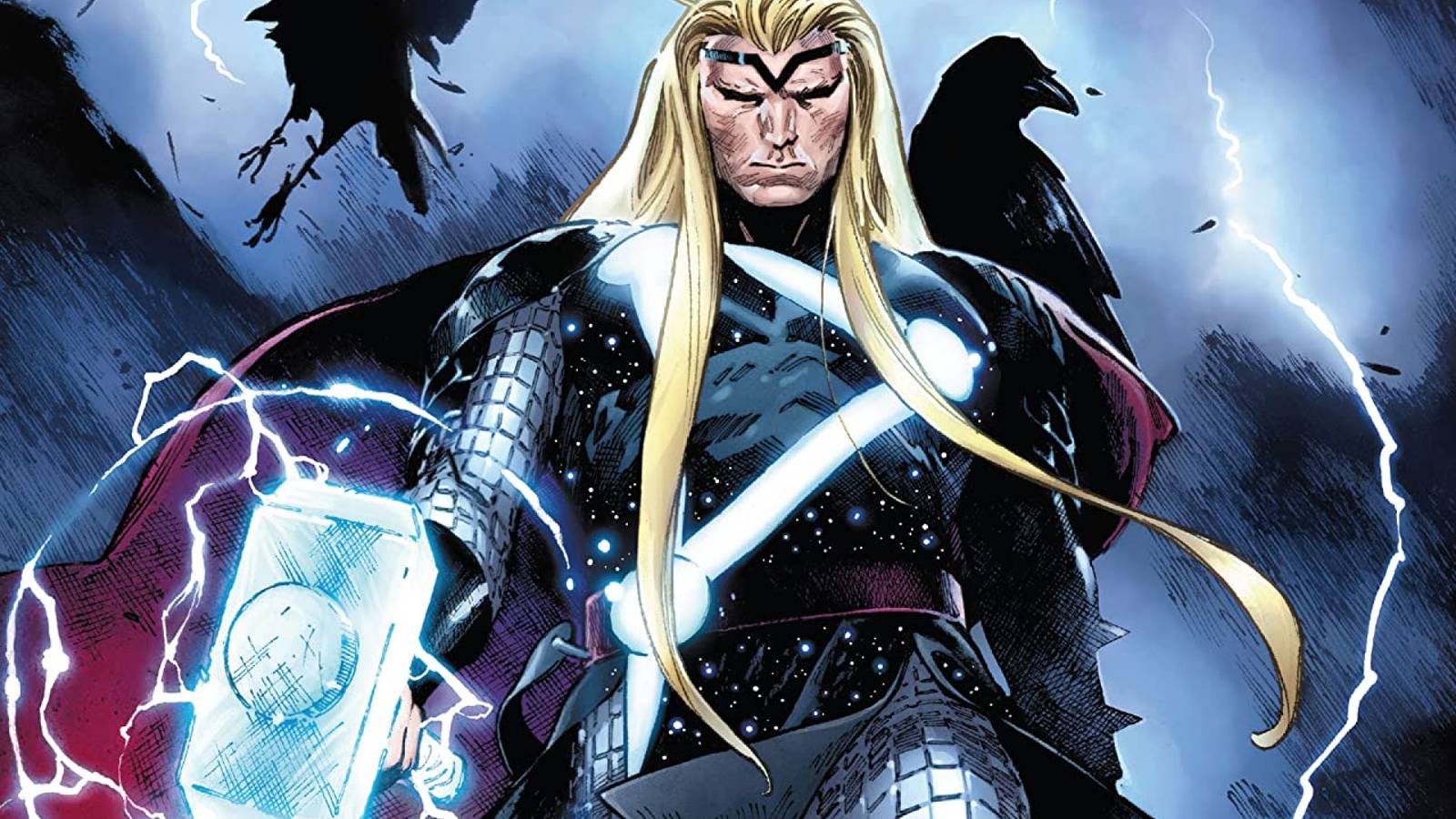
Thor has never been short on rich lore in Marvel Comics, and writers such as Jason Aaron, Al Ewing, and Donny Cates have pushed him to his most powerful heights. The latest Avengers: Doomsday trailer hints at a version of Thor that comic readers know well: a god wielding the Odinforce. The Odinforce is the near-limitless cosmic energy of Asgard's All-Father, often traced to the life forces of Odin's fallen brothers. When channeled, it amplifies its wielder's might much like the Power Cosmic elevates Galactus' Heralds and turns Thor into a cosmic-level force. That price to pay for such power is the deep recharging sleep known as Odinsleep. 7 King Thor Jason Aaron's 2019 four-issue series, King Thor, closes his seven-year Thor run with one of the most apocalyptic showdowns in the character's history. And on a cosmic scale, too. Set near the end of time in a dying universe, it sees All-Father Thor battle an aged Loki armed with All-Black the Necrosword. Their battlefield spans galaxies, during which Gorr the God Butcher awakens from within All-Black the Necrosword after it maims Loki. Fused with the dying universe's fabric, Gorr impales Old King Thor. Even after Thor's granddaughters and a band of awakened gods behead him, Gorr spreads the All-Black through all creation, turning the cosmos into his "All-Black Necroverse." Thor refuses to yield, channeling the Odinforce into the divine lightning known as the God Tempest. At the end of this battle, Gorr is destroyed, as are celestial bodies torn apart. Thor himself is also a casualty, using the last of his strength to restore life and balance to the cosmos. 6 Thor: The Reigning After Sutur’s invasion and Odin’s death, Thor inherits the Odinforce and relocates Asgard over New York. The US and global governments vehemently protest on grounds of airspace violation, national security, and sovereignty, especially after Thor meddles in foreign conflicts. Doctor Doom seizes this opportunity to manipulate global militaries into pre-emptively striking Asgard. Thor’s ally Tarene dies in the process. This clash, thus, kicks off the events of Thor: The Reigning. The dozen-issue arc, penned by Dan Jurgens alongside artist Scot Eaton and between late 2003 and mid-2004, sees Thor use the Odinforce to rain down vengeance on humanity, subduing the world's armies and neutralising nuclear arsenals. Taking the title "Lord of Earth," he rules the planet with an iron fist for nearly two centuries, an era known as "the Reigning." His fight with the Avengers and future resistance heroes reveals what an unhinged Odinforce-powered Thor can do. He shatters Captain America’s shield, melts Wolverine’s Adamantium, easily defeats the Hulk, and at some point freezes time. 5 Thor Disassembled: Ragnarok The aftermath of Thor: The Reigning spills over into Michael Avon Oeming and Andrea DiVito’s six-issue Thor Disassembled: Ragnarok (Thor Vol. 2 #80-85). Surtur attacks Asgard again, this time backed by a Loki armed with a Mjolnir-like Uru hammer forged in Nidavellir. During the onslaught, the original Mjolnir is shattered, as are Thor’s allies. Learning the dark truth behind Ragnarok and realizing conventional warfare is futile, Thor sacrifices himself to unlock the ancient Rune magic: he tears out both eyes and hangs himself from the World Tree, Yggdrasil, to die and be reborn. His resulting mastery over the runes, combined with Odinforce, turns the tide of the war in his favor. It also gives birth to Rune King Thor, the most powerful Marvel canon Thor, who ruthlessly beheads Loki (while keeping him alive) and defeats his forces. He also stops the cycle of Ragnarok for good. Understanding “Rune King Thor” is significant heading into Avengers: Doomsday since the Doctor Doom threat may push Thor into self-sacrifice to unlock ancient mystical knowledge. This wouldn’t be the first time the God of Thunder has shown willingness to put his life on the line to obtain a weapon or powerup. In Avengers: Infinity War, he endured the full force of a dying neutron star to forge Stormbreaker, nearly dying in the process. 4 Thor: The Devourer King Thor: The Devourer King tells readers, and the newly crowned Thor himself, that heavy is the head that wears the crown. After the War of the Realms, Thor learns that the weight of leadership means carrying the cost of every choice made. Mjolnir is getting heavier too, subtly hinting at his waning worthiness as his rule increasingly mirrors Odin’s. As king, Thor is forced into morally fraught decisions, such as allying himself with Galactus and helping him eat evacuated planets if both are to stand any chance of defeating the deadly multiversal plague called The Black Herald. As Thor Galactus’ latest Herald, Thor gains the Power Cosmic, in addition to the Odinforce (dubbed “Thorforce”). With this combination, Thor climbs into an absurd new power tier. He breaks Beta Ray Bill and his hammer Stormbreaker, kills ally-turned-foe Galactus, then destroys the Black Winter itself. 3 The Immortal Thor In classic Al Ewing fashion, Thor in The Immortal Thor is wiser and more formidable than ever, having mastered Mjolnir and the Odinforce; the latter is amplified by absorbed Zeus’ Olympian lightning. Stepping fully into his role as a sage-like All-Father, he uses this immense cosmic power to mend broken universal laws and battle the Elder Gods of Utgard. Aside from the Elder Gods, he also amasses foes (new and returning), most notably Roxxon CEO Dario Agger using corporate magic and the primordial storm god Toranoss. Thanks to Ewing elevating Thor to one of the highest power levels in Marvel Comics, Thor pulls off staggering feats: stripping Zeus of his divine power, shattering the cosmic Wheel of Fate. He only manages to fall at the hands of Loki. And that’s because the God of Mischief was wielding the immensely powerful Eternity Mask! 2 The Last Days of Midgard The Last Days of Midgard plays out across two parallel timelines and seven issues in Thor: The God of Thunder (from issues #19-25). In splitting the story across two eras, Jason Aaron and Esad Ribić ask both Thor and readers what it costs to protect a world. The world in question is Earth ("Midgard" in Asgardian terms). In the present-day timeline, shady corporation Roxxon and its Minotaur CEO, Dario Agger, are poisoning the planet for profit with unchecked pollution. When Thor and S.H.I.E.L.D. agent Roz Solomon move to shut Roxxon down, Agger calls the former's bluff by leaving Broxton, Oklahoma, in ruins. Thor humbles himself by begging Agger publicly to spare the city. In a future timeline, King Thor finds the Thor Force alone insufficient against Galactus, as both wage war across a barren Earth. What proves insufficient, however, is All-Black the Necrosword, which Thor retrieves from the black hole that had hitherto been containing it. After victory, Thor bleeds into the ground, using his blood to give life to Earth. 1 The God Butcher Where The Last Days of Midgard tells its story across two timelines, The God Butcher uses three: 893 AD, the present day, and the distant future. Two common threads run through all three timelines. The first is Gorr the God Butcher and his philosophy of the gods failing to protect the people who pray to them. In each era, Thor is set against him as the god who answers prayers, by responding to a forgotten planet's prayers and defending Asgard without expectations of "thank you"s. The second thread is Thor's growth. The timelines are actually the life cycle of Thor: he matures from a brash young warrior to a more thoughtful present-day hero, and finally to a wise, one-armed old king, the last man standing in Asgard's defence.
7 Best Odinforce & King Thor Comic Stories To Read Before Avengers: Doomsday
Full Article
Original Source
Read the full article at Screenrant →KhanList aggregates and links to publicly available news content. We do not host full articles from third-party sources. Always verify important information with original sources.