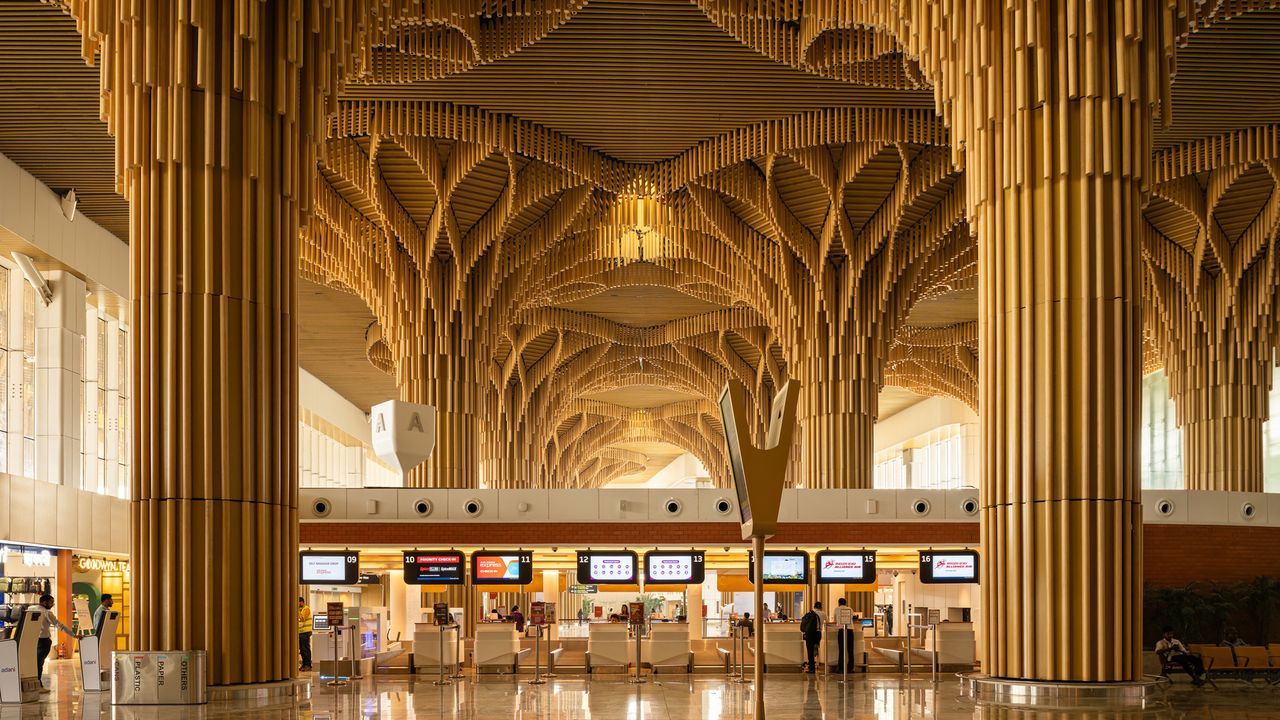
A bamboo-inspired sky forest in northeast India, a giant lotus flower seemingly floating above Mumbai, a Cambodian canopy of towering trees—these are just some of the architectural features found inside the world's most beautiful airports.Seven airports and terminals were selected for the 2026 Prix Versailles World’s Most Beautiful Airports List, unveiled in Paris on Monday, June 15. The annual architecture awards—which recognize outstanding contemporary design around the world—chose terminals in China, Germany, India, Cambodia, and the United States. According to the organization, the winners demonstrate how airports are evolving into destinations in their own right.The list spans from Guangzhou’s flower-inspired Terminal 3 and Frankfurt’s vast city-sized expansion to Pittsburgh’s mountain-shaped roofline and San Diego’s glass-wrapped waterfront gateway. Three of the seven projects will go on to receive additional world titles for architecture interior or exterior design later this year, per Prix Versailles.According to the judges, the selected airports are modern terminals that efficiently balance the demands of fast, high-volume travel while also reflecting a meaningful sense of place—rather than functioning solely as transit infrastructure. Jérôme Gouadain, Secretary General of the Prix Versailles, said contemporary airports had become “innovative, inescapable hallmarks of their regions and their eras.”He added: "They are innovative, because they resolve the apparent conflict between the increasing frequency of travel and the need for speed—both central to an airport’s purpose—on the one hand and, on the other, the singularity of a form of tourism that aims to be accessible and that values people’s time in places that, in this day and age, can no longer be described as mere ‘transfer’ spaces."And they are inescapable, in that this infrastructure leaves a lasting environmental footprint on the land but also on the history of humanity: in the amalgamation of architecture that they display, airports are becoming attractive settings, emblems of economic, cultural, and social dynamics that will continue to shape the societies of tomorrow, draw them together and unify them.”But don't just take their word for it—see for yourself. Below, the world's most beautiful airports for 2026.Prix VersaillesGuangzhou Baiyun International Airport, Terminal 3Guangzhou is known as China’s City of Flowers, and its new Terminal 3 combines clouds, water, and blossoms into a sequence of curves, terraces, gardens, and light-filled atriums set in one of the world's largest transport buildings. Designed by Artelia in collaboration with the Guangdong Architectural Design and Research Institute, the terminal draws heavily on Lingnan culture, the southern Chinese tradition shaped by Guangzhou’s subtropical climate and long history as a trading port. The building’s organic forms help steer passengers through the terminal, while gardens and open spaces break up its monumental scale. Its most dramatic outdoor feature is said to be the highest open-air public observation deck at any Chinese airport, giving travelers a rare chance to step outside and watch aircraft moving across the runways below.Prix VersaillesFrankfurt Airport, Terminal 3Architect Christoph Mäckler arranged Frankfurt's new terminal around spaces resembling streets, plazas and neighbouhood squares, giving passengers familiar points of orientation within one of Europe’s largest infrastructure projects. The most conspicuous pieces of public art hang overhead: three vast rings made from colored aluminum discs, continuously rotating and changing appearance as passengers move beneath them. Much of the terminal was also designed to be modular, allowing spaces to evolve as passenger numbers, technology, and aviation habits change.Prix VersaillesLokapriya Gopinath Bardoloi International Airport, Terminal 2Guwahati’s new terminal takes its cues from the bamboo orchid, a delicate pink flower found across parts of northeast India, but its most memorable feature may be the great indoor landscape beneath its roof. Sweeping vaulted ceilings rise above a bamboo-inspired ‘sky forest’, with curving forms and branching structures intended to evoke the region’s dense vegetation. Patterns overhead trace the movement of the Brahmaputra River and its tributaries, guiding passengers through the building as if following waterways across a map. Architect Nuru Karim also incorporate Indigenous art, tribal stories, and local craft traditions throughout the interior, turning lounges and waiting areas into informal galleries.Prix VersaillesNavi Mumbai International Airport, Terminal 1At Navi Mumbai, the terminal’s immense canopy has been conceived as a lotus flower opening with the morning light, its petals appearing to float above the building before sweeping down into broad overhangs and sculptural columns. Designed by Zaha Hadid Architects, Terminal 1 opened in 2025 following an extraordinary feat of engineering that involved redirecting rivers, moving high-voltage power lines, reshaping hills, and reclaiming marshland from the sea. The lotus motif continues inside, where geometric entrance portals extend into the ceiling and resolve into fluted, flower-like columns. Interactive digital artworks appear at key points throughout the building, adding movement and colour to the transition spaces.Prix VersaillesTecho International AirportDesigned by Foster + Partners, Techo international Airport's vast undulating canopy rises towards the centre of the terminal like the roofline of a Cambodian palace or temple. Inside, ceilings inspired by traditional basketry create the illusion of bamboo and rattan stretched across the building, filtering daylight while reducing the need for artificial lighting and mechanical ventilation. Giant structural columns branch beneath the roof like trees, while native rumduol trees—Cambodia’s national flower—grow through the soaring central space. Greenery follows travelers from check-in towards the gates, in a building that has been designed with a deliberately simple layout, with short walking distances and clear sight lines from the drop-off area to the boarding gates.Prix VersaillesPittsburgh International AirportPittsburgh’s new airport roof rolls and folds like the Allegheny Mountains beyond the city. Beneath it, 38 steel columns split into branching forms, creating a man-made forest across the terminal. Designed by Gensler and HDR in association with Luis Vidal + Architects, the building draws on western Pennsylvania’s wooded landscape while attempting to shorten the often exhausting distances associated with large American airports. Glass walls pour daylight into the terminal, while four outdoor terraces will eventually allow passengers to step outside for fresh air. Local artwork appears throughout, including a new “Petal Tunnel” inspired by the Fort Pitt Tunnel, where drivers emerge from darkness into a sudden, cinematic view of Pittsburgh’s skyline.Prix VersaillesSan Diego International Airport, Terminal 1At San Diego, the defining architectural gesture is a 800-foot-long wall of curved glass that stretches across Terminal 1, bringing the city’s famously generous sunlight inside without turning the departure hall into a greenhouse. Developed by Gensler with artist and architect James Carpenter, the facade filters glare and heat while creating a bright interior intended to recall San Diego’s waterfront promenades and gardens. An innovative structural system allowed designers to remove many of the columns that would ordinarily clutter an airport ticketing hall, opening up the space and helping reduce the building’s carbon footprint by 30%. The project has also transformed the roads, car parks and public-transport connections surrounding the airport, which is the busiest single-runway airport in the United States.This article was originally published on Condé Nast Traveller Middle East.
7 Airports That Are So Beautiful, They're Destinations Themselves
Full Article
📰 Original Source
Read full article at Cntraveler →KhanList aggregates and links to publicly available news content. We do not host full articles from third-party sources. Always verify important information with original sources.