
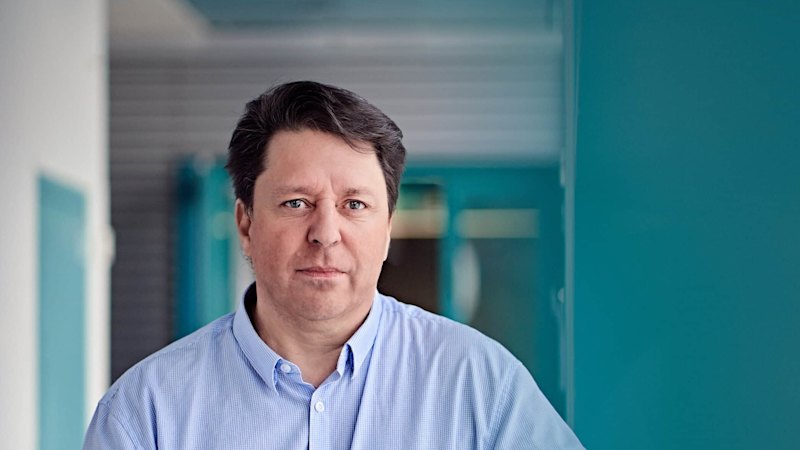
November 8, 2026 — 10:06amOulu, Finland: 5G was sold as the network for cloud gaming and driverless cars. More than half the phones in Australian pockets are now on 5G plans, and most of their users use them to stream the footy and send photos of the kids, much as they did on 4G.Now the industry is preparing to sell the next generation, with the first 6G phones due around 2030.Matti Latva-aho, founder of the world’s first 6G research program.Today’s technology has arguably failed to live up to expectations, both for consumers who were promised the future and for telcos banking on lucrative new revenue streams.The founder of the world’s first 6G research programme, at the University of Oulu in northern Finland, has a one-line verdict on what 5G delivered: “For consumers, data transfer speeds are somewhat faster than in 4G, but that’s kind of it,” Matti Latva-aho says.At the same university, radio engineering professor Marko Leinonen showed us an early 5G radio head built for 28-gigahertz spectrum. It was made for millimetre-wave 5G, the ultra-fast but short-range version that carriers in the US, South Korea and Japan rolled out first.‘Not gold mines’The signal barely travelled, so it needed far more towers than carriers built, and customers never trusted the coverage. “Those were not gold mines,” Leinonen says.Australia bought into the same idea. Carriers paid for similar spectrum at auction in 2021. The Australian Communications and Media Authority, which ran the sale, now finds rollout of those networks has been more limited and gradual than expected, here and overseas.Long before anyone can buy a 6G phone, the battle lines are already being drawn. The ACMA and the federal government must decide how much spectrum carriers can receive, what it will cost them and whether regional Australia is outsourced to offshore satellites.As consumer group Australian Communications Action Network (ACAN) notes, these decisions will shape Australian connectivity well into the 2040s.The carriers say they have learned from the 5G experience. “The biggest lesson from 5G is that customers don’t adopt a new technology because the industry gives it a new number,” said Optus chief technology officer Sri Amirthalingam. “They adopt it when it makes something they care about materially better.”University of Oulu radio engineering professor Marko Leinonen.Giovanni Chiarelli, his counterpart at TPG Telecom, which runs Vodafone, recalls that “there was a lot of science fiction around 5G”. TPG treated it instead as a way to make its network faster and less congested, which is where most customers felt the difference, he said.5G received swathes of investment – and hype – but without the revenue growth to match.Each new network generation has let carriers carry far more traffic without earning them much more from customers, according to independent telecommunications analyst Paul Budde. Telsyte senior analyst Alvin Lee said most people were already happy with 4G.For consumers, the advice is simple. Budde said there was no reason to delay buying a 5G phone.‘Customers don’t adopt a new technology because the industry gives it a new number.’Sri Amirthalingam, OptusACCAN chief executive Carol Bennett concurs. “Any device spruiked as ‘6G-ready’ any time soon is just marketing spin,” she says. 6G will run on new frequencies just above those used by home Wi-Fi, and is designed with artificial intelligence built in.Instead of reacting to congestion, the 6G network is meant to see it coming and reroute traffic before users notice, handing phones over to satellites where the towers run out.The main benefit carriers point to is capacity: a network that keeps working even when tens of thousands of people pull out their phones at a stadium or a train station.Carol Bennett, chief executive of the Australian Communications Action Network (ACAN).Alex Ellinghausen‘Continuous monitoring’Its newest feature is sensing, which uses the radio signals a network sends out to detect what is happening around it. Carriers pitch it for spotting floods and bushfires.The same technology can also track people. Telstra technology executive Channa Seneviratne said 6G could let the network observe the movement of people, traffic and eventually drones.Ming Ding, who leads CSIRO’s privacy technology group, said 6G could sense people without them necessarily using the network, creating risks of “continuous monitoring without people’s knowledge”.Spectrum, the band of radio frequencies a network uses, works like lanes on a motorway: the more lanes a carrier holds, the more traffic it can carry before things slow down.The three carriers say they each need a 200-megahertz block to launch competitive 6G networks from 2029. That is 600MHz in all. The ACMA has set aside up to 515MHz.Spectrum scrambleWithout more spectrum on offer, at least one carrier would start with less. Luke Coleman, chief executive of the Australian Telecommunications Alliance, the industry’s peak body, wants the band combined with the neighbouring lower 7GHz band and sold off in a single auction.The ACMA plans to release a consultation paper on how it will license the band by the end of this year.Keeping the spectrum they already hold will cost Telstra, Optus and TPG about $6.8 billion over six years, according to an independent report commissioned by the ACMA. Lee said that bill will impact how much they invest in 6G, and TPG’s Chiarelli said every dollar spent on spectrum is a dollar not spent building networks.ACMA chair Nerida O’Loughlin.Alex EllinghausenBennett said the ACMA renewed those licences rather than auctioning them, and attached no requirement to cover particular areas. Amirthalingam has made the carriers’ side of the argument: much of the global thinking about 6G assumes dense, lucrative cities, and Australia has neither the density nor, in the bush, the revenue.The industry’s answer for regional Australia is the 600MHz band used by free-to-air TV. Low-frequency signals travel further and get through walls more easily, so the band could carry 6G across the bush and improve coverage indoors.Coleman calls it “the next digital dividend” and wants licences issued from 2032, with TV kept available through other technology.The federal government is consulting on the future of free-to-air TV until November 26. Nine, the owner of this masthead, is a free-to-air broadcaster.‘We’re beaming up’Even if the carriers secure those low-frequency TV bands, consumer advocates fear the bush will be treated as an afterthought. “Left to commercial logic, the cities will be served first, and regional Australia will be waiting again, just as it was with 5G,” Bennett said.Leinonen’s answer for remote areas is satellite. When a phone loses 5G today, it drops to an older, slower network, he said. With 6G, it should switch to a satellite instead.“We are not falling back, we are beaming up,” he says.Australia has already legislated for part of that future – from next year, the Universal Outdoor Mobile Obligation requires carriers to provide basic outdoor voice and text coverage through a low-earth-orbit satellite partner, so a phone with no tower in range can still send a message.The industry’s peak body says there is no real competition among satellite providers yet. Telstra and Optus have both signed with Elon Musk’s Starlink for satellite-to-phone services. Yet Optus’ Amirthalingam has warned that much of this infrastructure sits outside Australian control.The potential risks of that are clear: In late October, Musk said SpaceX restricted Ukraine’s Starlink service as its military had used it for “offensive drone strikes”, a claim Ukrainian officials dispute. Service returned after US President Donald Trump said he had told Musk to “put it back”.Markus Räikkönen, chief commercial officer of Helsinki satellite maker ReOrbit, which builds sovereign satellites for defence customers, said that for defence and critical communications, the questions are simple. “Can somebody turn it off? Can somebody slow it down?”He said a sovereign Starlink-style service for Australia would need about 600 to 1000 satellites, though it could start with fewer. ReOrbit’s own first satellite is due to launch in February, on a SpaceX rocket.A Ukrainian uses a Starlink satellite-internet communication system on a rooftop in Kyiv.BloombergThe fight extends to the 6G standard itself, which decides whose equipment can be used to build the networks. Aki Enkenberg, who leads the technology unit at Finland’s foreign ministry, described it as “China versus the rest”, with markets already splitting.Finland and Australia both signed a US-led pledge, the Call to Action for 6G Leadership and Security, in July. Enkenberg said like-minded countries have to co-operate or lose the chance to shape the market.The two countries handle the security risk differently. Australia banned Huawei and ZTE from 5G in 2018. Finland names no specific vendors: its law applies the same rules to every operator and supplier, and lets authorities order equipment removed from critical parts of a network if there are weighty grounds to suspect a national security risk. From December 19, that will cover 5G base stations that control network access or traffic, including those run with AI.The 28GHz radio head in Leinonen’s lab belongs to the fastest version of 5G, the one that never paid its way.Australia’s carriers say they have learnt that lesson. When and how they get to apply it is very much up in the air.David Swan travelled to Finland as a guest of the Finnish Ministry for Foreign Affairs.The Business Briefing newsletter delivers major stories, exclusive coverage and expert opinion. Sign up to get it every weekday morning.David Swan is the technology editor for The Age and The Sydney Morning Herald. He was previously technology editor for The Australian newspaper.Connect via X or email.From our partners
6G phones arrive in 2030. The fight over the airwaves has already begun
Full Article
Original Source
Read the full article at Smh →KhanList aggregates and links to publicly available news content. We do not host full articles from third-party sources. Always verify important information with original sources.