
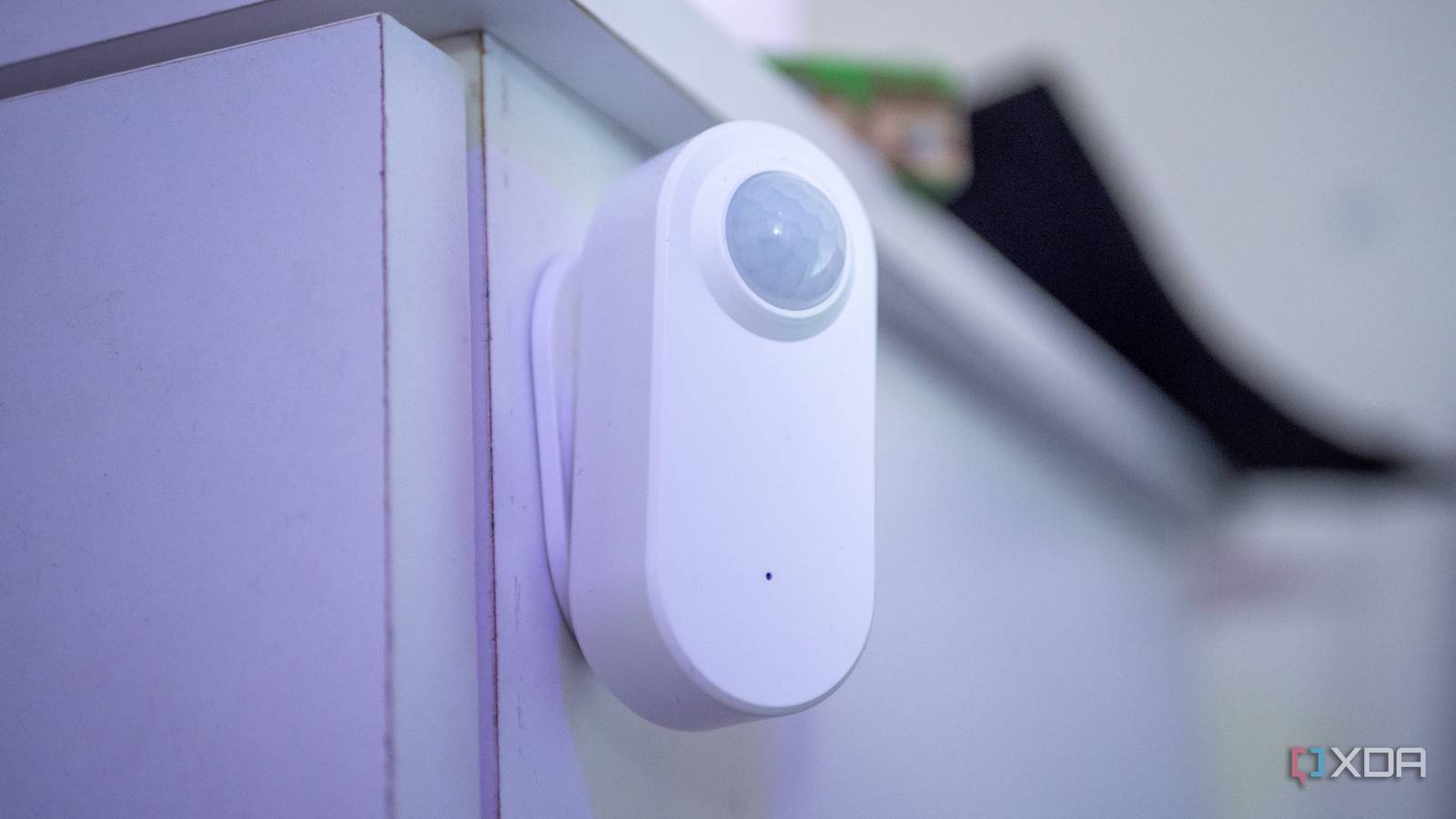
Published Sep 22, 2026, 5:00 PM EDT Jasmine is Software and PC Hardware Author at XDA with years of tech reporting experience ranging from AI chatbots right down to gaming hardware, she's covered just about everything. Whether it's breaking news about the latest AMD NPUs or creating video tutorials on social media platforms, Jasmine has contributed to the world of AI and tech in a variety of ways including interviewing the CEO of Razer, AMD's Director of Product Marketing and the VP of Lenovo. Passionate about gaming and PC technology, she has built countless computers, keyboards and other peripherals - knowing them inside and out. If you use motion sensors for the lights in your home, you've probably experienced being plunged into total darkness because your motion sensor assumes the room is empty when you're sitting still or resting. Traditional passive infrared sensors aren't presence sensors; they are motion detectors, meaning they look for shifting infrared heat signatures. If you aren't actively moving, you become invisible. Early mm wave sensors seemed like the solution, but they lacked spatial awareness. They could tell someone was in the room but not where. Now high-frequency 60GHz mmWave sensors broadcast tiny-wavelength radio packets and can analyze complex phase shifts. They don't just detect presence; they map a room into custom coordinate grids, track sub-millimeter chest movements from breathing, and pinpoint coordinates in real time without the need to DIY. Basic motion sensors treat a room as a binary on/off box. High-frequency 60GHz mmWave radars act as a localized spatial grid, shifting home automation from simple motion triggers to true room awareness, multi-zone tracking, and micro-motion intelligence. PIR sensors feel outdated mmWave is the way forward Traditional motion sensors typically use passive infrared, often referred to as PIR. They rely on pyroelectric elements to detect differential changes in ambient infrared radiation, but this comes with a flaw. It means that the sensors are blind to static objects and require gross physical displacement across segments to trip. If you're sitting still for a while, the sensor will fail to recognize that you're even in the room at all. Originally, a 24GHz mmWave sensor felt like a revolutionary step, and it was simple to DIY if you wanted. It uses longer radio wavelengths that excel at general macro presence detection through drywall and light obstructions, but it was still a compromise because it lacks the high spatial resolution needed for precise multi-zone tracking or subtle gesture recognition. Now with 60GHz high-resolution phased arrays, they operate at extremely short millimeter wavelengths using printed patch antenna arrays that form concentrated directional beams. This brings an exceptional level of automation because it lets the radar capture micro-Doppler shifts, distinguishing between a walking human, a swaying houseplant, and the gentle expansion of a human chest cavity during breathing. What can you actually do with mmWave? It gives you access to so many features It's all well and good having access to this technology, but what can you actually do with it in your smart home? It provides you with advanced capabilities that really separate 60 GHz sensors from standard automation hardware. The first is multi-zone room mapping, which lets you activate virtual tripwires. Advanced 60GHz units allow users to slice a single room into up to 30 distinct detection zones via companion apps or Home Assistant. In real-world use, Zone A (like the sofa) turns on ambient reading lights at 20%. Zone B (like the desk) turns on task lighting at 100%, and Zone C (like the doorway) triggers entry paths. You don't need separate sensors for different areas of the room anymore. You also have multi-target tracking because you can track up to five separate individuals simultaneously within the same spatial matrix, updating coordinates as people move across different furniture layout quadrants. Of course, these sensors also track your vitals and provide fall detection. That way, it can measure respiration rate, specifically breaths per minute, as well as micro-displacements to enable fall detection or sleep monitoring without invasive video cameras in your bedroom. It's not all perfect There are points of friction when setting up a 60GHz mmWave sensor A 60GHz mmWave sensor might sound like it's from the future, but real-world friction points come up when you deploy a high-frequency radar like this. Sometimes you can experience false positives because 60GHz radars are sensitive enough to detect micro movements. An oscillating desk fan, blowing window curtains, or even pets moving across a room can trigger false occupancy states. If sensitivity filters aren't tuned properly, it may take some getting used to when you first install your sensor, as you'll need to adjust the filters to what works for your home. Also, unlike omnidirectional PIR bulbs, the 60GHz phased arrays have specific beam patterns. Proper mounting height, tilt angle, and exclusion zones are critical to prevent radar reflection off of hard tile floors and glass windows. These surfaces can skew coordinate maps and make the mapping you set up essentially unusable. Despite the fact that you get access to a whole new range of features, the setup process for these sensors can be a little bit more finicky and frustrating. But once you have them ready to go, they are fantastic. No more waving your arms around in darkness A new sensor will give you access to so many more automations For decades, smart home automation has been hamstrung by seemingly binary motion switches, but upgrading to 60GHz mmWave radar can change the paradigm entirely. One sensor can introduce multiple automation settings for an entire room as it becomes a spatially aware environment that reacts to human presence with surgical precision. If you're still using legacy PIR motion detectors in your primary living spaces, then you might benefit from installing a 60GHz radar sensor, mapping your room's active zones, and experiencing a smart home that actually knows that you're in the room even when you're sitting still.
60GHz radar finally solved the problem that's been killing smart home lighting for years
Full Article
Original Source
Read the full article at Xda-developers →KhanList aggregates and links to publicly available news content. We do not host full articles from third-party sources. Always verify important information with original sources.