
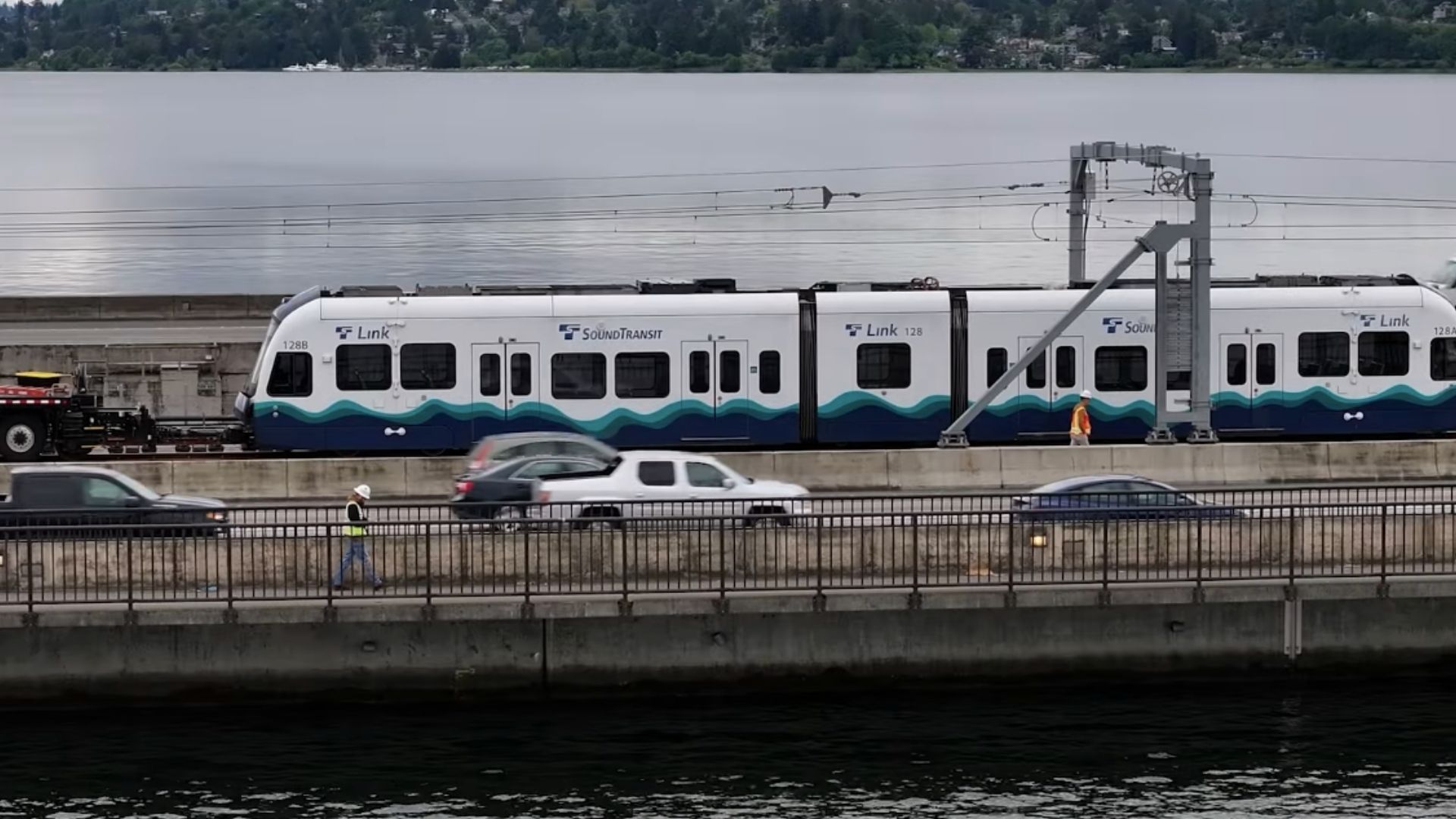
Building the passenger light rail line over a “floating bridge” was not a easy task. It connects Seattle and Bellevue across Lake Washington on Interstate 90. Engineering experts at Sound Transit and WSDOT had to solve three primary technical hurdles to safely operate 600,000-pound trains across a shifting, floating concrete bridge. As trains must cross a structure that shifts constantly with wind and waves, engineers spent years developing unprecedented technologies to handle the immense weight and prevent catastrophic derailments into the water. Strengthening the bridge To the millions of passengers taking in the sweeping views of Mount Rainier, the journey feels like an effortless commute. But under the floorboards lies a engineering feat that borders on science fiction: the first and only passenger railway on a floating bridge. It was a billion-dollar leap into the unknown. Lake Washington is a 200-foot-deep trough carved by glaciers that retreated 16,000 years ago. Its bottom is lined with soft, soupy silt that makes traditional bridge pillars impossible. Since 1940, drivers have crossed on massive concrete pontoons. But forcing heavy steel trains onto a floating highway that rolls, sways, and shifts with the tides was widely considered an invitation to disaster. Failure meant derailment into frigid water. To pull off what project directors called Sound Transit’s “moon shot,” engineers had to solve three nightmarish puzzles: weight, motion, and electricity. First came the sheer physics of mass. Reportedly, a single stalled train could sink the bridge eight inches. To prevent catastrophe, crews strung a million feet of steel cables inside the cramped pontoons and bound ten separate concrete blocks into a single rigid barge. They stripped away heavy gravel, used lightweight concrete, and squeezed the bridge deck so tight with jacking force that the concrete actually shrank three inches. Then came the problem of the lake itself. Water levels rise and fall two feet every year. Wind and waves push the bridge continuously. Traditional train tracks would snap, warp, or throw wheels off the line within days. The breakthrough came from a British engineer who sketched a solution using wooden coffee stirrers. Instead of rigid steel, track sections over the bridge’s expansion joints rest on 43-foot-long steel platforms supported by flexing seismic bearings. The continuous rails bend so imperceptibly that passengers feel nothing more than a smooth, butter-like glide across the water. Real-time monitoring Finally, they had to tame the invisible killer: stray electricity. Electric trains leak current. On land, it dissipates into dirt. On a lake, current mixes with water to eat through structural steel, rust internal rebar, and snap the massive underwater cables tethering the bridge to the lakebed. Engineers swaddled 9,000 rail support blocks in waterproof rubber and submerged hundreds of metal “sacrificial” anodes. The current eats the sacrificial metal instead of the bridge. To keep watch over it all, a “digital twin” of the bridge streams real-time data to computer screens ashore. Sensors track cable stress by the minute and record pontoon depth down to a tenth of an inch. The project ran six years late, but it works. When the inaugural train packed with passengers hit the first pontoon, the entire structure dipped just a single inch — far better than even the most optimistic computer models predicted.Get the latest in engineering, tech, space & science - delivered daily to your inbox.Mrigakshi is a science journalist who enjoys writing about space exploration, biology, and technological innovations. Her work has been featured in well-known publications including Nature India, Supercluster, The Weather Channel and Astronomy magazine. If you have pitches in mind, please do not hesitate to email her.
600,000-pound trains now crossing Lake Washington on ‘floating rail bridge’
Full Article
Original Source
Read the full article at Interestingengineering →KhanList aggregates and links to publicly available news content. We do not host full articles from third-party sources. Always verify important information with original sources.