
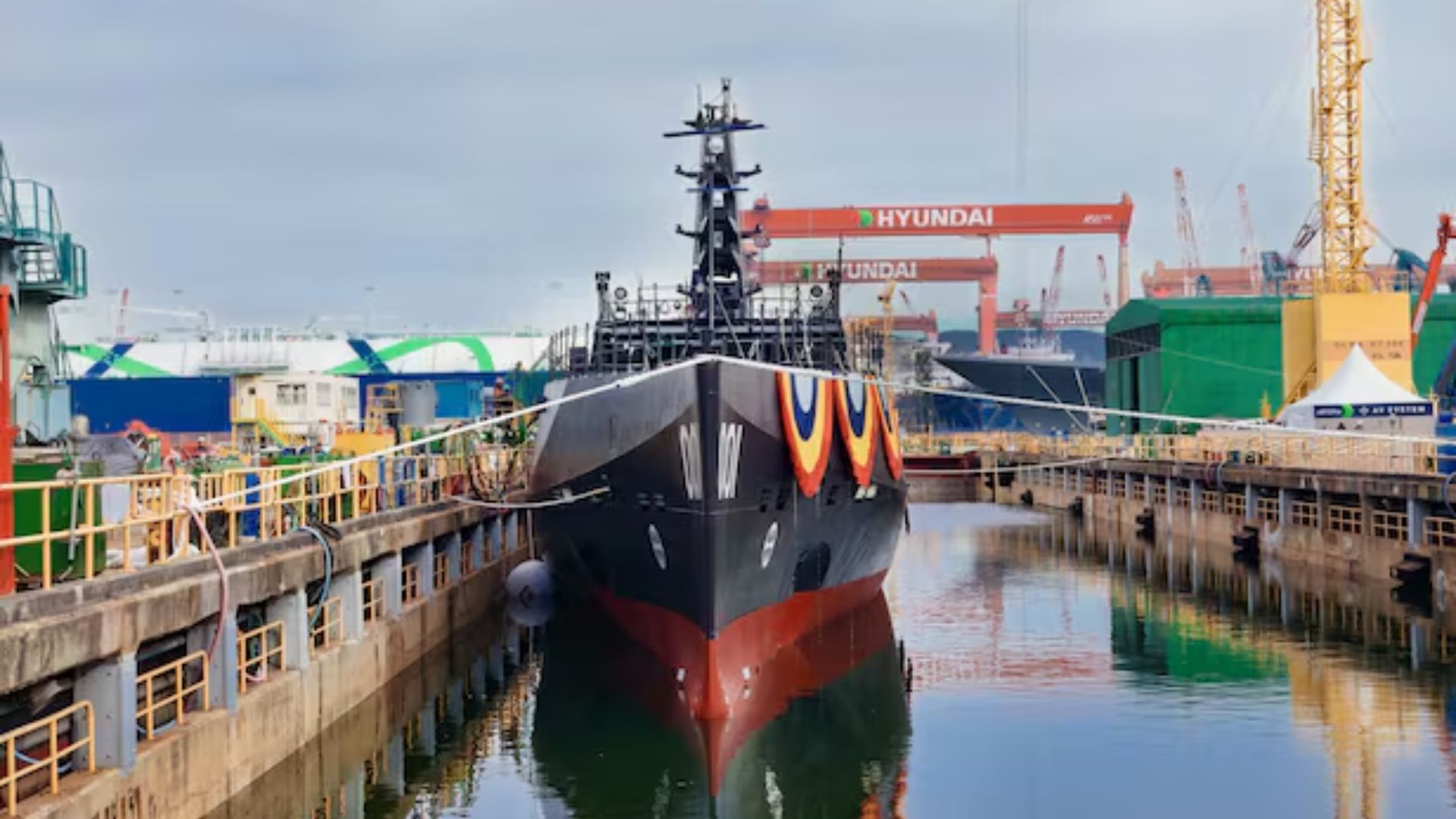
HD Hyundai, the South Korean manufacturing giant, has teamed up with US-based artificial intelligence (AI) defense company Anduril to build a 600-ton unmanned vessel for the US Navy. This is the first collaboration between the two companies, and the vessel was constructed without any official order from the US Navy. As we enter a new age of warfare, military tactics are moving toward the use of more autonomous vehicles to not just expand capabilities but also reduce loss of human lives. The effectiveness of such strategies has been demonstrated in the Russia-Ukraine conflict, where the latter’s unmanned surface vessels were successful in bringing down ships of the former’s Black Sea fleet. In response to China’s rising naval presence, the US Navy is looking to expand its existing naval fleet. Instead of relying only on crewed vessels, the US plans to include uncrewed vessels too, which can conduct reconnaissance and surveillance missions in high-risk areas without any risk to crew. In September this year, three US companies were awarded contracts to supply 30 such uncrewed vessels to the US Navy, at an average price of 30 million dollars. Hyundai and Anduril team up The joint effort of Hyundai and Anduril was docked as a 600-ton vessel at the HD Hyundai Heavy Industries’ shipyard in Ulsan and carries the temporary name Al001. The companies did not disclose much about the technical details of the vessel. Accounting for its size, the vessel would have carried a crew of 50 but carries none. Powered by VAone, a vessel autonomous system from HD Korea Shipbuilding and Offshore Engineering Company, the vessel can handle propulsion and navigation. VAone can help a vessel select a predetermined route to a destination and avoid obstacles along the way. The system can detect issues with critical equipment like engines and generators and respond to them, where required. Anduril’s Lattice system gives it mission autonomy for military operations. The system transmits its reconnaissance and surveillance data to human operators located remotely, where combat operations are taking place. How Al001 is different Unlike other autonomous shipping technologies that work primarily on route navigation and obstacle or collision avoidance, the vessels go a step further and also have automated hull and machinery management roles. Since military vessels can be deployed in challenging environments and for long durations, an uncrewed vessel should also be capable of responding to equipment failures and hull damage. In this prototype vessel. HD Hyundai has integrated these roles into the autonomous system so that the anomaly detection and response are also handled during deployment. On deck is a 39-foot (12 m) long container module that can be reconfigured with equipment or armaments depending on the nature of the mission. The design of the container is modular and compatible with naval equipment and armament used around the world, making it suitable for deployment without any retrofitting. Instead of a linear approach to design, procurement, and production, HD Hyundai procured propulsion systems and then designed the vessel around them, shortening the construction timeline to nine months, instead of the years shipbuilding usually takes. Now that the vessel is launched, it will undergo sea trials for three months at Ulsan before moving to the US for further testing in 2027. HD Hyundai and Anduril are hopeful that their prototype unmanned vessel will bring them orders that will be constructed on the US shores, as per new shipbuilding agreements between the US and South Korea. Get the latest in engineering, tech, space & science - delivered daily to your inbox.Ameya is a science writer based in Hyderabad, India. A Molecular Biologist at heart, he traded the micropipette to write about science during the pandemic and does not want to go back. He likes to write about genetics, microbes, technology, and public policy.
600-ton unmanned warship hits the water in nine months, targets US Navy fleet
Full Article
Original Source
Read the full article at Interestingengineering →KhanList aggregates and links to publicly available news content. We do not host full articles from third-party sources. Always verify important information with original sources.