
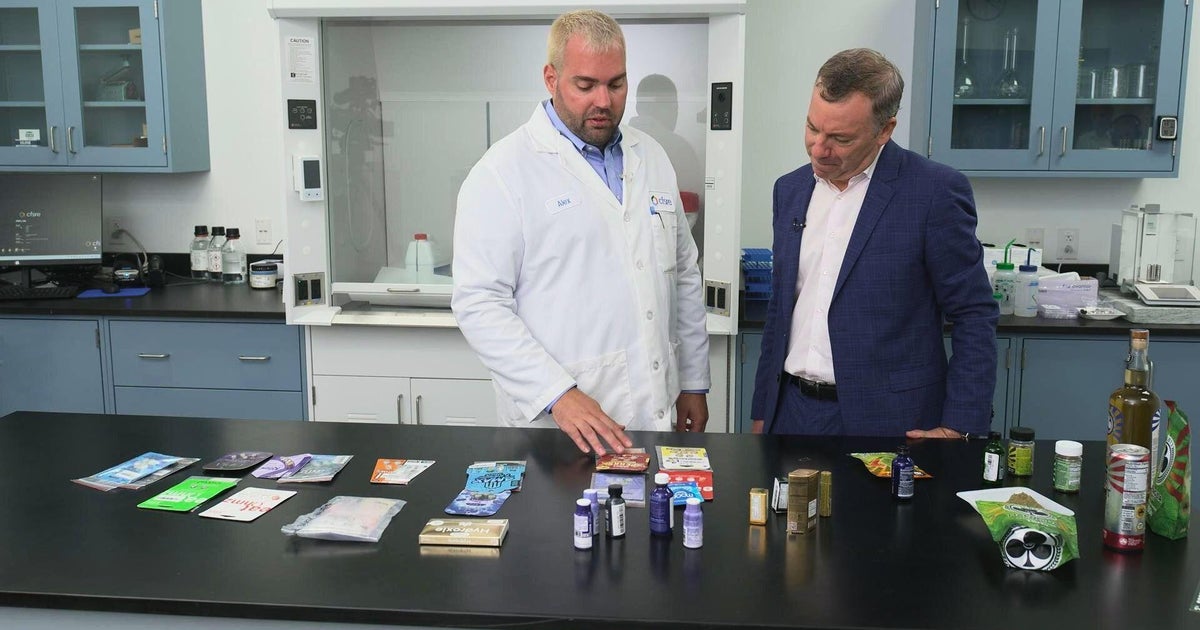
Over the next two weeks, we bring you a special report on the status of the American opioid crisis that's claimed nearly a million casualties and is far from over. We start with kratom. You've probably seen the signs advertising kratom, a substance that can be no harder to obtain than a bag of chips. It's become a billion-dollar industry, the products available online and in tens of thousands of stores around the country. The kratom industry hails the substance as a mild stimulant, even an aid in recovery from opioid addiction, and has supporters in the highest ranks of government. Increasingly, though there's outrage that kratom, an opioid that can lead to addiction and death, still in most states remains legal.A trained opera singer living in Michigan, Melanie Clark struggled with post-partum depression and fatigue. In 2022, scrolling Instagram, she saw ads for Feel Free Classic Tonic, a plant-based energy drink, enticing her with catchphrases like "Feel Free to be SuperMom." Jon Wertheim: How are you hoping it would make you feel?Melanie Clark: Focused, energized. You know, I really just was hoping it would give me a little boost.Jon Wertheim: Did it meet your expectations initially?Melanie Clark: It more than met my expectations.Jon Wertheim: How did it make you feel? Melanie Clark: Just almost like, like I had super powers. Melanie Clark 60 Minutes An active ingredient in Feel Free: kratom: derived from a tree native to Southeast Asia, where for generations people have chewed kratom leaves or boiled them to make a stimulating tea with opioid effects.Jon Wertheim: And you were getting this product where?Melanie Clark: You know, gas stations near my house. There was a little corner market really close to my house that sold them. Jon Wertheim: When did you realize this was a problem?Melanie Clark: I probably only took one bottle my first week and then, you know, a couple the next. And then soon, I felt like I needed them to just even kind of get going for the day. So that was probably only three weeks in, that I felt really addicted.Feel Free, priced around $10 a bottle, is one of hundreds of kratom products on the market. There are bags of leaf powder, capsules, gummies, extracts, available at smoke shops, convenience stores and corner delis.Dr. Andrew Kolodny: The effects produced by kratom are very similar to the effects produced by oxycodone, heroin, even fentanyl.Dr. Andrew Kolodny is the medical director for the Opioid Policy Research Collaborative at Brandeis University. He has treated hundreds of patients addicted to opioids. He's also worked for states as an expert witness, testifying that pharmaceutical companies, in part, caused the opioid crisis. Jon Wertheim: How did kratom come across your radar? Dr. Andrew Kolodny: I remember hearing from people concerned about kratom and I was just blown away by how pretty much everyone I was seeing who had developed opioid addiction in the past few years, they developed their opioid addiction taking kratom. Why is kratom an opioid? Its main compound, mitragynine, activates opioid receptors in the brain. Some of that mitragynine gets converted by the body into what's called 7-OH, which activates those same receptors even more intensely, eliciting an opioid high. Helping shape perception of kratom as a benign health supplement: the American Kratom Association, a consumer advocacy and lobby group. American Kratom Association video: "Natural kratom is a safe food used by many as an herbal supplement and is used by millions for their health and wellbeing or for an energy boost."Those promised benefits? Susan Eppard: We all just miss him terrible. These parents say it's why their sons, all recently deceased, started using kratom in the first place. These parents say itheir sons, all recently deceased, used kratom. 60 Minutes Susan Eppard: He said it was just like coffee, because he read that it was from the coffee family. Wendy Chamberlain: He was looking for something for energy. A friend of his told him it was safer than Red Bull. Patti Wheeler: And he said, "Oh, mom, it's just an herbal supplement. It's helping me ease away from alcohol."David Bregger: He was looking for a natural way to deal with his anxiety, is what we believe the issue was, yeah. "Cause of death" for David Bregger's son, Daniel, and Patti Wheeler's son, Wyatt, lists mitragynine, alongside prescription and over-the-counter medications.The deaths of Wendy Chamberlain's son, Joe, and Susan Eppard's son, Matthew, were attributed solely to mitragynine, the main opioid in kratom. At 22, Matthew was playing cards with friends when he suddenly collapsed.Susan Eppard: They tried resuscitating him for a long time. Time I got there, they wouldn't let me in at first, so I'd just sit out on the ground outside screaming for God to keep my baby here. And they finally let me go in there and see him. I knelt down to him and gave him a kiss on his forehead. And he was just cold and dark and gray.Mac Haddow is the public voice of the American Kratom Association. Mac Haddow at Congressional Brief June 2026: "They are wrong. They perpetuate this myth about kratom, they say that kratom is dangerous."Convicted of felony ethics violations committed in the 1980s while working as chief of staff for HHS, the Department of Health and Human Services, Haddow claims, repeatedly, that there is no proof that kratom can be deadly.Mac Haddow at Congressional Brief June 2026: "There is no known dose of mitragynine or kratom that would cause a death."Jon Wertheim: We've spoken to people. They say you can't die from kratom.Justin Brower: Yeah, that's not true at all.Justin Brower is a toxicologist at NMS Labs, a forensic testing facility outside Philadelphia. He's analyzed thousands of death cases involving kratom. Justin Brower: I know there's a lot of advocates out there for kratom. And kratom has helped a lot of people, you know, to alleviate withdrawal symptoms, to help with chronic pain and depression. Jon Wertheim: You sound unmistakable. There can be deaths.Justin Brower: There can be. Correct, and I've seen dozens and dozens of deaths attributed just to kratom, no other drugs at all. Justin Brower 60 Minutes The Centers for Disease Control and Prevention has, since 2020, identified more than 5,000 overdose deaths involving kratom. Jon Wertheim: What has been the arc of fatalities?Justin Brower: It's probably increased probably about tenfold…Jon Wertheim: Tenfold?Justin Brower: …from 2014 through 2025 into 2026. It's pretty incredible how many people are using it now compared to, you know, a decade-plus ago. The rare chance of death associated with kratom has been acknowledged by the Food and Drug Administration, which warns about the "risk of serious adverse events, including liver toxicity, seizures, and substance use disorder." In 2014 the FDA issued an import alert to stop the flow of kratom. But millions of pounds, mostly from Indonesia, continue to make it here every month, labeled as substances like cosmetics and incense. But there is a loophole: once here in the country, kratom can be sold in most states. Options for consumers have evolved. Products containing synthetic 7-OH have hit the market. Remember 7-OH, that opioid in kratom, triggering the more intense high? Manufacturers concentrate it, in tablets and liquid shots, products more potent than morphine – earning them the nickname, "gas station heroin."Alex Krotulski: Typically, you have these cardboard packets that have individual pills in them.Jon Wertheim: We have mango and wild cherry. Toxicologist Alex Krotulski, director at the Center for Forensic Science Research and Education, tracks the emergence of new drugs in the U.S. and he's not surprised by the user migration from leaf-based kratom products to synthetic 7-OH.Alex Krotulski: They're trying to chase this high that they have. But as their tolerance increases, they can't get there. So, they shift to more potent drugs. I think that understanding does align well when you think about the shift from mitragynine to something ten times more potent, 7-hydroxy, or 7-OH. Alex Krotulski and Jon Wertheim 60 Minutes Melanie Clark has lived that trajectory. After weaning herself off of Feel Free, the leaf-based kratom drink, she relapsed and last year started using synthetic 7-OH tablets made by another company, which landed her in the hospital. Melanie Clark: So this is from the end of my 7-OH use. It's hard to believe that this is me. In withdrawal, she had panic attacks and became suicidal to the point her husband called the police.Melanie Clark: As soon as I heard that the cops were coming, I took off, like sprinted across our yard, hopped a fence. Jon Wertheim: Just for people that may not understand addiction, they say, "Here's this nice woman from the Midwest with three kids who studied opera in college and now she's in a field running from the cops." Melanie Clark: It's hard for me to believe, too. But that's-- that's what addiction will do to you. With concern growing over 7-OH and other kratom-derived products, the federal government in July announced an intent to restrict, or schedule, 7-OH and three related substances, referred to as "dangerous opioids" by Robert F. Kennedy Jr., Health and Human Services secretary. But then, unexpectedly, last month, HHS changed its recommendation, increasing the amount of 7-OH allowed in products by 20-fold — a decision that stunned some health officials. Calley Means on Joe Rogan Podcast: It's causing deaths. It's causing devastation. It is an opioid. Earlier this year on Joe Rogan's podcast, Calley Means—until recently, a senior advisor at HHS—asserted that the loosened standards were the result of entanglements with the kratom lobby. Calley Means on Joe Rogan Podcast: "The amount of lobbying on this was unrelenting… huge pushing, huge, huge pushing meetings, pushing from the West Wing to relax the standards."60 Minutes found public filings from the last decade showing a constant stream of cash—much from the American Kratom Association—earmarked to lobbying the FDA, HHS, the White House, and members of Congress. Millions committed to keeping kratom legal. Further compounding matters: political contributions. Botanic Tonics, maker of Feel Free — and its founder, J.W. Ross, a convicted felon — donated nearly $1.2 million to RFK Jr.'s political campaigns and the PAC, Make America Healthy Again. What's more, Markwayne Mullin, secretary of the Department of Homeland Security, has disclosed an investment in Botanic Tonics, of up to $1 million. 60 Minutes reached out to Botanic Tonics, without response. Mullin confirmed the Botanic Tonics investment but denied lobbying. Calley Means, as well as Dr. Marty Makary, former head of the FDA, both told 60 Minutes they recently resigned from their posts in part because of recent changes to kratom policy shaped, as they say, by business interests, rather than public health. HHS declined our interview request but said in a statement that "Neither political contributions nor outside pressure influenced our recommendation. Our responsibility is to protect Americans, and that is exactly what we did." The AKA, in a lengthy statement to 60 Minutes, stressed the distinction between natural kratom and, quote, "dangerous chemically manipulated products."Dr. Andrew Kolodny says he recognizes the kratom industry's playbook. Jon Wertheim: You have drawn considerable parallels between Big Pharma lobbying and Kratom lobbying. What specific overlap are you seeing?Dr. Andrew Kolodny: Some of the same scientists who Purdue Pharma hired to make sure that regulators wouldn't take action against oxycontin are now working for the Kratom Association and delivering the same message, downplaying the risks, exaggerating the numbers of people who are potentially benefiting. We asked Dr. Kolodny whether these products might aid the recovery of the nearly 10 million Americans struggling with opioid use disorder. He was unequivocal. Dr. Andrew Kolodny: Don't use kratom. When it comes to kratom for opioid use disorder, we don't have the evidence. And what is available suggests that the risks of kratom outweigh the potential benefits.Susan Eppard, one of the parents we met, can't fathom that kratom is still for sale. She goes into convenience stores, as she did last summer in New York City, asking folks if they realize what they are selling. Often, she says, they don't. Susan Eppard: I just wanted to show you this is my son who died from kratom. Something very similar to that product. And this is his death certificate.Still today, hundreds of kratom products remain on the shelves, including Feel Free, the drink Melanie Clark says brought about her addiction. Jon Wertheim: How are you doing now?Melanie Clark: So much better. Jon Wertheim: What would you tell people after all you've been through about Feel Free?Melanie Clark: That it's a drug. It's a dangerous drug. You should not be able to buy bottled euphoria from the gas station. It will slowly steal your soul.Produced by Denise Schrier Cetta and Elizabeth Germino. Broadcast associate, Mimi Lamarre. News associate, Eric Frank. Edited by Warren Lustig. In: Kratom
60 Minutes Transcript: Kratom faces scrutiny over health concerns
Full Article
Original Source
Read the full article at Cbsnews →KhanList aggregates and links to publicly available news content. We do not host full articles from third-party sources. Always verify important information with original sources.