
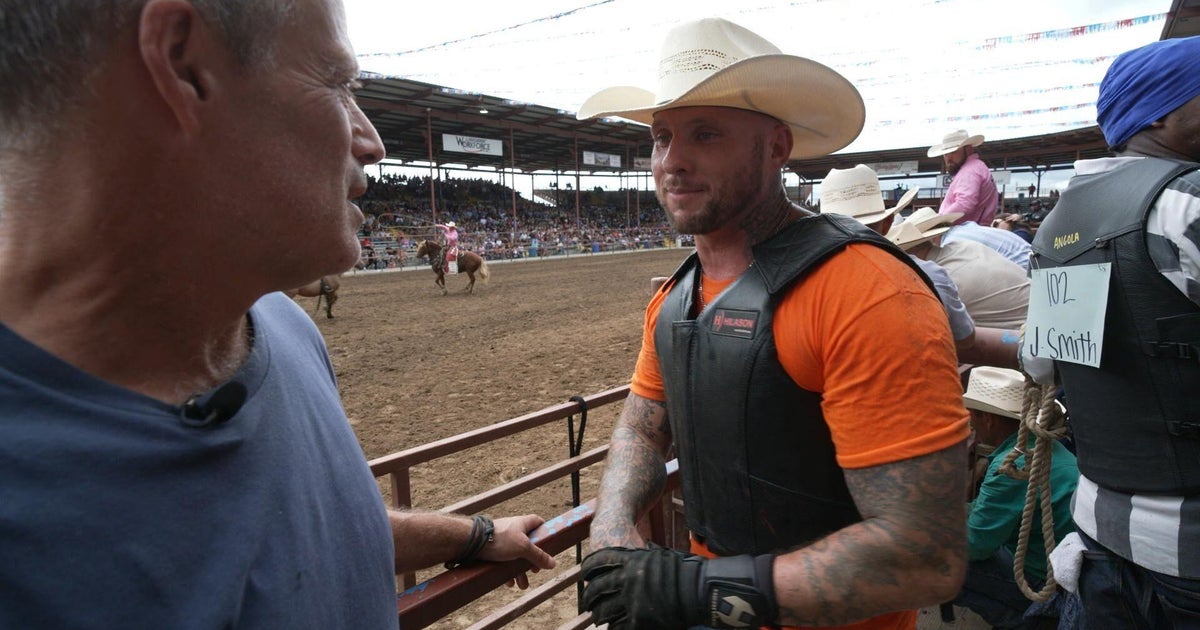
Tonight we're taking you to a rodeo in the most unlikely of places: the largest maximum security prison in the country, the Louisiana State Penitentiary.Commonly known as Angola, the prison houses nearly 5,000 men, most of whom are serving life sentences and will die there.It's a fate that leaves little room for hope.But for about 1,000 inmates, good behavior has earned them privileges that most of the prison population can only dream of: driving tractors, breaking horses, learning a trade.And for the exceptionally brave: leaping on the back of a wild bull or horse to chase redemption and a fleeting sense of freedom in a rodeo dubbed "the wildest show in the South."At the end of a 20-mile road that dead ends at the Mississippi River, are gates to a place that Kevin Gildhouse - who goes by "Country" - realized he will never leave.Kevin "Country" Gildhouse: I remember turning onto that road that said Angola State Penitentiary. And-- and I felt like my heart was beatin' out of my chest. I was scared to death. I'm about to go to the place they say I'm gonna die in. Almost 20 years ago, "Country" was sentenced to life without parole after being convicted of killing a cab driver in a botched robbery when he was 19. Kevin "Country" Gildhouse: I was involved in-- in a man losin' his life in a horrible way. A man lost his life, and a daughter lost her dad, a mother lost her son. Sebastian Junger: You must think about him.Kevin "Country" Gildhouse: Absolutely, him and his daughters. 'Cause that one-- that one incident wasn't just the end of their trauma, right? Their trauma is every dance that he can't be there for, missed weddings and missed school events, missed sporting events. That's my fault. I was a little boy tryin' to be a man, didn't know how to be. Kevin "Country" Gildhouse 60 Minutes During one weekend in April and on Sundays in October, "Country" and other inmates stand proud in front of thousands of spectators. It's a day of nerves and disappointment, holding on any way you can until you can take a knee in victory — when man conquers beast, and beast conquers man.And sometimes, Country and the bull tangle nose-to-nose …Sebastian Junger: What happened? Cowboy: My grip gave out. My balance was off. He got the best of me.Sebastian Junger: And then what happened when you hit the ground?Cowboy: Ooh. He stepped on me.Stepped on, gored, flipped upside down: it's all worth it for these volunteer, self-taught cowboys that society has given up on. Kevin "Country" Gildhouse: Those few hours that you're out here, you're-- you're-- you're free. You're not in prison. You're just out here competing. You're-- you're out here with other guys who are gettin' in the mud with you and-- and-- and-- and bleedin' with you. And-- and we love it. We're not forced to do anything here. Originally a slave plantation, Angola became known as the "bloodiest prison in America" for its rampant torture, murders and beatings.Conditions were so atrocious that in 1951, a group of inmates protested by severing their own Achilles tendons so they could not be forced to work in the fields. As conditions gradually improved, the beginnings of a rodeo started to take shape in the mid-1960s.Warden Darrel Vannoy: This is our 60th anniversary of the Angola Prison rodeo. It started out as just a event with cars parked around a fence watch-- watchin' inmates ride some horses, and it's grown into what it is today.Warden Darrel Vannoy has worked in corrections for more than five decades.Warden Darrel Vannoy: In the movies and all, you know, you get prisons are a terrible, terrible place. But I-- I hope you see that these guys here are not animals, that they're human beings. And that, you know, they're better than their worst day Today, the man to beat is preparing for his bare-back whistle … Travis Johnsonm nicknamed "Buckethead," is the reigning champion. Travis "Buckethead" Johnson 60 Minutes Travis "Buckethead" Johnson: It's that moment of accomplishment. It's a moment of bein' almost weightless'"Buckethead" remembers a simple childhood in rural Louisiana, but when the family moved to a city called Thibodeaux, he wound up addicted to drugs.Sebastian Junger: So, tell me about the incident that got you in here.Travis "Buckethead" Johnson: Well, I'm in here for murder. I was thinkin' about gettin' high and a lotta things went down … reliving it never gets … I can't even…. It's the one time you're gonna see I don't have the words to say…What "Buckethead" can't talk about are his two first-degree murder convictions from almost three decades ago when he was 18. Sebastian Junger: To me I think if you're brave enough to get on the back of a wild horse or wild bull and you can't talk about this, it must be really hard to talk about--Travis "Buckethead" Johnson: It's-- it's-- it's absolutely. 'Cause it's somethin' that you cannot change. Sebastian Junger: Can't go back--Travis "Buckethead" Johnson: And you realize you put somethin' in front of someone. And you just lay there and look at the ceilin' and you're like, "Man."The real thing these men must tame is their former selves.Outside the prison, the rodeo has elicited charges of exploitation and comparisons to roman colosseums and gladiators.Travis "Buckethead" Johnson: A lady asked me one time ,"What you out there doin' all that crazy stuff?" I said, "You know what? "I know how you might see it right now, but it's a whole lot better than how I used to get my money." Sebastian Junger: it was hard not to notice that a lotta the people that came -- to watch-- were white, and - a lotta the inmate population here is Black. Does race disappear in that situation?Travis "Buckethead" Johnson: Cowboy's a cowboy. It don't have a color. If you got cowboy in you, people gonna see it regardless.Kenny "300" Palmer: Yeah, me, I call 'em constructively insane. But I tilt my hat to 'em, not I. But, I mean, some dudes, they was raised for that, you know? And the-- it's good for a lot of people, you know, 'cause everybody needs some type of, you know, way to vent in here, man?Kenny Palmer - nicknamed "300" - was sentenced to life without parole after being convicted of killing a man in a drug deal almost 20 years ago. His venting outlet is making chessboards and beaded necklaces — two of the thousands of hand-made arts and crafts that inmates sell to the public during the rodeo. Kenny "300" Palmer 60 Minutes Kenny "300" Palmer: It gives you a chance to be creative. It gives you a chance to make money, like my mama said. "Find something to occupy your mind," Riders keep every dollar they win. Craftsmen pay 11% to the prison and keep the rest. Like any small business, sales fluctuate. And the day we were there, Kenny made $87. He says some men stood at their tables all day and sold nothing… Kenny "300" Palmer: Once I bill up enough, I want to send it home to my niece and get her to open up-- a brokerage account in her name, and try to teach them financial literacy. That's one of the things I've been learning, since I've been here. Visitors pay $25 at the gate. The entire event could be mistaken for a wholesome country fair in any small town. For the day at least, the barbed wire fences aren't a barrier.Sebastian Junger: Tell me about what it feels like seeing the world pour in through those gates for a few hours.Kenny "300" Palmer: One of the best parts is-- is-- is the visitation part. You come out here, your family can sit with you for eight to 12 hours.And you never know who you're going to meet.Kenny "300" Palmer: You got guys that met wives, out here. They done married. Sebastian Junger: So let me get this right. There was a guy who's an inmate here. And on rodeo day, he met a lady? And they got married? Kenny "300" Palmer: We got a lot of stories like that. I mean, I don't want to get-- get into some of them women business, but they come up here, you know? They find 'em a good man, you know? And a man find him a good woman. And then, there you go. You get blessed, man. God work in mysterious ways. Inmate John Corley is the editor of an award-winning prison magazine called the Angolite. John Corley 60 Minutes John Corley: A lot of the officers here, grew up here. And-- and for many of 'em, it's a generational thing. Their-- their dad worked here, their mom worked here and their grandparents worked here.Many of the roughly 1,400 people who work at Angola, also live there in a civilian section called the B-LineJohn Corley: Even our warden Darrel Vannoy, you know, he came to work when he got out of high school. It was going to be a summer job. He's still here, you know, from age 18 to-- to what he is now. Sebastian Junger: He's a lifer. John Corley: He's a lifer as well. Corley is serving a life sentence without parole for second-degree murder.John Corley: It was a summer day. And-- my wife and I went to my dad's house. We had an argument and it became physical. And, you know-- I took her life that night. Corley believes that finding a sense of purpose helps inmates endure.John Corley: You take a guy who has-- who has no real chance of getting out. Give him something to do. Make him feel like he's somebody and is accomplishing something, and you've got a whole different guy. For all its ghastly history and shattered lives, Angola may be a place of redemption as well.Kevin "Country" Gildhouse: I do believe that I've been forgiven by my lord and savior. I don't believe that I could ever ask society for-- to forgive me for the things that I've done. Sorry is too small of a word for the things that I've done in my life and to the victims and their family. I could never ask them to forgive me. Sebastian Junger: Is there redemption here?Travis "Buckethead" Johnson: Redeemin' myself was knowin' that my family knew the one thing that I-- whatever I'm doin' they ain't gonna lose sleep over it 'cause I'm not doin' nothin' wrong. Announcer: Sixty years, ladies and gentlemen, of history and tradition the world-famous Guts and Glory There's a poker chip worth $500 between the horns of that bull and "Buckethead" — in the pink shirt — wants it. He takes a swipe, misses, watches a youngster make his move, and then takes his shot, with guts and then … glorySebastian Junger: So, after you won the Guts and Glory you leapt onto the stands, just radiant. Like, what were you feelin'. Travis "Buckethead" Johnson: I've been rodeoin' a long time and I know that these people are just as happy as I am that I actually pulled it off. I did it, but we did it.It took a life sentence for some men to find a better version of themselves, which often requires facing the cruelty that was done to them. Kevin "Country" Gildhouse: I come from-- a family who was broken because they come from a broken family. You know, hurt people hurt people.Sebastian Junger: Hurt people hurt people.Kevin "Country" Gildhouse: Yes, sir. And I grew up in foster care. I bounced through probably about 72 homes throughout my childhood. I was subject to a lot of abuse, probably about every kind of abuse you would think of. And-- it led me down-- a horrible path full of drugs and violence and-- and ultimately prison. the way I grew up, man, I think the world expects you to be angry. The world expects you to lash out. Growin' up, I was everything the world said I was supposed to be.Far from the rodeo grounds are two inmate cemeteries. Some men chose to be buried there, and others simply wound up there because no one claimed their remains. John Corley: When you're gone, when you leave this earth, You've served your sentence. And you should be remembered not for what you did, but for the fact that you existed.A plaque, with a dedication written by John Corley, reads, "Remember not my name, nor my sins, nor guilt, nor shame. only that I was a man."Sebastian Junger: What's it mean to you to be a man? Kevin "Country" Gildhouse: It's a big word. That's a big word that I think people misinterpret a lot. At one time in my life I thought bein' a man was-- was just bein' tough. but when I became a man of God that word transformed for me in a major way in my life and in my heart havin' integrity-- responsible, bein' dependable-- and just showin' up and showin' out in every aspect of your life, especially for your family and the ones that are around you.Produced by Laura Dodd. Associate producer, Grace Conley. Broadcast associate, Lola Jahant. Edited by Michael Cesario. In: Prison
60 Minutes Transcript: A rodeo inside a maximum security prison
Full Article
Original Source
Read the full article at Cbsnews →KhanList aggregates and links to publicly available news content. We do not host full articles from third-party sources. Always verify important information with original sources.