
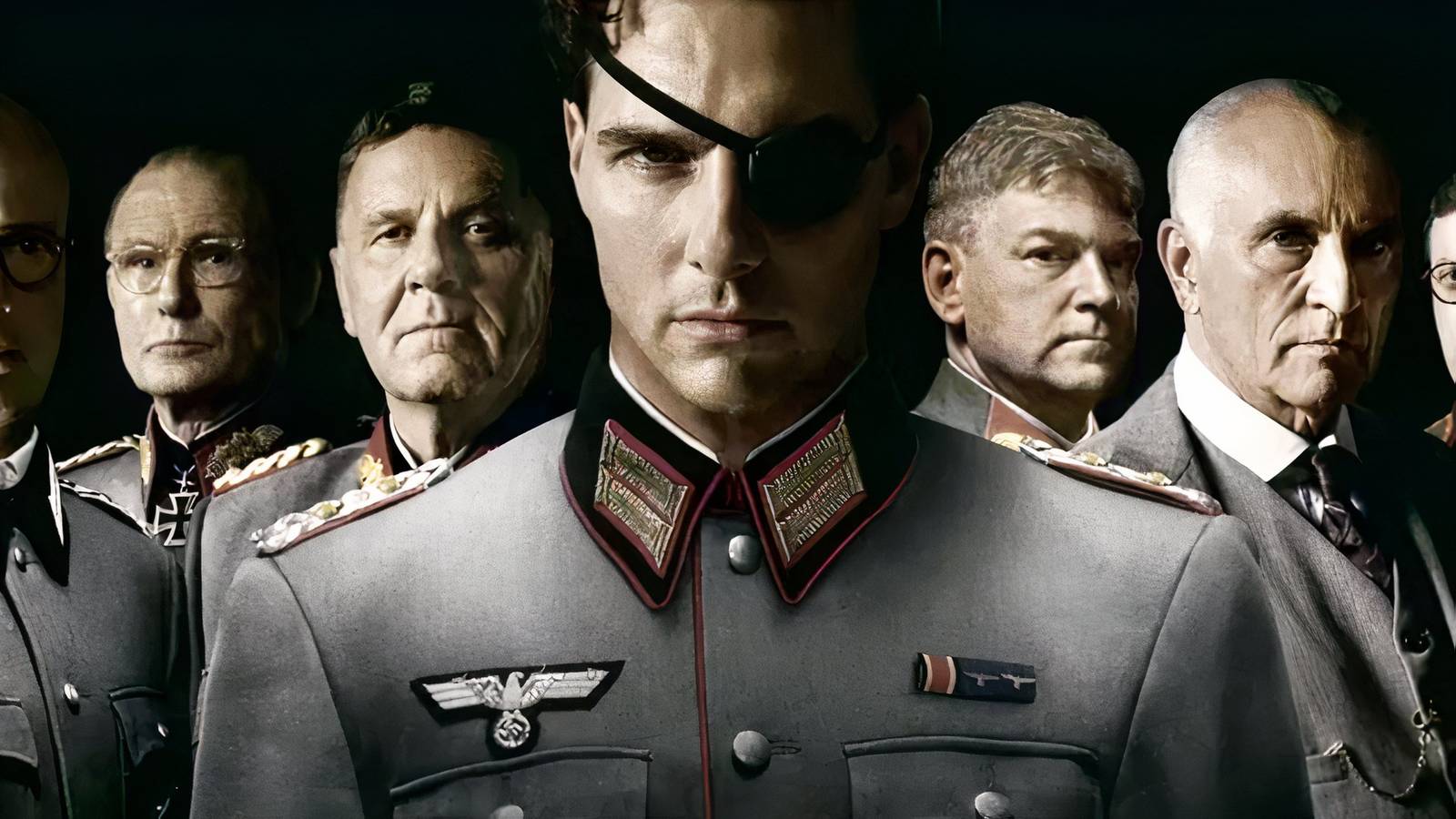
Published Sep 5, 2026, 12:55 PM EDT Simon Gallagher has worked in movie and TV journalism for more than 17 years. He has written more than 6000 articles and reviews, and edited thousands more. He is an expert in the entertainment industry, particularly in the golden age of screen superheroes. Simon is also a Rotten Tomatoes approved critic. Hollywood has always been fascinated by World War II, turning it over the 80 years since its end into an intense cinematic canvas exploring stories of untold suffering and vast heroism in equal measure. So all-encompassing was it that the stories is gave birth to exist on a frankly ridiculously rich creative spectrum. It’s also one of the world’s most prominent wars that fits most conventionally with the silver screen’s ideas of good and evil. The conflict left a massive library of human drama, which has been mined repeatedly, and has created not only some of the greatest war movies of all time, but also some of the greatest movies overall. It was an epoch-creating moment, and some of the real stories that came out of its multiple fronts were far grander, far more devastating, and far more awe-inspiring than any fiction could create. But that doesn’t mean there weren’t some liberties taken. When directors tackle the war, historical accuracy usually gets held up as the ultimate gold standard of quality. Whenever a war movie’s credentials are called into question, someone inevitably brings in a historian to run the rule and say how well the movie captured the reality of World War II. But it’s very possible for great movies to be unconcerned with preserving real history; sometimes it’s a concrete necessity in the pursuit of making a thrilling two-hour feature. Hell, even Saving Private Ryan claims to be based somewhat on a true story, when in reality it was a dramatic but fictional story inspired by the works of military historian Stephen E Ambrose (who wrote Band of Brothers) and on the real account of the Niland brothers. None of what happened in the movie actually happened, other than the one surviving brother being pulled out of conflict, but the rest of the movie is widely praised for its depiction of combat and D-Day in particular. So it gets a pass. And it's far from the only example... 6 Dunkirk (2017) In 2017, Christopher Nolan resoundingly proved that he's a master of any genre he turns his hand to by making the intense epic, Dunkirk. As with all of his movies, it won widespread acclaim for its immersive approach to depicting Operation Dynamo, the 1940 evacuation of over 300,000 Allied troops from French beaches. That was achieved thanks, in part to the use of real Spitfires, and a naturalistic filming style that avoided exaggerated effects. Historian John Broich wrote in Slate that there were “no big, glaring historical whoppers.” But at the same time, some historians have still raised concerns about what the movie omitted or misrepresented. Nolan said very clearly that he was ignoring the politics of war in an attempt to focus on recreating the experience, but nevertheless faced criticism for seemingly ignoring the role of the Indian Army. Broich balances his praise of some elements of Dunkirk by referencing the four companies of the Royal Indian Army Service Corps who were present on the beaches and didn’t make it into the film. That omission was enough to cause some controversy - as was the perceived underrepresentation of African soldiers. There are other creative liberties take too: while the idea of the small boat owners taking their own vessels to rescue stranded soldiers, the reality was less romantic. Most were requisitioned by the government and Navy. But that change would have robbed Dunkirk of one of its most human storylines, and the movie remains a remarkable experience. Exactly as Nolan wanted. 5 The Imitation Game (2014) Starring Benedict Cumberbatch, The Imitation Game is somewhat distinct from the other movies included here, because it’s not as focused on front-line battle or action at all. Instead, it tells the dramatic story of mathematician Alan Turing and his team at Bletchley Park and their important mission to break the Enigma code. It’s also a deeply compelling drama that went on to earn seven Oscar nominations, bu that didn’t protect it from historians heavily criticizing its fabrications. Chief among those criticisms were those lamenting the portrayal of Turing himself. The movie is very much a platform for Cumberbatch’s performance, but in service of that, it provoked Turing scholars, who pointed out that his portrayal as an isolated genius who single-handedly built the machine was plainly wrong. Not just that, but a crucial collaborator, Gordon Welchman was cut entirely, and his work was based on earlier work by Polish mathematicians. So many liberties were taken that GCHQ Departmental Historian Tony Comer famously offered the barbed assessment that "The Imitation Game [only] gets two things absolutely right. There was a Second World War and Turing's first name was Alan". The final word, however, goes to screenwriter Graham Moore who responded elegantly to accusations of historical accuracy with this rebuttal: “When you use the language of "fact-checking" to talk about a film, I think you're sort of fundamentally misunderstanding how art works.” Touché. 4 The Bridge On The River Kwai (1957) There is absolutely no argument that David Lean’s Bridge Over the River Kwai isn’t a masterpiece. And if you’re looking for quantifiable proof, it rightly won seven Academy Awards, including Best Picture. It has also aged remarkably well as a piece of art, partly because of its incredibly compelling story and some brilliant performances, including by Alec Guinness, of course. The story centers on British POWs forced to build a railway bridge for their Japanese captors, with Lieutenant Colonel Nicholson (Guinness), increasingly losing himself to obsessively building a perfect bridge to demonstrate British pride. But criticism came courtesy of survivors of the Burma-Siam "Death Railway,” who were appalled by the film's portrayal of their experiences. The film was criticized for downplaying the brutal conditions. In fact, when the film was being made, Britain’s War Office actually objected to its plot, putting on record their concerns in letters now prMajor A G Close wroteeserved in the National Archives: Major A G Close wrote to Hollywood producer Sam Spiegel to say the British POWs were more focused on sabotage and escape attempts rather than collaboration: “I do not think much of this story. In the first instance it is quite untrue and only very occasionally resembles the facts as they were at the time. I am perhaps biased as I worked for three and a half years on this particular railway.” He further revealed he had passed the script to others “and they agree with me that it would not go down well with the British public”. 3 Inglourious Basterds (2009) Now, this might seem a little like shooting fish in the barrel, given Quentin Tarantino set out to make Inglourious Basterds a warsploitation movie rather than a historical document, but the criticism here is a bit more specific than you might be expecting. Historian James Holland's breakdown of the movie is the best, particularly because it's done with the jovial spirit that it deserves, while also sharing actual issues. Hilariously, Holland also revealed that Tarantino's crew actually included a historian consultant. The point of Inglourious Basterds, despite that odd hire, was not to be too beholden to history and tell a sort of cartoonish fantasy, and the result is a gloriously entertaining romp. The performances are delightfully silly, there's genuine tension, and genuinely thrilling action, and the ending is as entertaining as it is madcap. But Holland points out that the iconic interrogation of the French farmer by Christoph Waltz's Standartenführer Hans Landa takes a lot of liberties, and the idea that he'd attempt to shoot Shoshana from a distance with a pistol with a range of 5 to 10 yards is specifically called out. He also took issue with the idea of Nazi Jew hunting squads in France - most victims were actually rounded up by the French - and gave it a 3 out of 10 for historical accuracy. Not that it matters. 2 Valkyrie (2008) In certain circles, Tom Cruise's Valkyrie - another Hitler assassination movie, but on a completely different level than Inglourious Basterds - is known as the movie where he may or may not have worn prosthetic butt cheeks. (Seriously, Screen Rant got the exclusive on it.) But it's also a hugely underrated World War II movie that tends to be overlooked despite Cruise's presence and an intense, exciting plot. In real history, Cruise's character - Claus von Stauffenberg - was a central figure in the plot to kill the Nazi leader that came closest to being successful. But for all of its projection of accuracy, Valkyrie takes a lot of liberties: war historian and NATO advisor James Rogers takes issue with it in particular because it represents the "Hollywoodization of history." There is some suggestion that the movie also overstates how close the plot came to succeeding, which is part of why its climax works so well, so that's somewhat forgivable too. More specifically, historian Peter Steinbach openly criticized how some of von Stauffenberg's co-conspirators are portrayed, including Dr. Carl Friedrich Goerdeler, who he says was portrayed in a "hurtful and irresponsible way". Likewise, he calls the portrayal of General of Infantry Friedrich Olbricht (Bill Nighy) as "downright degrading", given his actual importance to the plot. Both were seemingly done in the name of aggrandizing Cruise's role, and it's hard to fight the assessment that it works. 1 The Great Escape (1963) Steve McQueen’s iconic action-drama The Great Escape is one of the finest examples of military Americana, celebrating the true 1944 escape of Allied officers from Stalag Luft III. But, somewhat inevitably, the creative decision to push McQueen’s cooler than ice reveal Captain Virgil Hilts took the story well away from the actual events that inspired it. In obvious pursuit of US box office dollars - and because you don’t not use McQueen as a motorbike riding badass - the script heavily Americanized something that was actually largely executed by British and Commonwealth forces. Hilts, unsurprisingly was an invention, and overall, the movie was called "a strange mixture of fastidious creation and pure Hollywood fantasy" by historian and presenter Jem Duducu. The real mission’s star counterfeiter, Ley Kenyon also agreed when talking to the BBC in 1977 that while it was good entertainment, “it certainly didn't express the real horror of being a prisoner of war, the horror being, of course, in one's personal feelings about being behind barbed wire – the boredom, the hunger. The hunger was pretty grim." In reality, only three Americans were involved in the actual digging of the tunnels, and they were transferred to another camp before the night of the escape, so no motorcycle escape at all. Which would have made the final movie about 35% less cool, which is exactly the point. Duducu also points out that the real ending was less triumphant: “The escape infamously led to 50 men being shot. It did lead to further brutality against escaped prisoners. The Great Escape, sadly, led to more death and misery than anything else.” The decisions to rather sanitize the reality of the prisoners’ treatment and what happened either looks justifiable given the uplifting nature of the ending.
6 World War 2 Movies Called Out By Experts For Inaccuracies (That Are Still Great Anyway)
Full Article
Original Source
Read the full article at Screenrant →KhanList aggregates and links to publicly available news content. We do not host full articles from third-party sources. Always verify important information with original sources.