
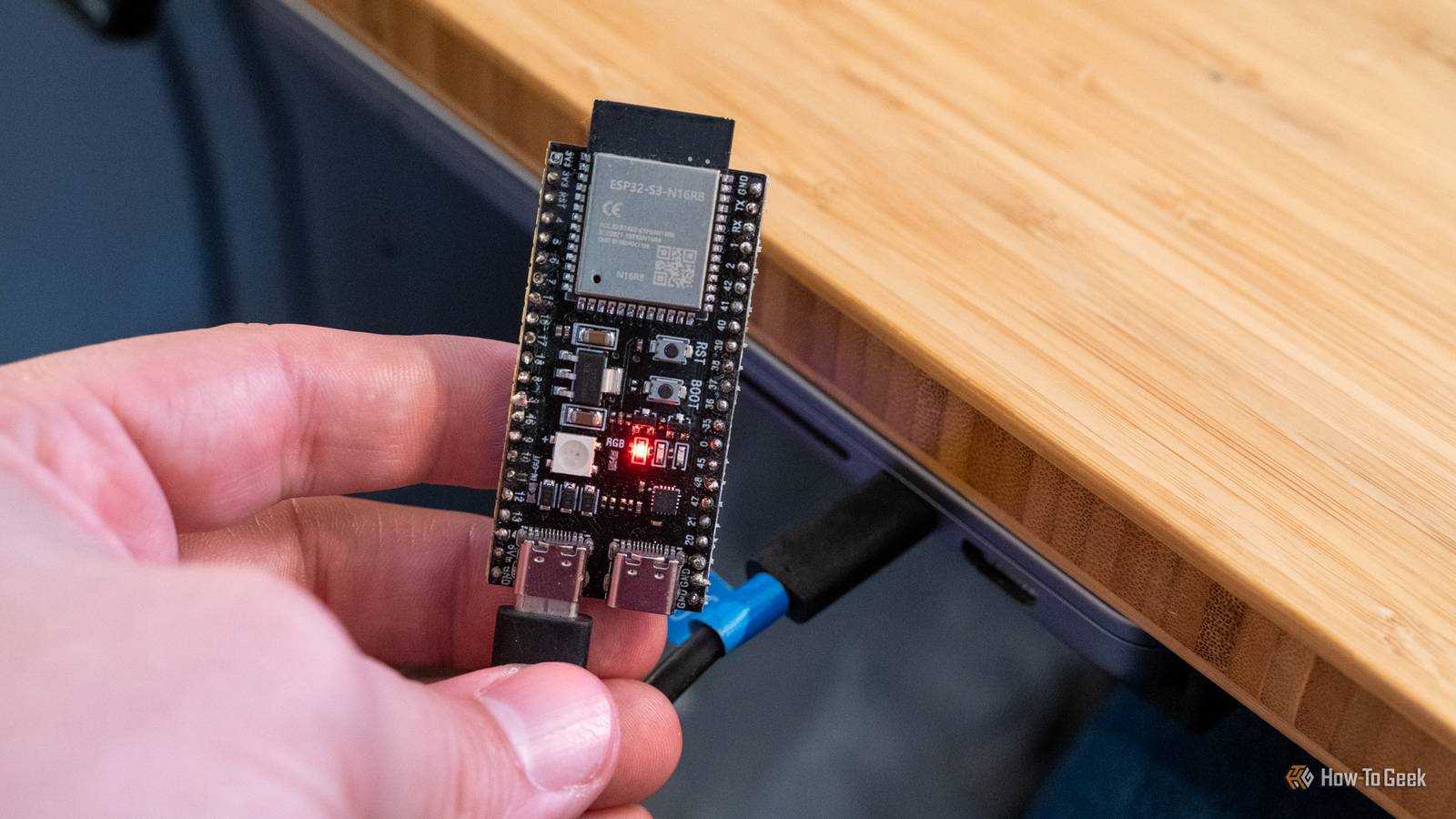
Published Nov 25, 2026, 12:00 PM EST Adam has a degree in Engineering and has a life-long interest in technology. He has been writing for over a decade for various print and online publications, with a focus on consumer tech. He joined How-To Geek in 2024 while working at Pocket-lint. As well as being a long-term fan of Apple products, he also has a strong interest in smart home tech, running a Home Assistant server at home to automate all his smart home devices. He believes that the ideal smart home should work with minimal interaction from the user, with automations running as if by magic rather than requiring you to push buttons on a control panel. You can find more of his work on Muck Rack. ESP32 development boards are hugely popular because they're relatively cheap and very versatile. You can use them to build simple Bluetooth proxies or create your own smart home sensors. There's a lot more that you can do with an ESP32, however. You may be surprised at some of the incredible things that are possible using this humble development board. Detect presence using just your Wi-Fi You can even detect breathing rate Presence sensors are a key part of my smart home. I use mmWave presence sensors to turn the lights on when we're in a room and turn them off when the room is empty again. I also use them to track how long I'm sitting at my desk, and to pause the TV when someone leaves the room briefly. Incredibly, a basic ESP32 can work as a presence sensor without any additional hardware. It works by analyzing Wi-Fi Channel State Information (CSI) to detect changes in the Wi-Fi signal reaching the ESP32 from your router when people pass through a room. I set it up in my living room using a generic ESP32 board, and it was able to detect my presence reasonably accurately. With a device correctly positioned, it's even possible to detect someone's breathing rate. Build long-range walkie-talkies Communicate wirelessly over ranges of more than 600 meters Credit: Aditya Verma You might not expect that an ESP32 would be useful for long-range wireless communication, but it's possible to get these boards to talk to each other over surprisingly long distances. ESP-NOW is a wireless communication system that lets ESP32 devices exchange data directly without needing a Wi-Fi router or any internet access. This can be used to allow a smart home to communicate with devices that are beyond the range of your router, but there are other uses. One example is a project that lets you build two walkie-talkies using ESP32 boards. Using external antennas, these walkie-talkies are able to send short audio messages over distances of more than 600 meters. Make things fly Cause tiny items to hover using sound Credit: Technische Universität Darmstadt If you were to make a list of all the things that an ESP32 could do, you probably wouldn't have "make stuff fly" written down. However, by hooking it up to the right hardware, that's exactly what you can do. Acoustic levitation is a technique that uses sound waves to keep tiny objects suspended in midair. Sound waves can exert pressure, and this can be enough to keep small objects floating against gravity. One example is AcoustiFly, an open-source project that uses an ESP32-S3 to control an ultrasonic transducer. Using a reflector, the device is able to levitate minuscule objects. The ESP32 is responsible for generating the perfectly timed signals necessary to drive the ultrasonic hardware and literally make stuff fly. Turn an ESP32 into a polyphonic synthesizer Make beautiful music with the tiny development board Synthesizers have been around for decades and have powered much of the best music of the 1980s and beyond. Small and inexpensive synthesizers have grown increasingly popular, with products such as the M-VAVE FM-1 proving to be a big hit. Synthesizers generate sounds purely electronically by producing waveforms and modifying their characteristics, and that's something that an ESP32 can do. ESP32Synth is an open-source audio-synthesis engine designed for ESP32 boards. It can play multiple voices at once (polyphony) and can handle stereo processing, digital audio effects, and more. The exact performance depends on your model of ESP32, but with suitable output hardware, such as an I2S DAC, it's possible to get low latency and play multiple voices, making your ESP32 a genuinely useful part of your music-making setup. Build your own Stream Deck A Cheap Yellow Display can help automate your workflows A Cheap Yellow Display (CYD) is an inexpensive ESP32 board with a built-in touchscreen display. This makes it a great choice for things such as small smart home dashboards or other controls. You can also use a CYD to build your own small Stream Deck. The buttons can be configured to send commands to software such as Home Assistant via ESPHome, but you can also configure the ESP32 to act as a Bluetooth Human Interface Device (HID) which makes the board appear as a Bluetooth keyboard to a paired computer. You can then use the touchscreen to trigger shortcuts, launch apps, and more. Host a fully interactive website The entire web server can fit on your ESP32 A typical ESP32 is far from being the most powerful microcontroller in the world. It has very little RAM and flash storage, which helps to make ESP32 boards so affordable. Despite the limited specs, however, an ESP32 can be all you need to run a web server. The beauty is that you can build a website that runs entirely locally, so that it's only accessible over your home network. I made a simple web page that allows family members to vote on what we're going to watch on TV or what we want for dinner. Everyone can vote from their own device, and the whole thing is hosted on a cheap ESP32. The sky is the limit with an ESP32 People continue to push the boundaries of what's possible using a simple ESP32 development board. This list covers just some of the incredible things that you can do using one. If you've never messed with ESP32 boards before, it's worth trying it out; it can be much easier than you might think.
6 things you'd never guess were possible with an ESP32
Full Article
Original Source
Read the full article at Howtogeek →KhanList aggregates and links to publicly available news content. We do not host full articles from third-party sources. Always verify important information with original sources.