
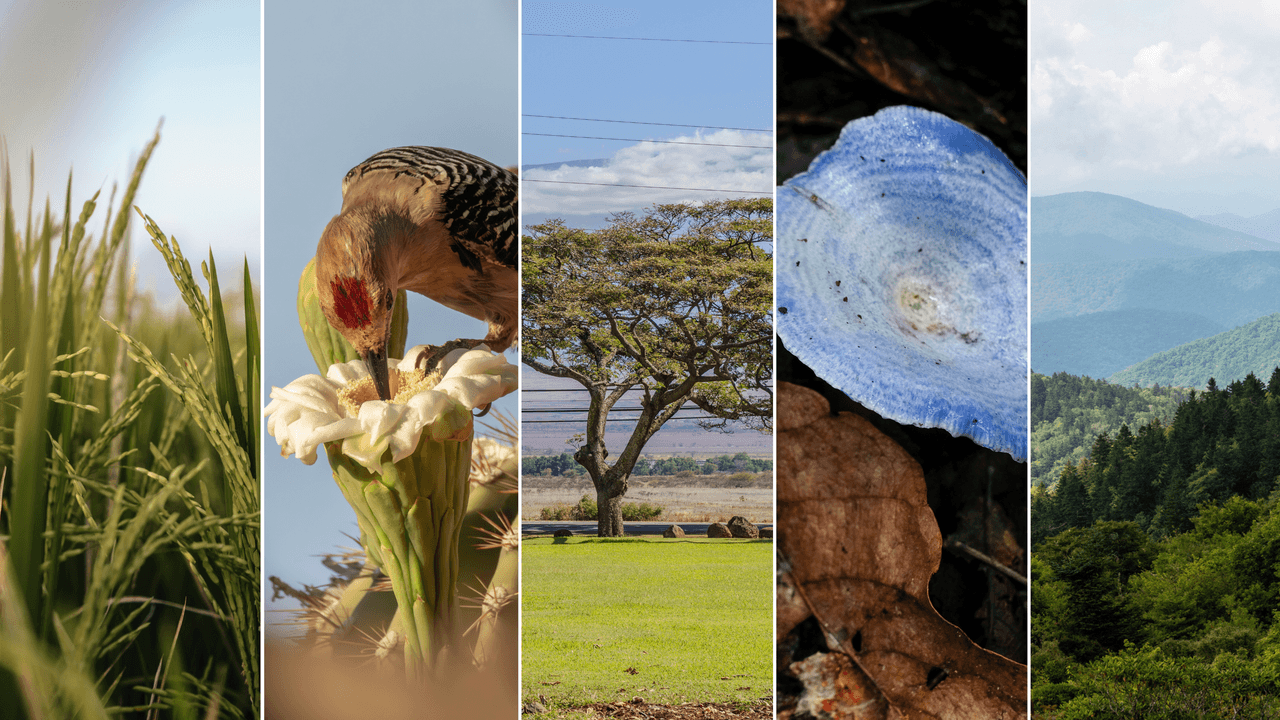
May we suggest harvesting wild rice in Minnesota, foraging for cacti in Arizona, or fishing for invasive catfish in Chesapeake Bay?Getty / UnsplashThis article is part of a series of stories on hunting, fishing, and foraging experiences in North America. Read more here.My boyhood summers tasted like wild fruit and fish. When I gathered blueberries from the pine and oak woods around my father’s New Hampshire home, he would stir their purple sweetness into pancake batter. When I pulled brook trout from the waters of a long-abandoned granite quarry, I would sauté them in a cast iron skillet until delicate flesh flaked from translucent bone.Mount Monadnock in New Hampshire, where the author learned how to forage and fish. GettyAt twenty, I went vegan and quit fishing. For food, I looked to the grocery store and, seasonally, the garden. Though I still gathered the occasional handful of berries or chanterelles, I took little sustenance directly from wild nature.Ten years later—my black-and-white dietary ethics shaken by the realities of agriculture and my body demanding a wider array of nutrients—I began a journey back to omnivory and the wild. I took up a fishing rod again. I paid more attention to mushrooms emerging from the forest floor. And I began learning to hunt.Striped bass GettyIndigo milk caps, an edible wild mushroom GettyPicking portobello-like indigo milk caps, casting for trout or striped bass, or sitting at the base of a maple with rifle in hand as dawn brightened the frosty deer woods, I began to remember that the land is a source not only of beauty but also of food, that the earth feeds our bodies as well as our souls. Over the past two decades, I have gradually awakened to this continent’s vast diversity of wild edibles and to the deep meanings wild foodways still carry across cultures. Many of us, of course, have lost these practices. We have forgotten how to eat wild.If you want to reconnect with the entire nature-to-plate experience, you need to get out there and harvest with your own hands. Even if you aren’t ready to dive into relearning ancient skills, across the country you can find opportunities to experience wild foods, each a gift flavored by local land and culture, each a chance to savor what a place tastes like, straight from the source.Sochan gathering in Great Smoky Mountains National Park is a Cherokee tradition. GettyForaging the forests of Asheville, North CarolinaPeople have walked the Blue Ridge Mountains in search of edibles since the end of the last Ice Age. Of the tens of thousands of species that inhabit the region’s lush and astonishingly biodiverse forests today, a handful dominate Asheville’s vibrant foraging and culinary scene.Ramps, or wild leeks, bring the earthy, garlicky promise of spring. Pawpaws, the continent’s largest edible native fruit, ripen in late summer and early fall, delivering a near-tropical blend of mango and banana to the tongue. And a bounty of edible fungi—from morels and black trumpets to lion’s mane, chanterelles, and chicken of the woods—fill mushroom hunters’ baskets in every season but winter.Overharvesting, both legal and illegal, has triggered some restrictions. In Great Smoky Mountains National Park, for example, the collection of ramps has been forbidden since 2004 and daily mushroom harvest is limited to a pound per person. The prohibition on gathering ramps extends to the Eastern Band of Cherokee, though a recent agreement with the National Park Service permits several dozen members to gather sochan within park boundaries.Outside the park, opportunities still abound for all. In the nearby Pisgah and Nantahala National Forests, for instance, you can gather up to three pounds (or one gallon) of ramps or mushrooms for personal use, though truffles and chaga are off limits. Even if you don’t see yourself setting off into the woods in search of dinner, or exploring foraging possibilities within Asheville itself, the area offers a cornucopia of ways to enjoy and learn about wild edibles.How to experience itNo Taste Like Home offers foraging tours, including a forage-to-table program that lets you bring wild ingredients to local restaurants, where chefs prepare them for you.The Market Place restaurant, a James Beard Award semi-finalist in 2025, often serves locally foraged mushrooms.At Asheville Farmers Markets, vendors offer pawpaws and other wild foods in season.The Rainbows and Ramps festival, hosted by the Eastern Band of Cherokee in late March, includes a meal featuring local ramps and rainbow trout.The early May Waynesville Ramp Convention features a ramp dinner and Appalachian music and dancing.A non-resident fishing license from D.C., Virginia, or Maryland lets you head out on your own. GettyBlue catfish are invasive to Chesapeake Bay and a predator of the ever-popular blue crab GettySwap blue crab for blue catfish in Chesapeake BayCovering nearly 4,500 square miles, the Chesapeake Bay and its tidal tributaries are famous for blue crabs, beloved by locals and visitors alike. Though the bay still supplies a significant portion of the nation’s catch, blue crab numbers have been impacted by habitat loss, overharvest, and predation.Among the crab’s predators are locally invasive blue catfish. Introduced to Virginia rivers decades ago, the fish have proved able to tolerate the saltier waters of the bay and are now outcompeting native species. To mitigate the negative impacts, diverse stakeholders—including scientists, government agencies, seafood producers, restaurants, and grocery stores—are working to build a thriving “River to Table” market.In recent years, Virginia and Maryland have each recorded millions of pounds in annual commercial blue catfish harvest. Though consumers are advised to eat smaller fish or to trim away belly fat and dark meat to remove contaminants, blue catfish is increasingly popular table fare. Delicious fried, grilled, smoked, or blackened, it is available in a growing number of restaurants and grocery stores around the region.You can also catch your own, with or without a fishing guide. In most tidal waters, neither state limits how many blue catfish recreational anglers can keep. If you go, be prepared for some big, hard-fighting fish. Blue cats regularly run 30-plus pounds and can get much larger.How to experience itFrom Skrimp Shack fast food to the elegance of Dauphine’s, many local restaurants serve blue catfish.Maryland’s Best maintains a catfish-focused directory of restaurants and grocery stores, including Wegmans, Safeway, and Whole Foods.Among many other local fishing guides, Capital Blues Fishing and Goober Time can help you catch your own.Depending on where you want to fish, a non-resident fishing license from D.C., Virginia, or Maryland lets you head out on your own for the day, week, or year.The Chesapeake Bay Maritime Museum gives visitors the chance to learn about the history of the bay, including its storied bounty of wild foods.Farmers Jeffry Bellcourt (standing) and Bob Libby harvest wild rice using traditional methods on Rice Lake in northern Minnesota. GettyHarvest wild rice by canoe in MinnesotaCenturies ago, the Anishinaabe migrated from the Atlantic coast to the western Great Lakes region. At the heart of their migration stories is a prophecy telling them to travel west until they found the place where food grows on water. That food was manoomin, or wild rice, an annual grass that grows in shallow water. An important traditional food for multiple Indigenous nations, wild rice (psiŋ in Dakota) continues to carry deep cultural meaning and is central to food sovereignty efforts in the western Great Lakes region.To harvest wild rice in late summer, two people work from a canoe, one navigating with a long forked pole, the other using a pair of smooth cedar sticks to gently bend tall stalks over the gunwales and tap the ripe grain loose. (Mechanized harvest has been banned in Minnesota since 1939.) Knowledge of when and how to harvest is passed down by other harvesters and comes with experience. Once dried and parched, grain must be separated from chaff. Though some people still use traditional methods, most finishing is now done mechanically.Nutty and smoky, manoomin works any time of day, from rice and berries with maple syrup for breakfast to a hearty stew for dinner. Natural wild rice grains are a mix of earthy hues and cook in 20 minutes or less. In contrast, “paddy” or “cultivated” variants grown in Minnesota and California are glossy black and take much longer. Minnesota law requires clear labeling to distinguish the two.Though Minnesota residents and nonresidents alike can purchase a wild rice license, harvesting and processing is a complex process. For Tribal communities, it is also an ancient and ongoing relationship. For those new to ricing, learning from experienced harvesters or attending a Tribal-led camp or educational event is a respectful place to begin. Visitors can also support Tribal communities by purchasing manoomin directly from them.How to experience itThe Minnesota Department of Natural Resources posts harvest outlooks and maps on its wild rice management page. Generally, state-managed waters are open to public harvest, while federally- and tribally-managed waters are not.Indígena by Owamni in Minneapolis serves manoomin, among many other wild and cultivated foods native to the Americas.Autumn Harvest Ojibwe Wild Rice sells wood-fire-parched rice at the St. Paul Farmers’ Market.Native Harvest, part of the White Earth Land Recovery Project, sells wild rice online.Festivals, camps, events, and workshops organized by Tribal nations, intertribal organizations, and municipalities offer opportunities to learn about (and eat) wild rice, especially in September.Restaurants across Pensacola, Florida offer fishermen the option to cook their catch. UnsplashHarbor Docks combines fishing trips with restaurant preparation. UnsplashCook your catch in Pensacola, FloridaDubbed the “Gloucester of the Gulf,” the commercial fishing hub of Pensacola, Florida, anchored a late 19th- and early 20th-century fishery that hauled in millions of pounds of red snapper each year. After World War II, recreational fishing surged as well. The pressure, combined with bycatch from shrimp trawlers, proved too much: between 1950 and 1990, red snapper numbers plunged. Since the 1990s, federal managers have capped the annual catch, split it between commercial and recreational fishermen, and limited anglers to two fish per day.Sweet, mild, and firm, red snapper can be roasted as Snapper Veracruzana, fried as snapper bites, baked whole with Thai seasonings, or grilled with lemon sauce. You’ll find it at seafood markets along the Florida panhandle and Alabama coast. You’ll also find it at restaurants, many of which will cook your catch. Snapper season peaks in summer but often runs into fall.Many snapper are released because they’re undersized, out of season, or over the two-fish limit. When anglers reel up a snapper from deep water, the fish’s swim bladder often expands, leaving it unable to swim back down. To keep released fish alive, Florida Sea Grant’s Return ’Em Right program urges anglers to use descending devices, which return fish quickly to depth, and offers free devices to those who complete an online course. In recent years, federal rules have also required anglers to carry them.How to experience itJoe Patti's Seafood, a Pensacola waterfront market since 1930, sells red snapper fillets and other Gulf seafood.Numerous local guide services, including Panhandle Charters, Pelican Adventures, and O Sea D Fishing Charters, offer snapper-focused fishing trips.Many restaurants in Destin, Pensacola, and Orange Beach will cook your cleaned catch, and some, like Harbor Docks, combine fishing trips with restaurant preparation.Each October, the Destin Fishing Rodeo offers a month-long fishing tournament experience for anglers of all ages.State and federal laws ban nearly all sale of wild game in the US, but federal rules allow USDA inspection and then sale of some non-native species, including axis deer. Pu‘u O Hōkū RanchHunt for invasive axis deer in HawaiʻiIn the 1860s, the British colony of Hong Kong gave the Kingdom of Hawaiʻi eight axis deer. The beautiful spotted animals, native to India, were released on the island of Molokaʻi. In the absence of predators, they multiplied swiftly. In 1959 and 1960, nine deer were relocated to Maui. There, too, numbers soared.Alongside other large herbivores, none of which are native to Hawaiʻi, axis deer have devastated crops and stripped hillsides of drought-stressed vegetation, allowing rain to erode soil and sweep it into wetlands and onto coral reefs, harming critical habitats. To accelerate deer control measures, Hawaiʻi has issued more than two dozen emergency proclamations in recent years.Many families hunt deer and prize the meat, especially on Molokaʻi, but hunting alone hasn’t kept numbers in check. So islanders have turned to an unconventional solution: commercial harvest. State and federal laws ban nearly all sale of wild game in the US, but federal rules allow USDA inspection and then sale of some non-native species, including axis deer. In 2007, Molokaʻi hunter Desmund Manaba became the first in Hawaiʻi to win approval to harvest axis deer and sell the meat. In 2012, Maui County backed a harvesting cooperative of its own.Today, shooters working for Maui Nui Venison take deer from private ranches each night. Fresh or processed into snack sticks, most of the meat is sold. A portion is distributed for free to local families through the company’s Holo ʻAi program, which the company links to Hawaiʻi’s long tradition of food-sharing and which helped ensure food security during the COVID-19 pandemic and after the devastating 2023 wildfires.How to experience itAmong other restaurants, Tiffany’s in Wailuku, Gather on Maui, and Ulupalakua Ranch serve local axis venison.If you’d like to cook your own, you can buy Maui Nui Venison online and in local stores.With a nonresident license and hunter education from Hawaiʻi or another state, you can hunt in a public game management area.You can also hunt with a professional outfitter, such as Pu‘u O Hōkū Ranch on Molokaʻi, which offers conservation-focused hunts as well as cabins and a lodge.Prickly pear fruit can be eaten raw or squeezed into juice. GettyVisitors to Arizona's Sonoran Desert can purchase wild foods gathered by O’odham harvesters. GettyGather the fruits of the desert in Tucson, ArizonaThe word “desert” may conjure ideas of emptiness, barrenness, a lack of life. Sitting on the eastern edge of the Sonoran Desert, Tucson, Arizona, dispels all such notions. Designated as a UNESCO Creative City of Gastronomy in 2015, Tucson boasts both the longest continuous agricultural history of any city in the United States and a rich set of wild foods traditions.Among other plants, cacti are on the menu. For millennia, Tohono O’odham people have gathered food from—and maintained vital relationships with—multiple species, following a calendar set by the desert’s two rainy seasons. From late summer into fall, during and after the summer rains, people harvest prickly pear fruit, which can be eaten raw or squeezed into juice. In spring, after the winter rains, harvesters pluck cholla buds. Reminiscent of lemony asparagus tips, they can be cooked and eaten fresh or dried for later use.In June, before the summer rains return, people gather saguaro fruit, knocking it from towering cacti with a kuipad, a long pole made of saguaro ribs, then dry the protein-rich seeds and make jam from the fruit. They also make syrup, fermenting some into wine for the rain ceremony that marks the O’odham New Year.Foraging is prohibited in Saguaro National Park, with exceptions for O’odham harvesting traditions. Though gathering is legal on private land with permission, participating in guided harvests and walks is an ideal place to begin. You can also purchase foods gathered by O’odham harvesters.How to experience itSan Xavier Co-op Farm, run by members of the Tohono O’odham Nation, sells wild foods, including cholla buds and mesquite flour.Mission Garden hosts public events and classes and grows heritage crops on an O’odham site that has been under cultivation for 4,000 years.The Tohono Chul Sonoran Botanic Garden offers guided walks from September through May and the Arizona-Sonora Desert Museum offers a guided saguaro fruit harvest each June.Sonoran House Sam Hughes, Barrio Bread, and Ursa use local ingredients, including prickly pear and mesquite.The Tucson Meet Yourself festival, held each October, features many local food vendors.
6 Places in the US Where Travelers Can Hunt, Fish, or Forage for Their Own Food
Full Article
Original Source
Read the full article at Cntraveler →KhanList aggregates and links to publicly available news content. We do not host full articles from third-party sources. Always verify important information with original sources.