
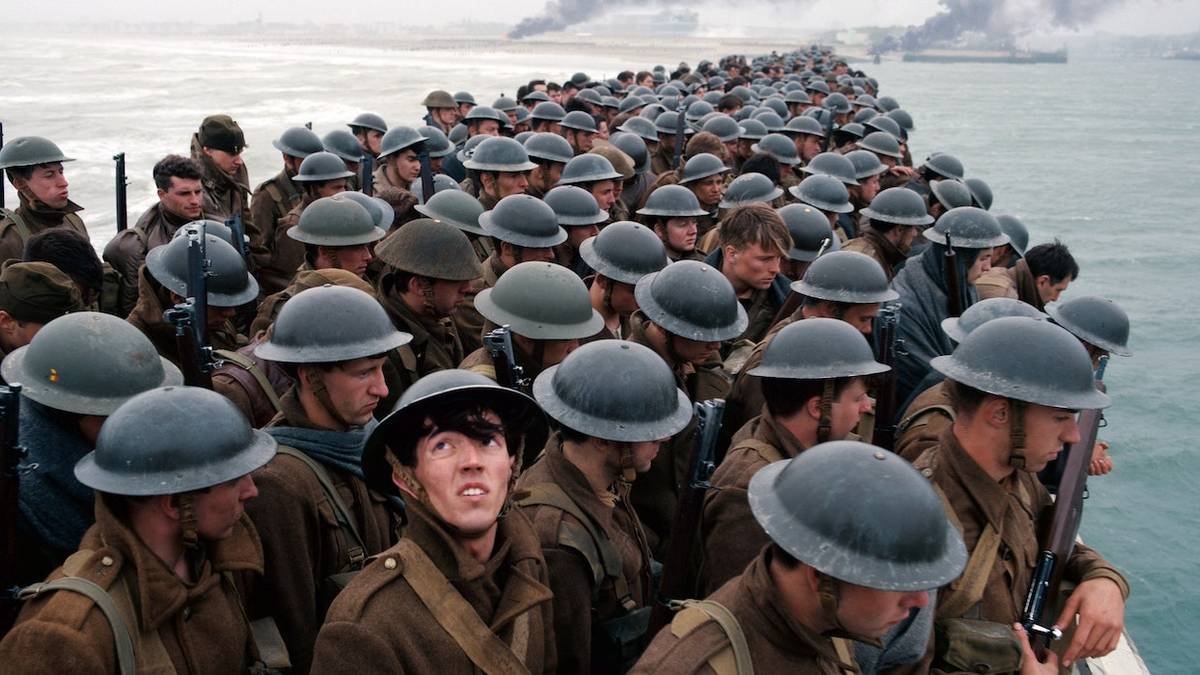
Image via Warner Bros. Pictures Published Nov 21, 2026, 11:21 PM EST Ben Brewster is a filmmaker, critic, screenwriter, and actor whose work sits at the intersection of film culture, craft analysis, and storytelling. He is a movie list contributing writer at Collider and a contributing writer for High on Films, where he covers contemporary cinema, independent film, and festival releases with an eye toward narrative structure, performance, and visual language. Ben is an active film festival participant, having worked with Newport Film, the Nantucket Film Festival and as a screener for the Austin, Boston & Woodstock film festivals. He brings to that work a programming instinct shaped by years of close engagement with independent and documentary cinema. This comes with a deep investment in the kinds of films that rarely find their way into the mainstream conversation without someone willing to advocate for them. His background spans documentary and narrative filmmaking, film marketing, and production, including work with award-winning directors. This as well as developing his own indie production company, Lilac Creative Studio, through which he develops and produces original work across fiction and nonfiction forms. His debut documentary, Diamond in the Rust, is an examination of economic redevelopment and displacement in the Queens area of New York City. The film was recently accepted to the Unisphere Film Festival, the Defense of Democracy Film Festival, and the Urbanite Arts & Film Festival. This would mark his first festival recognition as a director. In addition to his writing and programming work, Ben hosts Beneath the Bloom, a film podcast exploring the work behind the scenes in cinema, and the struggles one can face to make a movie become a reality. The show reflects the same sensibility that runs through all of his work. A conviction that film is not merely entertainment but one of the most powerful tools human beings have for understanding each other. Across mediums, his work is driven by a deep belief in film as a communal, transformative art form. Sign in to your Collider account In the 2010s, war films felt odd and hard to pin down. The fighting in Iraq and Afghanistan was still running its course. At the same time, World War II veterans were passing away one by one. Hollywood looked two ways in response. It nodded back to the older "good war" stories that shaped the genre for years. It also faced newer conflicts that did not end neatly. No clear heroes always showed up. Because of that, many movies seemed to argue with each other about what a war film is supposed to do and what it is supposed to stand for in this decade. The top films from that era share one main trait: intensity. This was the period of films that try to place you right in the middle of events. Directors like Christopher Nolan and Sam Mendes leaned into big, crisp images and shots that do not cut away for a long time. The goal was simple, even if the work was not. Put the viewer in the mud and the water. Other filmmakers, including Kathryn Bigelow and Peter Berg, leaned toward a documentary kind of drive. Their stories often felt like they came straight from headlines. Even the sound mattered a lot. In several cases, major awards recognized the way these films made gunshots, machinery and quiet hit hard in the gut. Some movies in this list got mixed reviews from critics. A few of the highest earners also stirred strong reactions. This happened most often when the films dealt with tense recent history. If you sort them by Rotten Tomatoes scores, you get a quick, not necessarily wholistic view of what some critics thought at the time. That method is by no means perfect. Scores do not always say how a film has held up later. They also do not always match what viewers liked. The range here is wide. There are grim POW survival stories. There are also very detailed retellings of real military missions, scene by scene. These are the most intense war films of the decade, ranked. 6 'Unbroken' (2014) Image via Universal Pictures Angelina Jolie directed Unbroken, based on Laura Hillenbrand's 2010 book about Olympic runner and bombardier Louis Zamperini. The film stars Jack O'Connell as Zamperini, who survives a plane crash in the Pacific. He drifts on a raft for 47 days before being captured and taken away by the Japanese. O'Connell plays him with a wiry, stubborn energy, with Jolie cutting between flashbacks to his boyhood and his running days in between the horrors. He lands in prison camps under the cruel corporal Watanabe (Miyavi), known as the Bird, who runs the prison camp. The great Roger Deakins captured the open ocean and shot the muddy camps in wide, painterly-like frames. Joel and Ethan Coen, Richard LaGravenese, and William Nicholson share the screenplay credit. Unbroken opened on Christmas Day 2014 and grossed $163 million worldwide. Rotten Tomatoes lists Unbroken at 52%, and its consensus calls it well-intentioned but too dependent on overly familiar prestige war genre beats. Deakins earned an Oscar nomination for his cinematography, and the National Board of Review named the film one of its top ten of the year, despite the Oscar bait it had written all over it. Many felt the story became a long parade of suffering, although the audience score was friendly, landing at 70%. Zamperini died in July 2014, a few months before it opened, and a faith-based sequel, Unbroken: Path to Redemption, followed in 2018. 5 'American Sniper' (2014) Image via Warner Bros. Clint Eastwood directed American Sniper at age 84. It is a biopic of Navy SEAL Chris Kyle, the most lethal sniper in U.S. military history. He's a Texas cowboy who netted the nickname Legend for his pinpoint accuracy in Iraq. Bradley Cooper bulked up for the role, and plays Kyle across four tours in Iraq, as he struggles to connect with his wife at home, Taya (Siena Miller). Jason Hall adapted the script directly from Kyle's memoir, with the film cutting from Iraqi rooftops to quiet kitchen scenes in Texas. Rotten Tomatoes lists it at 71% from critics and 84% from audiences, and moviegoers gave it an A+ CinemaScore. The opening scene, in which Kyle must decide whether to fire at a child carrying a grenade, sets a tense tone. A rival sniper known as Mustafa gives the story a cat and mouse thread. Cooper earned a Best Actor nomination, one of six Oscar nominations that included Best Picture and a win for Sound Editing. American Sniper grossed $547.6 million worldwide on a $58 million budget, marking it as Eastwood's highest grossing film, and the biggest January release ever up to that point. Controversy followed, with critics arguing about its heroic portrait of Kyle and its historical liberties. More than a decade later, it landed in Netflix's top 10 with 4.4 million views in a single week. 4 'Fury' (2014) Image via Sony Pictures Releasing David Ayer wrote and directed Fury, which follows a five-man Sherman tank crew pushing through Germany in April 1945. It's when the war's last days are its most brutal, and Brad Pitt plays Wardaddy, a battle-scarred sergeant who has kept his crew alive since North Africa. Logan Lerman is Norman Ellison, a young typist forced into the crew, with Shia LaBeouf, Michael Peña, and Jon Bernthal as the veterans who both mock and protect him. Ayer allegedly put the cast through a brutal boot camp before filming. Fury grossed $211.8 million and opened at No.1 at the box office on a budget of about $68 million. The production used a real Tiger tank, Tiger 131, the only operational Tiger in the world. Rotten Tomatoes lists it at 75% from critics, and 84% from audiences. The consensus calls it a well acted, raw depiction of war that does not fully live up to its lofty ambitions. James Berardinelli praised how it shows the horrors of war without reveling in cruelty, while LA Weekly's Amy Nicholson felt that Ayer wallowed in ugliness. Ayer drew on the real 2nd Armored Division, nicknamed Hell on Wheels. 3 '1917' (2019) Image via Universal Pictures 1917 follows two young British soldiers on a single day in April 1917, and Sam Mendes built it to look like one unbroken shot. George MacKay and Dean-Charles Chapman play Lance Corporals Schofield and Blake, two young British soldiers sent across no man's land to deliver a message that could save 1,600 men from a German trap. Mendes co-wrote the story with Krysty Wilson-Cairns, drawing on tales his grandfather Alfred Mendes told him about WWI. Roger Deakins shot through trenches, craters, and rivers, and captured a burning town without a visible cut. Colin Firth, Benedict Cumberbatch, Mark Strong, and Andrew Scott appear in brief but memorable roles. Rotten Tomatoes lists 1917 at 88% from 472 reviews, and its consensus calls it hard-hitting, immersive and an impressive technical achievement. The movie won three Oscars, garnering a Best Picture nomination as well. It also took home the BAFTA for Best Film and the Golden Globes for Best Motion Picture, Drama and Best Director. The night sequence in a burning town lit by flares and the final run across the battlefield are the most visually stunning sequences. 2 'Zero Dark Thirty' (2012) Image via Columbia Pictures Zero Dark Thirty opens with darkness and the sound of real 9/11 calls. Kathryn Bigelow directed the film off a script from Mark Boal, her collaborator on The Hurt Locker. Bigelow constantly stresses the stakes, with Jessica Chastain as the lead Maya, a CIA analyst whose obsession has driven a decade's worth of work hunting Osama bin Laden. The film then pivots to harsh and brutal interrogation scenes, with Jason Clarke playing the interrogator Dan, and Jennifer Ehle, Kyle Chandler, Mark Strong, and Joel Edgerton rounding out the cast. Rotten Tomatoes lists it at 91% from 304 reviews, with an 80% audience score. Boal's script moves like a procedural, with offices, briefings, and dead ends. Critics called it gripping, suspenseful, and brilliantly crafted. Chastain earned an Oscar nomination for Best Actress, and the movie tied with Skyfall for Best Sound Editing. The final 30 minutes recreate the May 2011 raid on the Abbottabad compound in dim green night vision, and the sequence is considered among the most tense in modern war movies. Controversy surrounding its torture scenes has never faded, and some critics now see the movie differently after the 2014 torture report. 1 'Dunkirk' (2017) Dunkirk divides its story into three timelines, one week on the beach, one day at sea, and one hour in the air. Christopher Nolan depicts the 1940 evacuation of Allied troops through the perspective of Tommy (Fionn Whitehead), a young solider hunting for any way off the sand, and Harrier (Tom Hardy), a spitfire pilot with a failing fuel gauge. Mark Rylance is a man named Mr. Dawson, a civilian who sails his boat across the channel to help rescue troops. Kenneth Branagh, Cillian Murphy, Harry Styles, Barry Keoghan and Jack Lowden appear in the ensemble. Hoyte van Hoytema shot it in large format, and Hans Zimmer's score keeps a ticking clock running in the background. Rotten Tomatoes lists Dunkirk at 92%, with an 81% audience score. Nolan used real ships and planes which gave the beaches and skies a physical weight. The consensus describes the project as an emotionally satisfying spectacle from a writer-director in full command of his craft. Dunkirk grossed more than $500 million worldwide and saw eight Oscar nominations, including Best Picture and Best Director. Between the grand practical effects, the dialogue is sparse, and the sound design carries much of the tension. Critics have called it one of the most immersive war movies ever and one of the best movies of the 2010s.
6 Intense War Films of the 2010s, Ranked by Rotten Tomatoes Score
Full Article
Original Source
Read the full article at Collider →KhanList aggregates and links to publicly available news content. We do not host full articles from third-party sources. Always verify important information with original sources.