
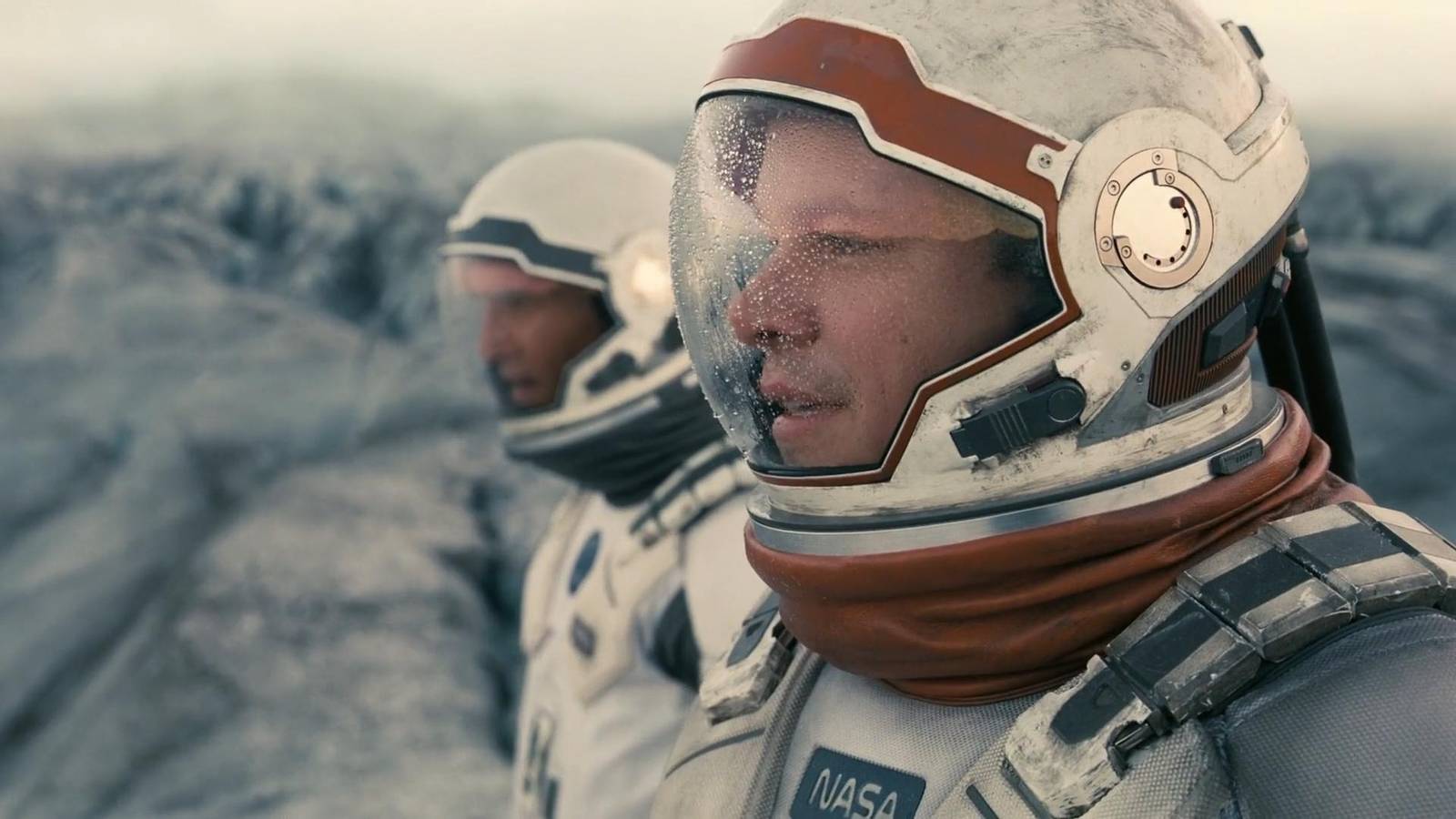
Published Nov 11, 2026, 7:07 AM EST Senior Music Editor at Screen Rant, Sarah's love of sound and story drive the beat. A globetrotting brand whisperer and award-winning journalist, she’s built cross-cultural narratives around the world—but music has always been her true north. She launched DJ Mag North America, successfully introducing the iconic UK brand to the U.S. market. Previously, she carved a space for EDM inside the pages of VIBE, blending electronic and hip-hop culture long before it was trendy. Christopher Nolan's Interstellar accomplished something otherwordly: It made theoretical physics emotionally devastating. With Matthew McConaughey traveling through wormholes, confronting black holes, and watching decades disappear while his daughter grows older on Earth, the 2014 epic brought some seriously complicated science into mainstream cinema. As Screen Rant's examination of Interstellar's scientific accuracy explains, physicist Kip Thorne helped ground its more ambitious ideas in legitimate scientific theory. Yet Interstellar isn't untouchable. For all its spectacle and intellectual ambition, other filmmakers have taken similarly challenging scientific concepts and produced movies that are tighter, more unsettling, or arguably more emotionally satisfying. And while hard sci-fi movies that rival Project Hail Mary demonstrate the genre's enduring appeal, scientific credibility alone doesn't guarantee a great film. The best hard science fiction establishes rules while taking its science seriously. It then explores what happens when human beings confront the consequences. These six hard sci-fi movies approach that challenge from wildly different directions, and each has a compelling claim to surpass Nolan's celebrated epic. Primer (2004) Interstellar reportedly cost $165 million to produce. Shane Carruth made Primer for approximately $7,000, and somehow created one of cinema's most intellectually demanding time-travel stories. The premise involves two engineers, Aaron and Abe, who accidentally discover that a machine they've been developing can manipulate time. Naturally, they begin experimenting, eventually discovering that controlling the past is considerably harder than it sounds. Unlike most time-travel movies, Primer refuses to simplify its mechanics for the audience. Its characters talk like actual engineers, the technology has specific limitations, and each experiment introduces consequences that become increasingly difficult to untangle. There's a reason it belongs among the sci-fi movies that demand multiple viewings. Carruth's film has no interest in grand declarations about humanity's place in the universe. Instead, it examines what happens when two intelligent, deeply flawed men acquire technology they barely understand. Its scientific premise is speculative, but the characters' methodical approach gives Primer a remarkable sense of authenticity. Where Nolan offers cosmic wonder, Carruth delivers something considerably more disturbing. Ex Machina (2014) Alex Garland's Ex Machina confines most of its story to a secluded research facility, yet the questions it raises are enormous. Domhnall Gleeson plays Caleb, a programmer invited by his company's billionaire CEO, Nathan (Oscar Isaac), to evaluate an advanced humanoid artificial intelligence named Ava (Alicia Vikander). What initially appears to be a controlled experiment soon becomes a psychological battle between three characters with competing motives. The film draws on genuine questions surrounding artificial intelligence, consciousness, and the Turing test, even as its technology ventures beyond current capabilities. Like the different replicants in Blade Runner 2049, Ava challenges the assumption that humanity can manufacture intelligence without confronting the ethical consequences. What makes Ex Machina particularly effective is Garland's refusal to provide easy answers. Nathan's arrogance is every bit as dangerous as his invention, while Caleb's confidence in his own judgment becomes increasingly misplaced. Interstellar uses science to explore humanity's capacity for love. Ex Machina wonders whether our understanding of human behavior might be precisely what makes us vulnerable. Gattaca (1997) Andrew Niccol's Gattaca arrived years before modern genetic technologies made its premise feel uncomfortably plausible. Set in a future where genetic screening determines a person's professional opportunities, it follows Vincent Freeman (Ethan Hawke), a naturally conceived man whose supposedly inferior DNA prevents him from becoming an astronaut. His solution is to assume the genetic identity of Jerome Morrow (Jude Law), a genetically privileged former athlete. The film's understanding of genetic determinism is deliberately exaggerated, but its central warning remains remarkably relevant. As with several '90s tech thrillers that seem less ridiculous today, Gattaca imagines a technological advancement becoming dangerous through the institutions that control it. Niccol is particularly interested in the consequences of allowing scientific predictions to determine human potential. Perhaps its greatest achievement is making an argument about genetics feel deeply personal. Vincent's desperation to reach space has nothing to do with saving humanity. He simply refuses to accept that his future was decided at birth. Interstellar reaches for the emotional significance of crossing galaxies, while Gattaca finds something equally profound in one man's determination to get there. The Martian (2015) Matt Damon went from playing Interstellar's least trustworthy astronaut to one of cinema's most resourceful in the space of a year. Ridley Scott's The Martian, adapted from Andy Weir's novel, follows Mark Watney, a botanist accidentally abandoned on Mars after his crew believes him dead. With limited supplies and no immediate means of contacting Earth, Watney must figure out how to survive long enough for someone to rescue him. Rather than relying on impossible technology, The Martian builds its suspense around practical scientific problems. Watney cultivates potatoes, manufactures water, and improvises solutions using his knowledge of botany and chemistry. The film takes liberties with certain details, particularly the strength of its opening Martian dust storm, but remains unusually committed to portraying space exploration as an engineering challenge. Scott also recognizes something that Interstellar occasionally overlooks: Complicated science can be genuinely entertaining without an accompanying existential crisis. Damon's humor provides welcome relief, while the rescue effort generates tremendous suspense. Where Nolan's film can become overwhelmed by its own ambitions, The Martian maintains an appealing clarity of purpose. Sometimes the most impressive thing a science-fiction hero can do is stay alive. Rearrange the movies into the correct US release order. Long before Matthew McConaughey traveled through space in Interstellar, he appeared in another ambitious science-fiction movie exploring humanity's place in the universe. Robert Zemeckis' Contact, adapted from Carl Sagan's novel, stars Jodie Foster as Dr. Ellie Arroway, a scientist searching for extraterrestrial intelligence who discovers a mysterious signal originating from the star Vega. Sagan's scientific background informs the film's detailed portrayal of radio astronomy and the search for intelligent life. Although the story eventually ventures into speculative physics, Contact spends much of its running time examining how scientists might actually respond to evidence that humanity isn't alone. Its treatment of discovery is patient, methodical, and surprisingly suspenseful. Foster gives one of the finest performances in science-fiction cinema, portraying Ellie's devotion to empirical evidence alongside an intensely personal longing for answers. Her relationship with McConaughey's Palmer Joss introduces a thoughtful conflict between scientific proof and religious faith. Interstellar shares many of these preoccupations, but Contact approaches them with greater restraint. Its ambiguous conclusion trusts audiences to wrestle with the questions long after the credits roll. 2001: A Space Odyssey (1968) More than four decades before Interstellar, Stanley Kubrick and Arthur C. Clarke fundamentally changed what science-fiction cinema could accomplish. 2001: A Space Odyssey follows humanity's evolution from prehistoric beginnings to an extraordinary encounter with an intelligence beyond human comprehension. Along the way, a mission to Jupiter becomes a terrifying confrontation between astronauts and HAL 9000, the spacecraft's increasingly dangerous artificial intelligence. Kubrick's attention to scientific detail was extraordinary for its era. From the silence of outer space to the rotating spacecraft designed to simulate gravity, 2001 portrayed space travel with a realism that continues to impress. Its influence on Nolan is unmistakable, and it remains essential viewing among the science-fiction movies recommended by Christopher Nolan. Yet the film's greatest achievement extends beyond its scientific credibility. Kubrick allows imagery, music, and unsettling stretches of silence to communicate ideas that lesser movies would laboriously explain. HAL's quiet menace is more frightening than most cinematic villains, while the enigmatic final sequence remains open to interpretation nearly 60 years later. Interstellar is an extraordinary achievement in modern science fiction, but 2001: A Space Odyssey established much of the cinematic language that made Nolan's film possible. It remains the standard against which ambitious space movies are measured. Release Date April 10, 1968 Runtime 149 minutes Director Stanley Kubrick Cast Keir Dullea Dr. David Bowman Gary Lockwood Dr. Frank Poole
6 Hard Sci-Fi Movies Even Better Than Interstellar
Full Article
Original Source
Read the full article at Screenrant →KhanList aggregates and links to publicly available news content. We do not host full articles from third-party sources. Always verify important information with original sources.