
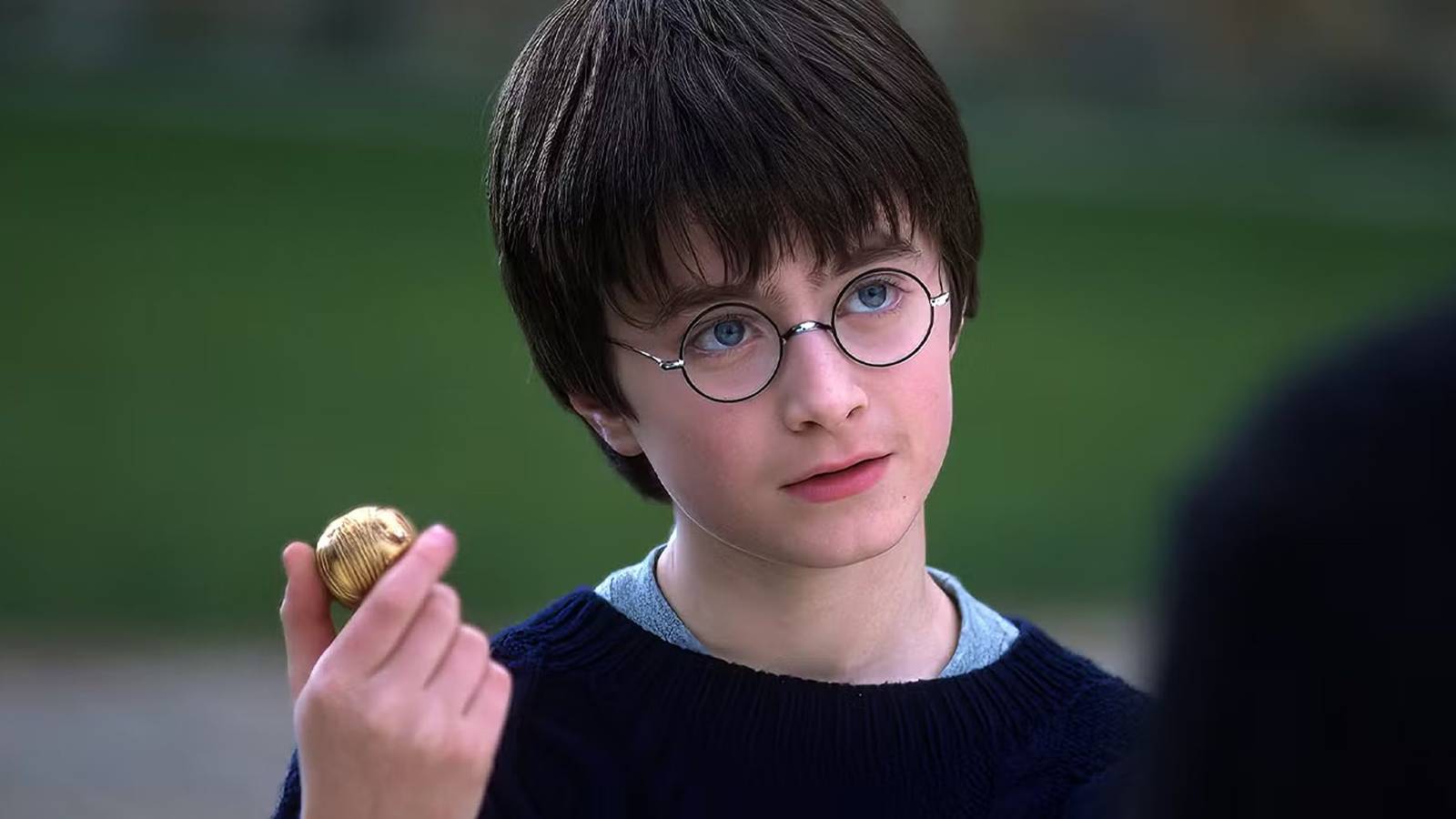
Image via Warner Bros. Published Nov 6, 2026, 7:46 AM EST Sign in to your Collider account Harry Potter showed us how magical it feels to grow up alongside characters you love. These six books capture different parts of that experience, from discovering worlds you never knew existed to facing dangers that change who you are. And the worlds themselves are just as inviting. There's a twelve-year-old criminal mastermind caught in a standoff with fairies, a kingdom trapped in endless winter, and a wardrobe that leads four siblings straight into its troubles. Yet beneath all that magic, the books on this list are filled with friendship, difficult choices, and characters worth caring about, and that is what made Harry Potter so memorable in the first place. Let's get started. 6 ‘Artemis Fowl’ (2001) Image via Hyperion Books Artemis Fowl begins with a boy who seems impossible to root for, twelve-year-old Artemis kidnaps Holly Short, a fairy officer, and demands ransom to restore his family’s fortune. He already has a plan, a captive, and a price. Then the fairies arrive as an armed, organized, technologically advanced force, unlike the harmless folklore Artemis thinks he can outsmart. The siege becomes a contest between Artemis’s confidence that everything can be controlled and Holly’s refusal to accept his rules. Butler’s loyalty gives Artemis’s schemes a human cost. At the same time, Holly’s courage forces him to recognize a mind he cannot simply buy. That uneasy change is the book’s real pleasure. Eoin Colfer makes intelligence exciting, then asks what it’s worth if Artemis uses it only to serve himself. 5 ‘Nevermoor: The Trials of Morrigan Crow’ (2017) Image via Orion Children's Books Morrigan Crow has been blamed for every misfortune around her, and she expects to die on her eleventh birthday. Then Jupiter North takes her to Nevermoor, where she must compete for a place in the Wundrous Society. The challenge is that the trials demand a special talent, and Morrigan is convinced she has none. That makes the competition more affecting than a string of clever tests. Above all, Morrigan is testing whether Jupiter’s belief in her is real, and if the first person who ever chose her will keep choosing her. The city’s oddities and the Society’s dangerous trials bring plenty of fantasy adventure, but the question underneath them is painfully recognizable, what if everyone else has already decided what you’re worth? Jessica Townsend turns Morrigan’s search for home into the real engine of Nevermoor. It is a brilliant, unforgettable start to the series. 4 ‘The Lightning Thief’ (2005) Image via Hyperion Books Percy Jackson’s voice is the first reason to read The Lightning Thief. He meets danger with suspicion, jokes, and the particular irritation of a kid who keeps being told that his life is his own fault. When Zeus’s master lightning bolt is stolen and Percy becomes the prime suspect, he travels across the country with Grover and Annabeth to return it before the gods’ conflict becomes a war. With Rick Riordan at the helm, Greek mythology becomes Percy's immediate reality, where classroom myths suddenly become the rules for surviving monsters, gods, and betrayal. Percy’s friendship with Annabeth grows through shared danger. Then, Luke’s choice gives the ending a sting that lasts beyond the quest. The book is funny, but the jokes never make Percy’s fear or loyalty feel trivial. It’s fast, witty, and every bit as addictive as a trip to King's Cross. 3 ‘Northern Lights’ (1995) Image via Scholastic Lyra Belacqua lives among the scholars of Jordan College with Pantalaimon, her dæmon, who can change shape. When children begin disappearing, including Lyra’s friend Roger, she follows their trail north. At Bolvangar, she finds the Gobblers’ terrible work as they cut children away from their dæmons. Philip Pullman makes that horror personal by giving the missing children names, friendships, and futures Lyra wants to protect. Lyra is brave, but she is still a child making choices with incomplete knowledge. That matters most at the end, when Lord Asriel uses Roger’s death to open a passage between worlds. Lyra follows him through it with Pan. It doesn't let you rest easy for a second, abruptly stealing away the comfort of a clean rescue. Pullman gives the reader a victory, a profound loss, and a reason to follow Lyra into the next book. 2 ‘A Wizard of Earthsea’ (1968) Image via Gollancz In Ursula K. Le Guin’s A Wizard of Earthsea, Ged’s trouble starts because he wants to prove how powerful he is. At the school of wizardry on Roke, he attempts a forbidden spell and brings a shadow-creature into the world. From then on, his education has less to do with winning approval and more to do with accepting responsibility for what he has done. The book gives its magic rules real moral weight, proving that names matter, power has limits, and trying to dominate what you fear only makes matters worse. Ged spends much of the book fleeing the creature he unleashed. At last, he turns to face it and speaks its name, which happens to be his own. The resolution is startlingly simple and deeply earned. Instead of relying on brute strength, Ged overcomes the shadow by finally understanding what he has been running from and accepting it as part of himself. That is a wizard’s story with real wisdom in it. 1 ‘The Lion, the Witch and the Wardrobe’ (1950) Image via HarperCollins In The Lion, the Witch and the Wardrobe, Lucy steps through a wardrobe and finds Narnia under the White Witch’s rule, frozen in winter. Edmund’s meeting with the Witch makes the danger personal when he wants her approval and the Turkish delight she offers, betraying his siblings to get both. The novel lets that choice stay ugly. Edmund acts out of genuine selfishness, putting the people he loves at risk. Then Aslan offers himself in Edmund’s place. The Stone Table, the Witch’s bargain, and Aslan’s return give the book its strongest claim, proving that guilt can be real without making a person impossible to forgive. That moral weight sits beside the pleasure of Lucy meeting Mr. Tumnus, the siblings traveling together, and Narnia changing as the Witch loses control. The story stays remarkably clear throughout. C.S. Lewis made it simple enough to read as a child while still giving an adult plenty to feel. Collider Exclusive · 8 Questions · 2 Minutes What Fantasy World Do You Belong To? Middle-earth · Grand Line · The Continent · Camp Half-Blood Pick your magic, your crew, where you want to wake up and who you would rather be fighting, and we will tell you which world you actually belong in. Four are open to you: an ancient kingdom living through its last good age, an endless sea full of pirates, a continent that pays people to kill monsters, and a summer camp where the Greek gods are extremely real and mostly a nuisance. 💍Middle-earth(Rings of Power) 👒Grand Line(One Piece) 🐺The Continent(The Witcher) 🔱Camp Half-Blood(Percy Jackson) FIND YOUR WORLD → 01 What kind of power do you want? Every one of these worlds runs on a completely different sort of magic. ASomething ancient and half forgotten that came down through my family. BSomething completely ridiculous that works in a fight and gets a laugh. CNo magic at all, just training, potions and a very sharp sword. DSomething I inherited from a parent I have barely met. NEXT QUESTION → 02 Who is travelling with you? Nobody gets through any of these stories entirely on their own. AA fellowship drawn from every corner of the world who barely trust each other. BA crew I picked up one at a time, all of whom would die for me. CTwo or three people I would never describe out loud as friends. DTwo mates from school who are exactly as out of their depth as I am. NEXT QUESTION → 03 Where do you want to wake up tomorrow? The best fantasy is usually just somewhere you would genuinely like to live. AA high city of white stone with the sea somewhere far below. BA ship under sail, with an island ahead that nobody has mapped. CA rented room over a tavern, in a town I am leaving in the morning. DA cabin at a summer camp with everybody else already awake outside. NEXT QUESTION → 04 How are you making a living out there? Even in fantasy somebody has to pay for the horse. AI am not, because somebody far older than me decided this was my duty. BTreasure, and I am not always careful about whose it used to be. CI take contracts, since people will pay well for what they will not touch. DI am fifteen and this is all technically a school trip. NEXT QUESTION → 05 There is something in the woods. What do you do about it? All four of these worlds keep something unpleasant out there in the dark. ASend word to somebody who has seen this before, then hold the line. BWalk straight in, because it is interesting and possibly edible. CAsk what it has been eating and what the village is willing to pay. DWork out which myth it escaped from, then improvise very badly. NEXT QUESTION → 06 Who is the villain of your story? The enemy tells you far more about a world than the hero ever does. AAn ancient evil that has been patient for several thousand years. BA government that has spent a long time calling itself the good guys. CA man who turns out to be far worse than anything I hunt for money. DA god, or possibly my own family, and quite likely both at once. NEXT QUESTION → 07 What do you actually believe in out there? Every world hands its heroes one rule and asks them to hold onto it. ASome things are worth defending even when the odds are hopeless. BNobody gets to tell me where I can go or what I am allowed to want. CPick the lesser evil, and never pretend afterwards that it was not evil. DMy friends come before anything a prophecy has to say about it. NEXT QUESTION → 08 A thousand years from now, how are you remembered? Eight questions in, this is the one that decides your world. AIn a song, in a language hardly anybody still speaks. BAs the one who got there first and proved the whole thing was possible. CBarely, and mostly wrongly, in ballads I would absolutely hate. DOn a plaque at a camp, read by kids about to do the same thing. REVEAL MY WORLD → The Map Is Drawn Your World Is…Four worlds and four completely different ideas of what a good life looks like. This is where you belong, what it would ask of you, and what you would get back in return. Middle-earthYou belong somewhere old enough that the mountains have names and somebody can still tell you who gave them. Middle-earth is for people who think the right thing is worth doing even when it will not be finished in their lifetime. This is the only world on the list where doing good is understood as a very long defeat, fought anyway, by people who will never see how it ends. You are drawn to grandeur, to white cities and deep forges and the sense that almost everything you touch is older than your entire family line. The Rings of Power is set in the last good age before it all goes wrong, which gives every quiet scene in it a slightly unbearable weight. You would take the hard road, and you would take it on foot. The Grand LineYou want the sea, a crew, and absolutely nobody telling you where you are allowed to go. The Grand Line is the world for people whose main ambition in life is finding out what is over there. One Piece has run for decades on one very simple engine, which is a group of people who each want something impossible and have decided to go and get it together. You collect people. Your ideal crew is a set of misfits who were each written off somewhere else before you turned up and offered them a better idea. The world is enormous and deliberately ridiculous, and the emotional gut punches land harder because of that rather than in spite of it. You would set sail knowing the map runs out, which is more or less the entire point of it. The ContinentYou would rather be feared and useful than liked and useless. The Continent is a world where the monsters are the straightforward part of the job and the people are where it all gets complicated. Witchers get paid to do what nobody else will and resented for existing at all, which is a trade most people would refuse and you would probably accept. You have no real illusions about which side is the good one, largely because on the Continent that question tends to have a disappointing answer. The best of these stories are not about the fighting. They are about somebody with a rigid code being repeatedly cornered into caring about people. You would take the coin, finish the job properly, and be out of town before the story got told wrong. Camp Half-BloodYou want the myths to be real and loose in the actual world, and you want to find out at about thirteen that you were never anywhere near as ordinary as everybody kept telling you. Percy Jackson takes the oldest stories we have and drops them into car parks and diners, which makes the gods considerably funnier and a great deal worse. You would be the kid every school gave up on, who turns out to have been built for something nobody thought to test for. The series is genuinely about friendship rather than destiny, and it says so out loud every time a prophecy tries to get in the way. Camp Half-Blood is the real fantasy here: a place where the thing that made you difficult everywhere else is the thing that makes you belong. ↻ RETAKE THE QUIZ
6 Fantasy Books Better Than Harry Potter
Full Article
Original Source
Read the full article at Collider →KhanList aggregates and links to publicly available news content. We do not host full articles from third-party sources. Always verify important information with original sources.