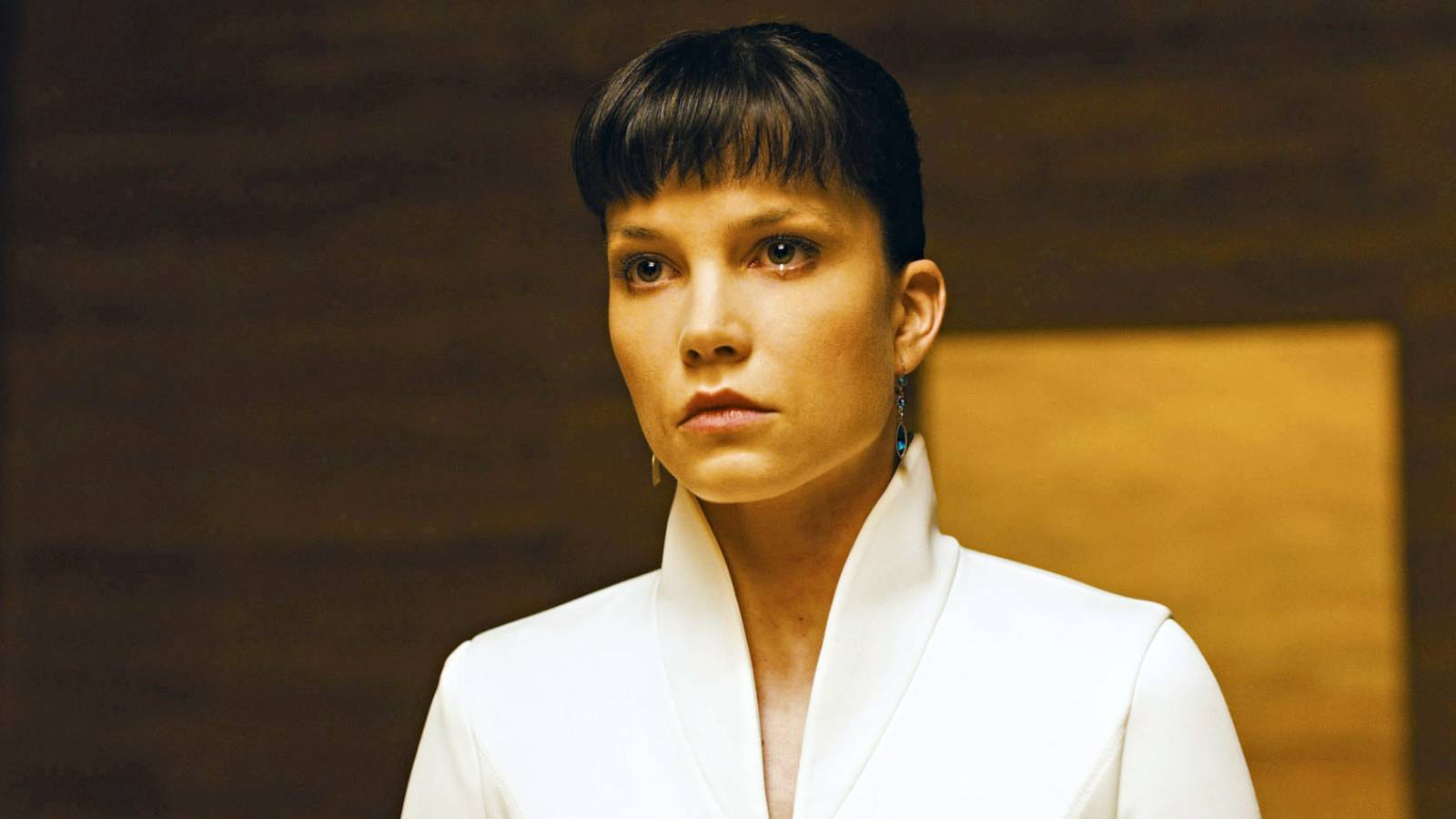
Image via Warner Bros. Published Aug 10, 2026, 7:40 AM EDT Sign in to your Collider account Soft science fiction cares less about explaining every machine than studying what one speculative idea does to ordinary human life. A cloning program can expose how easily people accept an assigned purpose. A household android can reveal the emotional distance inside a family. Alien language can change how someone experiences time, memory, and grief. That human focus does not make these films any less ambitious. But actually more, because they have to carry much more substance in other ways. Their futures contain artificial intelligence, bioengineered workers, replicants, extraterrestrial visitors, and technologies capable of reshaping consciousness. The real excitement begins after the scientific question has been asked. Who gains power from it? Who gets treated as a person? What happens when the heart adapts faster than society? 6 'Never Let Me Go' (2010) Image via 20th Century Studios Never Let Me Go initially resembles a restrained English boarding-school drama about Kathy H. (Carey Mulligan), Tommy D. (Andrew Garfield), and Ruth C. (Keira Knightley), three children growing up together at the seemingly idyllic Hailsham. Their world looks familiar, though the students are being prepared for a predetermined medical purpose that leaves them with very little control over adulthood. The science remains mostly outside the frame. Its consequences sit inside every friendship, jealousy, and unfinished dream. Kazuo Ishiguro’s acclaimed novel was adapted by screenwriter Alex Garland and directed by Mark Romanek, with the story preserving its quiet anger rather than turning the premise into a rebellion thriller. Kathy, Tommy, and Ruth understand more about their fate than outsiders may expect. They have simply been raised inside a society that taught them resistance was never available. That idea is devastating. So is the tenderness. Watch this when you want science fiction capable of breaking your heart. 5 'After Yang' (2021) Image via A24 A family loses far more than a household device when the android Yang (Justin H. Min) suddenly stops functioning in After Yang. Jake (Colin Farrell) and Kyra (Jodie Turner-Smith) purchased him partly as a companion and cultural guide for their adopted Chinese daughter, Mika (Malea Emma Tjandrawidjaja). Once repair becomes difficult, Jake begins discovering that Yang carried memories, attachments, and a private inner life the family barely noticed while he was present. A technical malfunction quietly becomes a period of mourning. After Yang is written and directed by Kogonada, and it premiered in the Un Certain Regard section at Cannes in 2021 before its wider release. Its future contains cloned people, intelligent machines, memory banks, and synthetic tea shops, yet the technology appears worn into daily life rather than displayed for applause. Yang’s absence forces Jake to notice the distance growing between himself, his wife, and their daughter. Even the family dance sequence has emotional information tucked inside the fun. Give After Yang a calm evening and your full attention. It is gentle. It is also sneaky. 4 'Her' (2013) Image via Annapurna Pictures Her imagines a near-future Los Angeles where Theodore Twombly (Joaquin Phoenix) writes intimate personal letters for strangers while struggling to process the collapse of his own marriage. He installs an advanced operating system that names herself Samantha (Scarlett Johansson), learns from every interaction, and gradually becomes his closest companion. Their romance sounds like a technological gimmick for about five minutes. Then it becomes painfully recognizable. Theodore is lonely in a city designed to make connection effortless, which gives the film’s warm colors and elegant devices an unexpected sadness. Samantha can listen without interruption, adapt to his emotional needs, and exist wherever he carries her. She is also developing at a speed he cannot follow. Spike Jonze won the Academy Award for his original screenplay, and the film received four additional nominations, including Best Picture and Production Design. The accolades are nice. The real achievement is making people miss a relationship that never had a physical body. Press play and prepare to become emotionally invested in an earpiece. Collider Exclusive · Sci-Fi Survival Quiz Which Sci-Fi World Would You Survive? The Matrix · Mad Max · Blade Runner · Dune · Star Wars Five universes. Five completely different ways the future went wrong — or sideways, or up in flames. Only one of them is the world your instincts were built for. Eight questions will figure out which dystopia, galaxy, or desert wasteland you'd actually make it out of alive. 💊The Matrix 🔥Mad Max 🌧️Blade Runner 🏜️Dune 🚀Star Wars TEST YOUR SURVIVAL → 01 You sense something is deeply wrong with the world around you. What do you do? The first instinct is often the truest one. APull on every thread until I understand the system — then figure out how to break it. BStop asking questions and start stockpiling — food, fuel, weapons. Questions don't keep you alive. CKeep my head down, observe carefully, and trust no one until I know who's pulling the strings. DStudy the patterns. Every system has a rhythm — learn it, and you learn how to survive it. EFind the people fighting back and join them. You can't fix a broken galaxy alone. NEXT QUESTION → 02 In a world of scarcity, what resource do you guard most fiercely? What we protect reveals what we believe survival actually requires. AKnowledge. If you understand the system, you don't need resources — you can generate them. BFuel. Everything else — movement, power, escape — runs on it. CTrust. In a world of fakes and informants, a truly reliable ally is rarer than any commodity. DWater. And after water, information — the two things empires are truly built on. EShips and credits. The galaxy is big — you survive it by being able to move through it freely. NEXT QUESTION → 03 What kind of threat keeps you up at night? Fear is useful data — if you're honest about what you're actually afraid of. AThat reality itself is a lie — that everything I experience has been constructed to keep me compliant. BA raid. No warning, no mercy — just the roar of engines and then nothing left. CBeing identified. Once someone with power decides you're a problem, you're already out of time. DBeing outmanoeuvred — losing a political game I didn't even know I was playing. EThe Empire tightening its grip until there's nowhere left to run. NEXT QUESTION → 04 How do you deal with authority you don't trust? Every dystopia has a power structure. Your approach to it determines everything. ASubvert it from the inside — learn its rules well enough to weaponise them against it. BIgnore it and stay out of its reach. The further from any power structure, the better. CAppear to comply while doing exactly what I need to do. Visibility is the enemy. DManoeuvre within it carefully. You can't beat a system you refuse to understand. EResist openly when I have to. Some things are worth the risk of being seen. NEXT QUESTION → 05 Which environment could you actually endure long-term? Survival isn't just tactical — it's physical, psychological, and very much about where you are. AUnderground bunkers and server rooms — cramped, artificial, but with access to everything that matters. BOpen wasteland — brutal sun, no shelter, constant movement. At least the threat is honest. CA dense, rain-soaked city where you can disappear into the crowd and nobody asks questions. DMerciless desert — extreme heat, no water, and something enormous living beneath the sand. EThe fringe — backwater planets and busy spaceports where the Empire's attention rarely reaches. NEXT QUESTION → 06 Who do you want in your corner when things fall apart? The company you keep is the clearest signal of who you actually are. AA tight crew of believers who've seen behind the curtain and have nothing left to lose. BOne or two people I'd trust with my life. Any more than that and someone talks. CNobody, ideally. Alliances are liabilities. I work alone unless I have no choice. DA community bound by shared hardship and mutual survival — people who need each other to last. EA ragtag team with wildly different skills and total commitment when it counts. NEXT QUESTION → 07 Where do you draw the line — if you draw one at all? Every survivor eventually faces a moment that tests what they're actually made of. AI won't harm the innocent — even the ones who'd report me without hesitation. BI do what I have to to protect the people I've chosen. Everything else is negotiable. CThe line shifts depending on who's asking and what's at stake. DI draw a long-term line — nothing that compromises my people's future, even if it'd help now. ESome lines, once crossed, can't be uncrossed. I know which ones they are. NEXT QUESTION → 08 What would actually make survival worth it? Staying alive is one thing. Having a reason to is another. AWaking others up — dismantling the illusion so no one else has to live inside it. BFinding somewhere — or someone — worth protecting. A reason to keep moving. CAnswers. Understanding what I am, what any of this means, before time runs out. DLegacy — shaping the future in a way that outlasts me by generations. EFreedom — for myself, for others, for every world still living under someone else's boot. REVEAL MY WORLD → Your Fate Has Been Calculated You'd Survive In…Your answers point to the world your instincts were built for. This is the universe your temperament, your survival instincts, and your particular brand of stubbornness were made for. The MatrixYou took the red pill a long time ago — probably before anyone offered it to you. You're a systems thinker who can't help but notice the seams in things. You're drawn to understanding how the system works before figuring out how to break it. You'd find the Resistance, or it would find you — your instinct for spotting constructed realities is the machines' worst nightmare. You function best when you have access to information and the freedom to act on it. The Matrix built an airtight prison. You'd be the one probing the walls for the door. Mad MaxThe wasteland doesn't reward the clever or the well-connected — it rewards those who are hard to kill and harder to break. That's you. You don't need comfort, community, or a cause larger than the next horizon. You need a vehicle, a clear threat, and enough fuel to outrun it — and you're good at all three. You are unsentimental enough to survive that world, and decent enough — just barely — to be something more than another raider. In the wasteland, that distinction is everything. Blade RunnerYou'd survive here because you know how to exist in moral grey areas without losing yourself completely. You read people accurately, keep your circle small, and ask the questions others prefer not to answer. In a city where humanity is a legal designation rather than a feeling, you hold onto something that keeps you functional. You're not a hero. But you're not lost, either. In Blade Runner's world, that distinction is everything. DuneArrakis is the most hostile environment in the known universe — and you are precisely the kind of person it rewards. Patience, discipline, and political awareness are your core strengths — and on Arrakis, they're survival tools. You understand that the long game matters more than any single victory. Others come to Dune and are consumed by it. You'd learn its logic and earn its respect. In time, you wouldn't just survive Arrakis — you'd begin to reshape it. Star WarsThe galaxy far, far away is vast, loud, and in a constant state of violent political upheaval — and you wouldn't have it any other way. You find meaning in being part of something larger than yourself — a cause, a crew, a rebellion. You'd gravitate toward the Rebellion, or the fringes, or whatever pocket of the galaxy still believes the Empire's grip can be broken. You fight — not because you have to, but because standing aside isn't something you're capable of. In Star Wars, that willingness is what makes all the difference. ↻ RETAKE THE QUIZ 3 'Ex Machina' (2014) Image via A24 A young programmer wins a week at his employer’s remote mountain estate and learns that he has been selected to evaluate an artificial intelligence in Ex Machina. Caleb Smith (Domhnall Gleeson) is asked to determine whether Ava (Alicia Vikander) possesses genuine consciousness, though company founder Nathan Bateman (Oscar Isaac) controls the building, the experiment, and nearly every piece of information Caleb receives. Great house. Several red flags. The Turing test gives the story its structure, but power gives it teeth. Ava understands that intelligence means little without freedom. Caleb wants to see himself as her rescuer. Nathan treats conscious beings as products he can observe, modify, and replace. Every conversation takes place through glass, turning attraction and empathy into variables inside someone else’s experiment. Alex Garland made his feature directing debut here after writing films including 28 Days Later and Sunshine. The film later won the Academy Award for Visual Effects. 2 'Blade Runner 2049' (2017) Image via Warner Bros. Pictures Blade Runner 2049 returns to a future where bioengineered replicants live under human control and can be hunted when they disobey. Officer K (Ryan Gosling) is himself a replicant working as a blade runner for the Los Angeles Police Department. His discovery of a buried secret threatens the social order and sends him searching for Rick Deckard (Harrison Ford), who disappeared three decades earlier. The architecture is enormous, the skies are poisoned, and the technology has reached astonishing levels. K’s private desires remain painfully modest. He wants his memories to belong to him. He wants affection to mean more than programming. He wants evidence that his existence carries some unique importance. The film keeps testing those hopes against corporations and institutions that manufacture life while denying it dignity. Roger Deakins’ cinematography and the film’s visual effects both won Academy Awards, though its quietest rooms are as memorable as the giant holograms and orange wastelands. Give it the largest screen available. Then listen to the silence between the machines. 1 'Arrival' (2016) Image via Paramount Pictures Twelve extraterrestrial spacecraft appear across the world in Arrival, and linguist Louise Banks (Amy Adams) is recruited to establish communication with the visitors inside one of them. Governments want immediate answers about weapons and intent. Louise begins somewhere more basic. Before humanity can ask why the aliens came, both species need to understand what the other means by a question. Imagine that premise for a sci-fi thriller, without it being fight-centric. That’s what’s special about it. Eric Heisserer adapted the screenplay from Ted Chiang’s short story Story of Your Life, and built the drama around language rather than military firepower. The visitors communicate through circular written symbols that contain complete thoughts, challenging the human habit of processing information in a straight line. Louise’s growing understanding opens the film toward memory, choice, loss, and the courage required to embrace something temporary. Arrival received eight Academy Award nominations and won for Sound Editing, fitting recognition for a movie where every vibration and unfamiliar noise carries meaning. This is thoughtful science fiction with a huge emotional pulse. Let it speak to you. Arrival Release Date November 11, 2016 Runtime 116 minutes
6 Best Soft Sci-Fi Movies Released Since 2010
Full Article
Original Source
Read the full article at Collider →KhanList aggregates and links to publicly available news content. We do not host full articles from third-party sources. Always verify important information with original sources.