
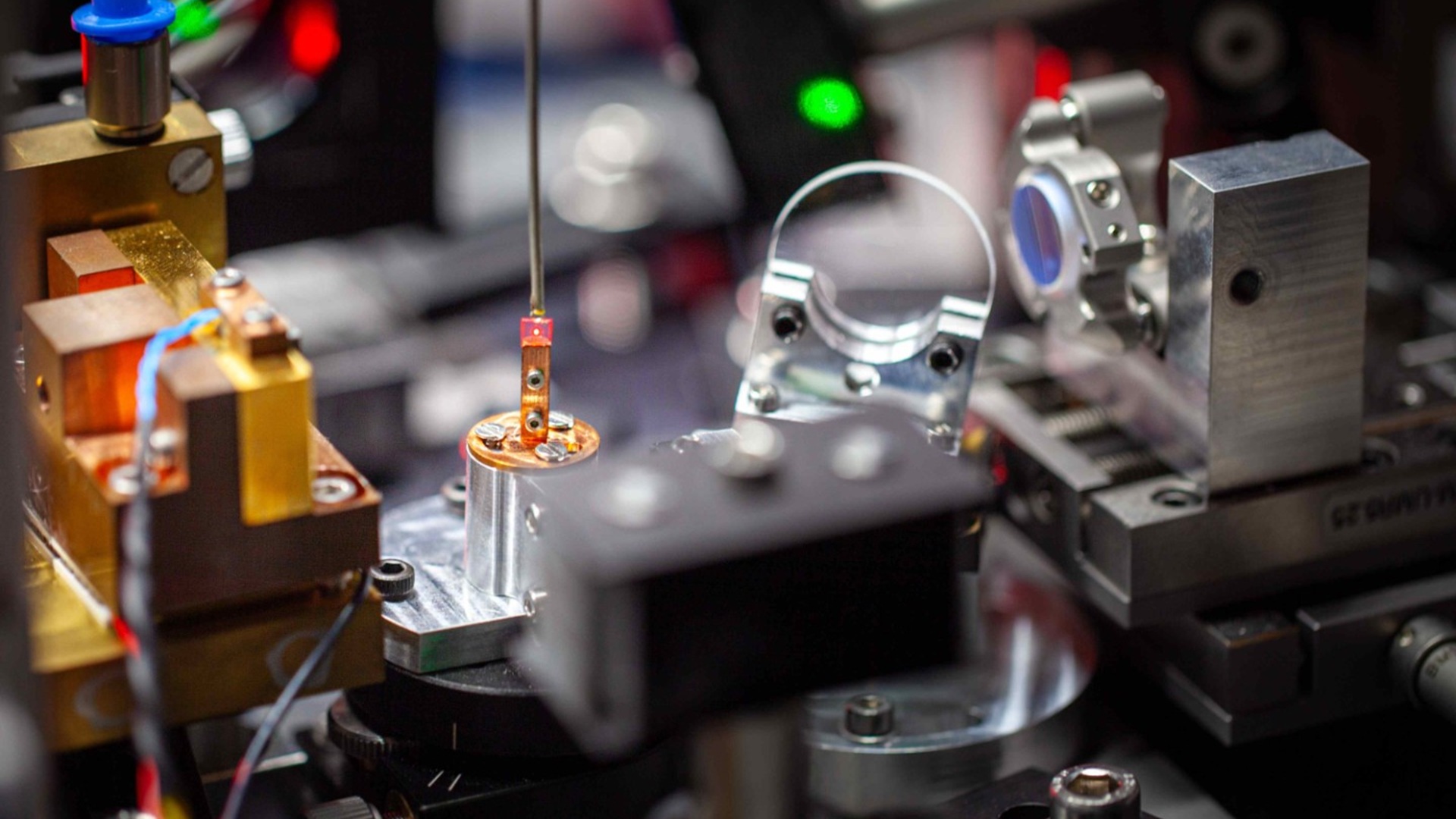
The diamond laser system detects changes in magnetic fields with 100 percent optical contrast.Fraunhofer IAF Scientists in Germany have just presented a new diamond-based quantum sensor that could let people with paralysis control robotic exoskeletons with nothing but the power of their minds. Developed by a research group at the Fraunhofer Institute for Applied Solid State Physics IAF in Freiburg im Breisgau, the sensor uses a laser system to detect weak magnetic fields with high sensitivity. It achieved 100 percent optical contrast and improved the balance between sensitivity and measurement range by a factor of up to 590 compared with existing technologies. The effort was led by Jan Jeske, PhD, a researcher at Fraunhofer IAF. Jeske, who heads the Quantum Sensing Group at Fraunhofer at the research institute, was the the first to come up with a theoretical model for a magnetic-field-sensitive laser system using diamond with nitrogen-vacancy (NV) centers a decade ago. “I am very pleased that we have now experimentally demonstrated the magnetic-field-dependent shift in the lasing threshold,” Jeske explained. The sensor could have applications in brain-computer interfaces, medical testing, navigation, and resource exploration. Detecting magnetic fields Sensors that detect very weak magnetic fields have a limited measurement range. At the same time, those with a wider range are generally less sensitive. This is why the team created a technique called laser threshold magnetometry. It relies on NV centers, which are, in essence, tiny defects in diamond crystals that respond to magnetic fields. An NV center forms when a nitrogen atom replaces a carbon atom in a diamond, leaving a neighboring spot empty. Conventional diamond quantum sensors measure fluorescent light that is emitted by these defects. The new technology instead places the diamond directly inside a laser cavity. The NV centers interact with the laser’s light field, causing changes in magnetic fields to affect the laser’s output. Under certain conditions, these changes can even turn off the laser and result in 100 percent optical contrast. For comparison, most NV-based magnetic sensors typically achieve just a few percent. The system can produce laser signals with a power of up to 50 milliwatts (mW). These are much stronger than those from conventional sensors. Real-life applications Calculations determined that the technology could spot extremely weak magnetic fields, with a sensitivity below 400 femtotesla (fT) per square root of hertz (Hz) for each of the three magnetic-field parts, under ideal photon shot-noise limits. According to the group, apart from improving magnetic-field measurements, the find could also help people living with paralysis. These signals could eventually be transmitted through a brain-computer interface to control robotic exoskeletons. Other possible uses include detecting weak magnetic signals from the heart and muscles, improving navigation, and spotting underground magnetic anomalies. Still, the technology is still under development and has yet to be tested. “Our approach could resolve a trade-off that has long limited the development and application of magnetic-field sensors,” Florian Schall, a PhD researcher at Fraunhofer IAF and the study’s first author, said in a press release. “It could pave the way for a new generation of mobile, highly sensitive magnetic-field sensors.” The study has been published in the journal Nature Communications.Get the latest in engineering, tech, space & science - delivered daily to your inbox.Based in Skopje, North Macedonia. Her work has appeared in Daily Mail, Mirror, Daily Star, Yahoo, NationalWorld, Newsweek, Press Gazette and others. She covers stories on batteries, wind energy, sustainable shipping and new discoveries. When she's not chasing the next big science story, she's traveling, exploring new cultures, or enjoying good food with even better wine.
590 times performance boost: Laser-powered quantum sensor hits 100% optical contrast
Full Article
Original Source
Read the full article at Interestingengineering →KhanList aggregates and links to publicly available news content. We do not host full articles from third-party sources. Always verify important information with original sources.