
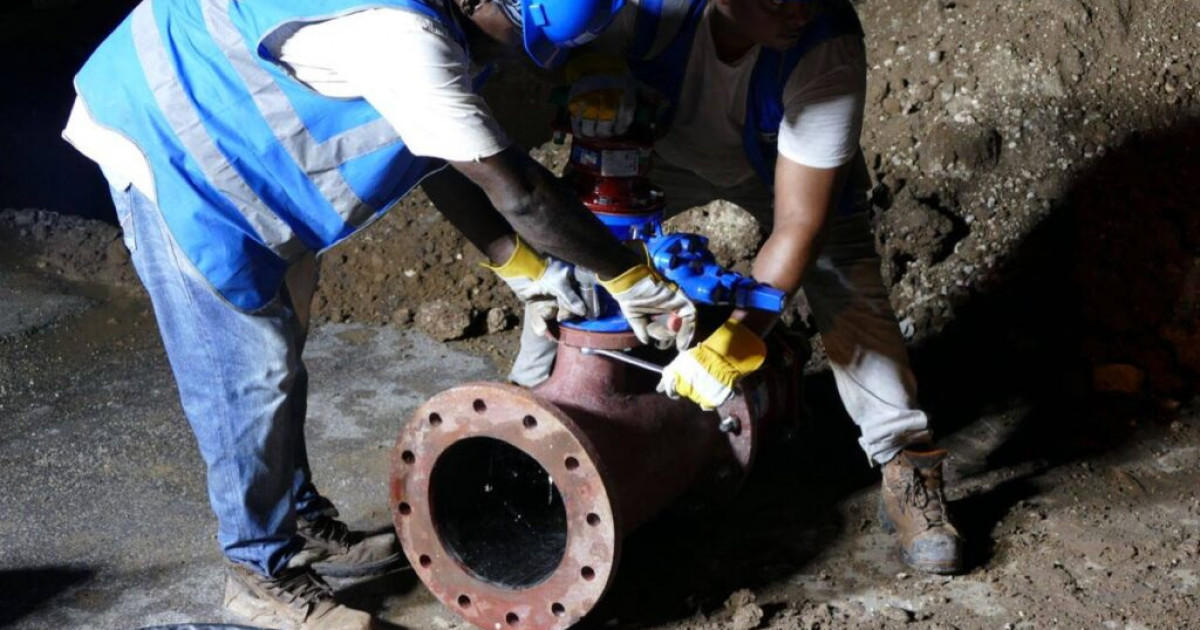
National Water Commission crew working on a supply line. The utility says it has approximately $256 billion in property, plant and equipment, with an estimated $5.7 billion required annually to replace ageing assets and another $20 billion needed for system upgrades. MORE than 5,800 proposed real estate developments, representing 35 per cent of applications reviewed over the past two decades, have failed to secure National Water Commission (NWC) endorsement, highlighting a costly obstacle for builders who may have to find and finance their own water supply before bringing projects to market. Figures presented by the NWC at a Jamaica Developers Association (JDA) webinar on Thursday show that of the 16,535 applications NWC processed between 2006 and 2026, a total of 5,855 development applications were not endorsed, compared with 7,814 that received the utility company’s approval. A lack of endorsement, however, does not necessarily mean a project has been rejected or abandoned. Where the NWC indicates that it cannot adequately serve a proposed development — whether because of insufficient water supply, limited pipeline capacity, or the absence of a distribution network in the area — the developer typically explores other options. These can include drilling a well and obtaining permission from the Water Resources Authority to extract groundwater, adding another layer of cost and complexity to the development process. “We have given new supply connections recommendations for [another] 1,098, which represents a total of about 83 per cent of all developments we have given some firm responses to. The others are under investigations to be done, awaiting information from developers,” NWC Assistant Vice-President for Systems Planning and Water Resource Development Ian Bennett said, in breaking down the numbers. The disclosures come as the NWC estimates that it needs approximately $25.7 billion annually to renew and upgrade its water infrastructure, much of which is ageing, while developers continue to grapple with the cost and uncertainty of securing essential services for new projects. Bennett’s presentation showed that applications for developments have been concentrated in Kingston and St Andrew and along the north coast, while areas such as Mandeville have recorded a high incidence of non-endorsements. He said improvements to the Greater Mandeville water supply system were beginning to create opportunities for additional projects to be accommodated. Despite the constraints, the NWC executive maintained that Jamaica has sufficient water resources to support further development. The difficulty, he explained, lies largely in the infrastructure needed to deliver that water reliably to consumers. “If you look at the total requirement of water supply for the entire island, it is approximately 120 million gallons per day. However, our production is in the range of 200 million gallons per day, which tells us that we have a reasonable amount of water available for development. However, we have some issues which are working against that available water. Number one, it’s ageing infrastructure,” Bennett said. He added that some pipelines are more than 50 years old, having reached or exceeded their expected useful life. BENNETT… the total requirement of water supply for the entire island is approximately 120 million gallons per day The challenges are already being felt by developers, according to Richard Mullings, president of the Incorporated Masterbuilders Association of Jamaica (IMAJ), who argued that both the cost of obtaining water infrastructure and the time spent navigating approval processes were contributing to higher housing prices. “The cost for water, the time that it takes to go to the water commission and get your approval, the time that it takes to find out that there isn’t even any water in where you want to develop, that just starts adding a dollar to the unit over time, a dollar each time, or many dollars,” Mullings told the webinar. He said uncertainty surrounding the availability of water and the eventual cost of connecting developments to public infrastructure made it more difficult for builders to establish the final price of housing units. “I look forward to a day when developers can know, well in advance, how much water is available in a particular zone, based on acreage, population, or density, rather than submitting an application only to find out later that there is no water,” Mullings said. He also raised concerns about situations in which developers are required to undertake infrastructure works that would ordinarily fall within the responsibility of public utilities, particularly the installation of sewerage systems. The IMAJ president argued that such requirements place additional pressure on the economics of affordable housing, where profit margins are already narrow, and can favour developments targeting higher-income purchasers. “Nobody who is trying to build units that are making marginal profit can afford to engage in performing the work for the utility and installing a sewer system. It favours the higher end units,” he said. Garth Jackson, NWC vice-president for engineering and capital projects, acknowledged that delays in processing development applications carried financial consequences and said the utility was working to improve its responsiveness. Jackson said efforts were being made to strengthen staffing and improve the technical review process, recognising that delays can encourage applicants to bypass established procedures. Further, the NWC has completed a developers’ manual outlining the process from initial service inquiries through to final connection and account establishment. The document is expected to be made publicly available shortly. Responding to Mullings’ call for developers to be informed much earlier about water availability in proposed development areas, the NWC said it was preparing water supply master plans across the island. These are expected to help developers determine where infrastructure is available, what additional investment may be needed and how soon their projects could be connected to the network. Minister with responsibility for water Matthew Samuda (right) and acting president of the National Water Commission (NWC) Kevin Kerr touring the NWC work on Munroe Road in St Andrew recently. “We’re currently developing some master plans for the entire island of Jamaica. We have finished St Thomas, we have finished St Elizabeth, I think we have finished Portland, and we’re moving around the island now. It’s not going to be instantaneous, because every master plan has to be implemented. And, of course, once you move to implementation it has to fall within the purview of our current financial situation, the current budgetary constraints of the current financial year, what can be done now, how is it that we’re going to move forward, what kind of support we can receive from external sources, private sources, maybe sources from central government, etc,” Bennett explained. The financial challenge now facing the NWC is substantial. Bennett disclosed that the utility has approximately $256 billion in property, plant and equipment, with an estimated $5.7 billion required annually to replace ageing assets and another $20 billion needed for system upgrades. Together, the requirements amount to roughly $25.7 billion annually, which he rounded to approximately $30 billion when discussing the scale of investment required. Against that expenditure, Bennett placed the utility’s annual revenue at approximately $50 billion and operating costs at about $45 billion. The disclosures come just over a week after the NWC applied to the Office of Utilities Regulation (OUR) for a 51 per cent increase in water and sewerage tariffs, covering the five-year period from 2026/27 to 2030/31. Acting NWC President Kevin Kerr told Parliament’s Public Accounts Committee on October 20 that the proposed increase was tied to an investment plan intended to finance priority projects. He warned that the utility would have to revise that plan if the full increase was not approved. The OUR has confirmed receiving the application but must first determine whether it meets the requirements for a formal tariff review. Any eventual determination will follow the regulator’s assessment and public consultation process. During Thursday’s webinar, Jackson indicated that the NWC was exploring several financing arrangements, including public-private partnerships, international development financing, commercial loans and bonds to support its infrastructure programme. The utility is also pursuing measures to reduce non-revenue water, including losses from leaking pipes, which continue to undermine its finances and the reliability of supply.
5,855 housing projects denied NWC approval over past 20 years
Full Article
Original Source
Read the full article at Jamaicaobserver →KhanList aggregates and links to publicly available news content. We do not host full articles from third-party sources. Always verify important information with original sources.