
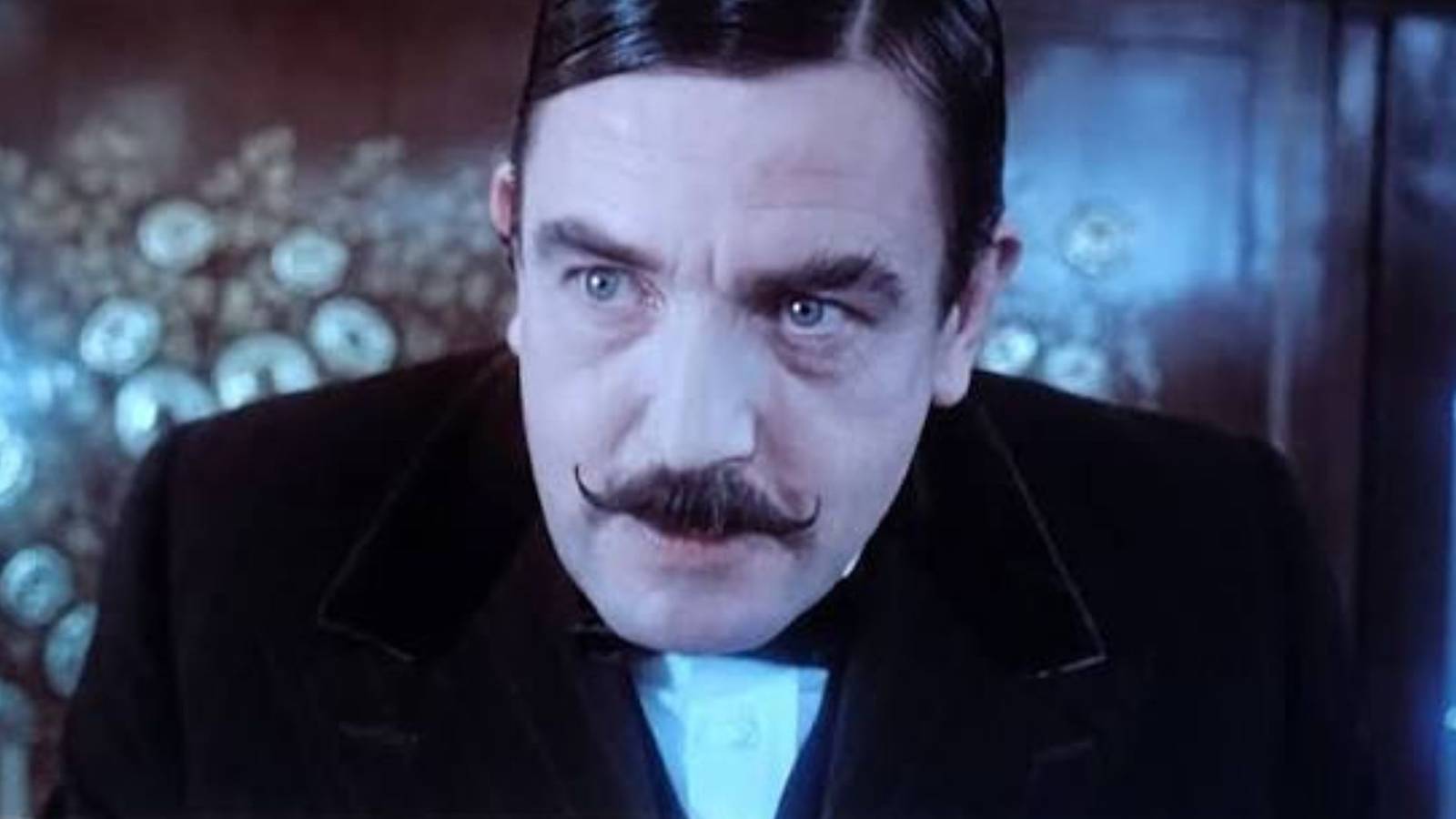
Published Sep 5, 2026, 11:30 AM EDT Simon Gallagher has worked in movie and TV journalism for more than 17 years. He has written more than 6000 articles and reviews, and edited thousands more. He is an expert in the entertainment industry, particularly in the golden age of screen superheroes. Simon is also a Rotten Tomatoes approved critic. Bringing Agatha Christie’s legendary Belgian detective to life on the screen has been a challenge taken on by actors as talented as Kenneth Branagh, Peter Ustinov, and John Malkovich. And despite how evocatively Agatha Christie wrote the iconic character, the range of performances is as remarkable as his mustache. But one stands above all the others who played Poirot, at least on the big screen. For TV audiences, David Suchet’s definitive, highly faithful portrayal was the gold standard, and lasted for an astonishing, but completely justified 70 adaptations across 24 years. But he was afforded the luxury of time to build up the brand of his performance, and the requirements for movies are very different. Ustinov played Poirot in 6 different movies, and while Branagh’s future as Poirot is unclear, he has so far made 3. Both could show change in their performances, against different backdrops, so it’s remarkable that the version that outshines both stayed for only one movie. 66 Novels · 14 Story Collections · Two Billion Copies Sold How Well Do You Know Agatha Christie? “The little grey cells, mon ami — they are everything.” 🕵PoirotLittle Grey Cells 🧶Miss MarpleThe Village Knows 🚆Orient ExpressTwelve Suspects ⚗PoisonHer Weapon of Choice 📖The Canon1920–1976 BEGIN THE INVESTIGATION → 01 Christie’s first published novel appeared in 1920 and introduced the world to Hercule Poirot. What was it called? AThe Mysterious Affair at Styles BThe Secret Adversary CThe Murder at the Vicarage DMurder on the Orient Express ✓ Correct! The Mysterious Affair at Styles — written on a wartime dare from her sister, and rejected by six publishers before it saw print. ✗ Not quite! It’s The Mysterious Affair at Styles. The Murder at the Vicarage came a decade later — and gave us Miss Marple. NEXT → 02 Poirot bristles every time someone assumes he is French. Which country is the retired police detective actually from? AFrance BSwitzerland CBelgium DLuxembourg ✓ Correct! Poirot is Belgian — a refugee of the First World War, which is exactly how he lands in England in Styles. ✗ Not quite! He is Belgian, and he will correct you at length if you suggest otherwise. NEXT → 03 Miss Jane Marple solves murders by comparing them to the petty scandals of her own tiny English village. Name it. AKingsmarkham BSt. Mary Mead CStyles St. Mary DMidsomer Norton ✓ Correct! St. Mary Mead — where, as Marple insists, human nature is much the same as it is anywhere else, only closer to hand. ✗ Not quite! It’s St. Mary Mead. Styles St. Mary is Poirot’s village, and Kingsmarkham belongs to Ruth Rendell. NEXT → 04 The Murder of Roger Ackroyd (1926) scandalised readers and nearly got Christie thrown out of the Detection Club. What was the twist? AThere was no murder at all BPoirot himself was the killer CThe victim faked his own death DThe narrator was the murderer ✓ Correct! Dr. Sheppard tells the whole story — and the whole story is a confession, hidden in what he leaves out. The narrator did it. ✗ Not quite! The narrator, Dr. Sheppard, is the murderer — critics called it cheating; it’s now considered one of the greatest twists ever written. NEXT → 05 In December 1926, Christie herself disappeared for 11 days, triggering a national manhunt. How did it end? AShe was found at a Harrogate hotel, checked in under a false name BShe was discovered aboard a train to Istanbul CShe returned home on her own and never left DShe was located at her mother’s house in Torquay ✓ Correct! She was recognised at a hotel in Harrogate, registered under an assumed surname. Christie never explained the episode — not once, not ever. ✗ Not quite! Her car was found abandoned, and 11 days later she turned up at a Harrogate hotel under a false name. She never publicly explained why. NEXT → 06 Which Christie novel is her best-selling book — and the best-selling crime novel of all time, at over 100 million copies? ADeath on the Nile BAnd Then There Were None CMurder on the Orient Express DThe A.B.C. Murders ✓ Correct! And Then There Were None — ten strangers on an island, no detective at all, and Christie’s own pick for the hardest book she ever wrote. ✗ Not quite! It’s And Then There Were None, the best-selling mystery novel ever published. NEXT → 07 Her play The Mousetrap opened in London in 1952. What distinction does it hold? AThe first play ever broadcast live on the BBC BThe most-adapted play in film history CThe longest-running stage production in the world DThe only play Christie wrote under a pen name ✓ Correct! It has run in the West End since 1952 — the longest-running stage production anywhere, and audiences are still asked to keep the ending secret. ✗ Not quite! The Mousetrap is the longest-running stage production in the world — over 70 years and counting. NEXT → 08 Christie wrote Poirot’s last case during the Blitz and locked it in a bank vault for 30 years. When Curtain was finally published in 1975, what followed? AIt was banned in Britain for a year BChristie publicly disowned the ending CHer publisher refused to print the last chapter DThe New York Times ran a front-page obituary for Poirot ✓ Correct! In August 1975 The New York Times gave Hercule Poirot a front-page obituary — the only fictional character ever to receive one. ✗ Not quite! The New York Times put Poirot’s obituary on its front page — an honour no other fictional character has ever been given. NAME THE MURDERER → The Drawing Room · Everyone Is Assembled Your Detective Rank 🔎 / 8 Order and method, mon ami — or merely a lucky guess? The grey cells will know the difference. ⤴ INVESTIGATE AGAIN Before Ustinov took over the role - and proved a formidable replacement - Sidney Lumet made the second adaptation of Murder on the Orient Express (after a little-known 1955 TV episode), and caught lightning in a bottle. It’s down to Lumet’s handling of the excellent source material, and the star performance of Albert Finney that Murder on the Orient Express is arguably the most famous of Christie’s stories in modern times. The fact that it released 52 years ago, and yet still remains the undisputed high-water mark for the legendary crime writer’s work on film is only surprising to those who haven’t seen it. Murder on the Orient Express is an Unarguable Masterpiece Well before Rian Johnson was assembling mega star ensembles for his Christie-like Knives Out franchise, Lumet’s film gathered a staggering line-up of major acting talent. And anything that could boast the combined talents of Sean Connery, Lauren Bacall, Ingrid Bergman, and Vanessa Redgrave - among many others - was always going to be good. The story, by now, should be familiar - even if Branagh’s adaptation muddied the waters by changing the moral message at the heart of the ending - and the twist is one of the most famous in the genre. But the movie is about so much more than the stunt of Christie’s writing. Despite being set on a train trapped by snow, Geoffrey Unsworth’s cinematography is lush, and the production quality is helped enormously by the luxury of the train’s interiors. That backdrop makes the murk of the murder within all the more delicous as things unravel. And though there are great performances across the cast (as you’d expect from those names), the stand-out is Albert Finney as Hercule Poirot. Like the movie itself, which chose only the slightest of inconsequential changes, Finney plays Poirot as if someone had pulled him magically from the page. He’s hautier than Branagh’s version, more arrogant than Suchet’s, and devilish in his wit and approach to solving crime. He’s a maverick, in charge of a mustache only a maverick could navigate. Even knowing the twist, and with more than 50 years on its back, Murder on the Orient Express has lost nothing since its release. Yes, it’s not in high definition, and the morality of the ending is somewhat odd (so odd that Branagh couldn’t stand to leave Poirot’s casual criminality without some cost in his version), but it’s an enormously entertaining detective story that even Agatha Christie loved (and she was famously cold on almost every other adaptation). Albert Finney's Poirot Masterclass Ended Too SoonThe simple, non-gimmicky creative choices behind Murder on the Orient Express gave Finney and his co-stars a lot of space to truly perform. And while Ingrid Bergman’s was the only Oscar win of its six nominations, Finney was robbed in a tough year by Art Carney (Al Pacino also didn’t win for The Godfather Part II, so he was in good company). But sadly, of course, Finney’s tenure of Poirot ended when he disembarked the train. Finney’s transformation into Poirot was complete and completely spellbinding; he’s an eccentric who doesn’t quite belong to any time or any setting, whose absurdity is a joy. Branagh’s more modern take is contextualized, and given some trauma to play with, but Finney is just a good old-fashioned spectacle. A brilliant one. Tragically, Finney wouldn’t return when EMI Films moved forward with 1978’s Death on the Nile, declining a return because of the cost of preparation. Even without considerable prosthetics, Finney found the makeup and hair preparation, and the adornment of padding to capture Poirot’s rounder middle too taxing. The idea of doing it all again with the addition of Egyptian heat was seemingly the deal-breaker. So, as history captured it, Peter Ustinov took over and was very good as Poirot in the next six movies into the 1980s, but it’s still a tragedy that we didn’t get to see more of Finney. Not getting to see how he would have taken on more classic cases is still one of the biggest losses in movie history.
52 Years Later, This Hercule Poirot Masterpiece Remains The Greatest Agatha Christie Movie Of All Time
Full Article
Original Source
Read the full article at Screenrant →KhanList aggregates and links to publicly available news content. We do not host full articles from third-party sources. Always verify important information with original sources.