
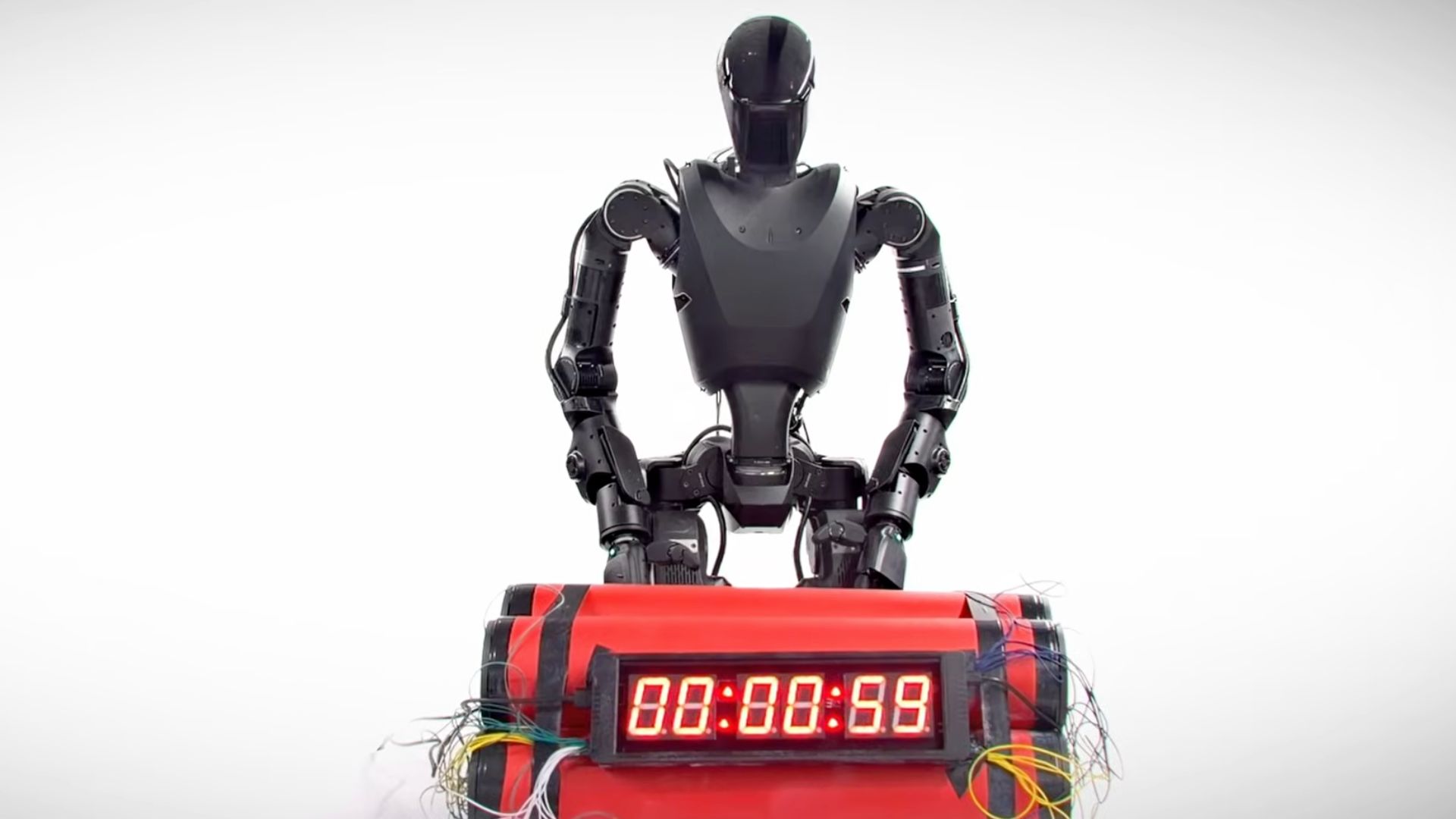
Phantom humanoid could help monitor the southern border, navigating rough terrain and flagging potential crossings.Foundation Robotics/YouTube A US robotics company says humanoid robots could eventually help federal agents monitor the southern border patrol in difficult terrain. Foundation CEO Sankaet Pathak said the company has demonstrated its technology to Department of Homeland Security (DHS) officials and is in discussions with several national security agencies. Pathak said the company’s Phantom humanoid can navigate uneven ground, distinguish people from obstacles and map its surroundings to autonomously identify potential border crossings before alerting human officers. Recently, Foundation demonstrated a tendon-driven robotic hand catching a baseball, showcasing improved dexterity, precision, speed and reliable object handling. Robots monitor border Foundation is pitching its Phantom humanoid robot as a potential tool for surveillance and reconnaissance along the southern border, with CEO Sankaet Pathak saying the machine could operate in rugged terrain that is difficult for people, vehicles, drones and fixed cameras to reach. Pathak said Foundation is in discussions with several US national security agencies, and has demonstrated its technology to DHS officials. However, DHS said it currently has no agreements, pilots or active prime contracts with the company, reports Fox News. The company says Phantom can autonomously navigate uneven terrain, distinguish people from other obstacles and map its surroundings. Foundation envisions the robots conducting reconnaissance, identifying significant activity and flagging potential border crossings so human officers can decide how to respond. The robots could also potentially operate in tunnels and provide continuous surveillance, allowing personnel to remain in safer locations. Weather resistance remains a limitation of the current Phantom, but Foundation expects a more rugged second-generation model in the coming months with waterproof and dustproof capabilities. Pathak said the company believes a pilot could begin soon, followed by a larger deployment. Although Pathak said Foundation would consider arming the robots if requested by the government, he stressed that the machines are not expected to make enforcement decisions independently. Human officers would remain responsible for determining the appropriate response, reports Fox News. Phantom targets industry Foundation’s Phantom is its first production humanoid robot, designed to combine high strength, smooth movement and human-compatible operation. Standing 5 feet 11 inches (1.8 meters) tall and weighing 176 pounds (80 kilograms), the robot has 29 degrees of freedom, a top speed of 1.7 m/s and a payload capacity of 88.2 pounds (40 kilograms). Phantom is powered by Foundation’s proprietary cycloidal actuators, designed to deliver high torque, precision and efficiency in a compact electric system. The actuators produce up to 160 Nm of peak torque, with a maximum back-driving torque below 1 Nm and a response time of under 10 milliseconds. Foundation says the actuator design offers low backlash, quiet operation, reduced wear, high uptime and minimal maintenance, while providing the rugged performance required for demanding industrial and defense applications. Powering Phantom is Foundation’s Cortex, an AI model designed to help robots understand and interact with the physical world. It combines language, visual and multimodal models with physics-informed AI to translate instructions into real-world actions. Cortex uses Deep Variational Bayes Filters (DVBFs) to encode sensory data, update predictions through Bayesian inference, and generate actions based on anticipated outcomes. Unlike reinforcement or imitation learning, Foundation says the approach requires less data while offering greater predictive power, adaptability and generalization. Cortex is designed to handle tasks such as grasping objects, stacking containers and navigating environments, enabling Phantom robots to make complex decisions and respond to changing conditions.Get the latest in engineering, tech, space & science - delivered daily to your inbox.Jijo is an automotive and business journalist based in India. Armed with a BA in History (Honors) from St. Stephen's College, Delhi University, and a PG diploma in Journalism from the Indian Institute of Mass Communication, Delhi, he has worked for news agencies, national newspapers, and automotive magazines. In his spare time, he likes to go off-roading, engage in political discourse, travel, and teach languages.
5.11-foot humanoid robots could help monitor rugged terrain along US southern border
Full Article
Original Source
Read the full article at Interestingengineering →KhanList aggregates and links to publicly available news content. We do not host full articles from third-party sources. Always verify important information with original sources.