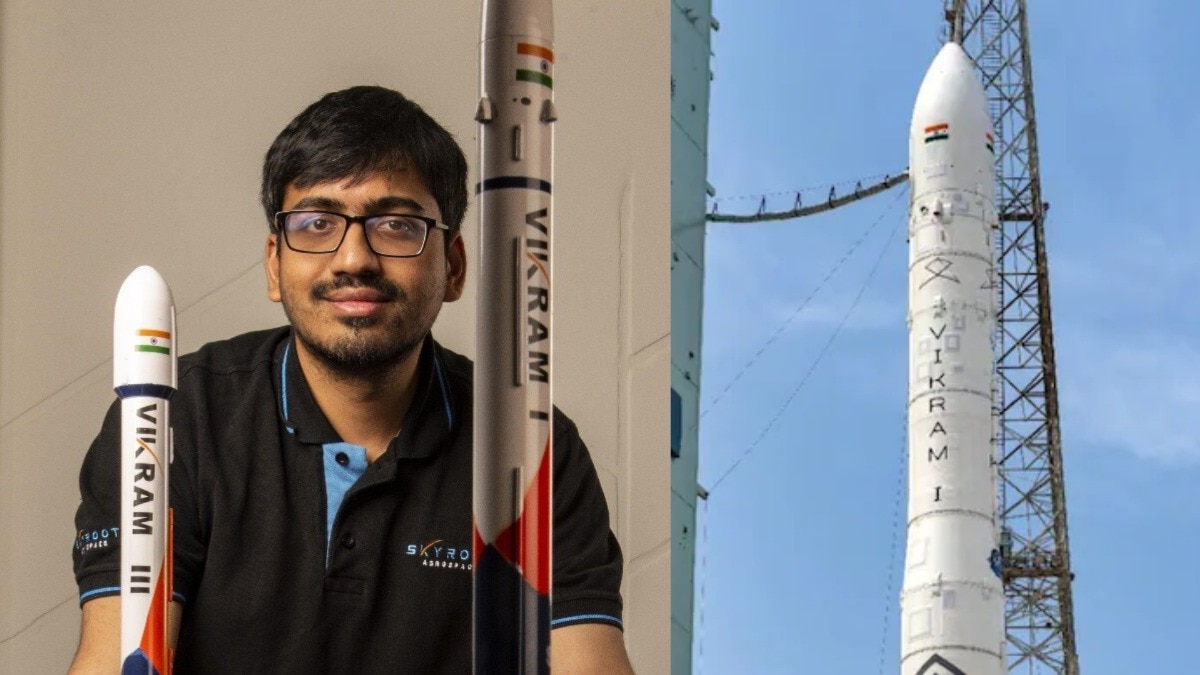
Today is a big day for India's space ambitions. The launch of Vikram-I this morning was successful. Now, the man behind the launch, an IITian, a former ISRO scientist, and an ambitious entrepreneur who gave India's space journey a new direction, has emerged from the ground to become a sensation and an inspiration for many youngsters. It is a story you must know.PM Modi spoke to Skyroot Aerospace founders after the successful launch of Vikram-1, telling them, "You have not only planted a new tree in space, but also strengthened new roots on the ground to inspire the next generation."Scoring 51 marks in mathematics is not usually how stories about rocket scientists begin.Yet, this is where Pawan Kumar Chandana's story truly begins. Today, his rocket, Vikram-I, has made history by becoming India's first privately developed rocket to reach space.More than a technological milestone, the launch marks a blazing moment in India's space journey.Behind Vikram-I is Skyroot Aerospace, the startup co-founded by Chandana, which has propelled itself onto the global space map with this leading light achievement. Years before he became the co-founder and CEO of India's largest private rocket manufacturing facility and helped launch the country's first privately built rocket, Chandana was simply a student trying to find his footing in academics.Mathematics did not come naturally to him. But what he lacked in marks, he made up for with curiosity, persistence and a fascination for machines. In June 2018, Chandana and fellow ISRO engineer Naga Bharath Daka, an IIT Bombay graduate, co-founded Skyroot Aerospace in Hyderabad. Skyroot Aerospace is the story of two engineers whose experience has shaped India's space journey. AT ISRO, CHANDANA FOUND HIS CALLING IN SPACE TECHNOLOGYBorn and raised in Hyderabad, Chandana grew up in a middle-class household, much like millions of other Indian children. He was drawn towards how things worked and spent much of his early years exploring machines and technology.His father continued to encourage him even during difficult phases, a support system Chandana often credits for helping him stay on course.Over time, his relationship with academics changed. The subjects that once troubled him gradually became areas of interest. Mathematics and science, which had once seemed like obstacles, became the foundation of Chandana's future career.More than two decades ago, Chandana cleared the IIT entrance examination on his first attempt and joined the Indian Institute of Technology (IIT), Kharagpur.For many students, that achievement alone would have been enough. But for Chandana, it was only the beginning.While many engineering graduates were pursuing lucrative careers in the technology sector, his attention remained fixed on space and rockets.That interest eventually took him to the Indian Space Research Organisation (ISRO), where he was recruited directly from the IIT Kharagpur campus.The job did not come with the salaries offered by private technology firms, but it gave him something he valued more: the opportunity to work on India's space programme.At ISRO, Chandana worked on the GSLV Mk III, India's heaviest launch vehicle.His contribution earned him an internal innovation award. Over six years at the Vikram Sarabhai Space Centre in Thiruvananthapuram, he gained experience in rocket design and development while witnessing India's space ambitions grow.But another idea was beginning to take shape. Image: Linkedin India's startup ecosystem was expanding rapidly, and Chandana started wondering whether rockets could be built outside the traditional framework of government institutions. The thought stayed with him."You know, it's just two years since the space sector has opened up. I think it will be a great future for us in the next 10 years. And I strongly suggest exploring space as a career in future," he told India Today in 2023.ENTREPRENEURSHIP, INNOVATION AND A GLOBAL STAGEStarting a private space company in India was not an easy proposition. Funding remained a challenge and investors were cautious about backing a sector that was still in its infancy.One of the first believers in Chandana's vision was Binny Bansal, co-founder of Flipkart and a fellow IIT Kharagpur alumnus, who invested $1.5 million in the venture.Soon after, the Covid-19 pandemic disrupted fundraising efforts, making growth even more difficult.Just when the company needed support the most, renewable energy firm Greenko stepped in with financial backing, helping Skyroot continue its journey.The breakthroughs followed.In July 2020, Skyroot became the first private Indian company to successfully test a rocket engine. The engine, named Raman-1 after Nobel laureate C.V. Raman, marked a significant step for the young startup.The following year, after the Indian government opened the space sector to private participation, Skyroot became the first private company to sign a memorandum of understanding with ISRO. It later raised $51 million, one of the largest investments in India's deep-tech sector at the time.For Chandana, however, success was never only about funding or valuations.He has repeatedly emphasised the importance of fundamentals."For example, even Dhirubhai Ambani was very sound in business fundamentals. He's not an MBA from Harvard or anything else, right?" he once remarked.His belief in entrepreneurship remains equally clear."According to me, the best career option is entrepreneurship because it gives freedom, it gives independence. It gives an opportunity to build a country. It gives an opportunity to create employment," he said.On November 18, 2022, Skyroot launched Vikram-S, India's first privately developed suborbital rocket. The launch marked a turning point not only for the company but also for India's private space sector.The milestones continued.During the 14th Indo-French CEO Forum in Paris, Chandana represented Skyroot Aerospace alongside business leaders from both countries. Reflecting on the event, he noted that India and France share a long-standing partnership in space exploration and highlighted the growing focus on collaboration between private space startups.Then came another landmark moment.On May 7 this year, Skyroot inaugurated what is now regarded as India's largest private rocket manufacturing facility.The unit, inaugurated by Prime Minister Narendra Modi, has the capacity to support the company's expanding launch ambitions. What started as an idea between two former ISRO engineers has now grown into an organisation employing around 1,000 people.The company also raised $60 million in a funding round co-led by Sherpalo Ventures, the investment firm of Silicon Valley entrepreneur Ram Shriram.Looking back, Chandana's story is not really about scoring 51 marks in mathematics. It is about what happened afterwards.A student who once struggled with numbers went on to crack IIT, work on some of India's most important launch vehicles, leave a secure government job and build a company that is helping shape the future of India's private space industry.The marks remained in the past. The curiosity did not.- EndsPublished By: Rishab ChauhanPublished On: Jul 18, 2026 13:06 IST
51 in maths, IIT, ISRO and rockets: The story of Pawan Kumar Chandana
Full Article
📰 Original Source
Read full article at Indiatoday →KhanList aggregates and links to publicly available news content. We do not host full articles from third-party sources. Always verify important information with original sources.