
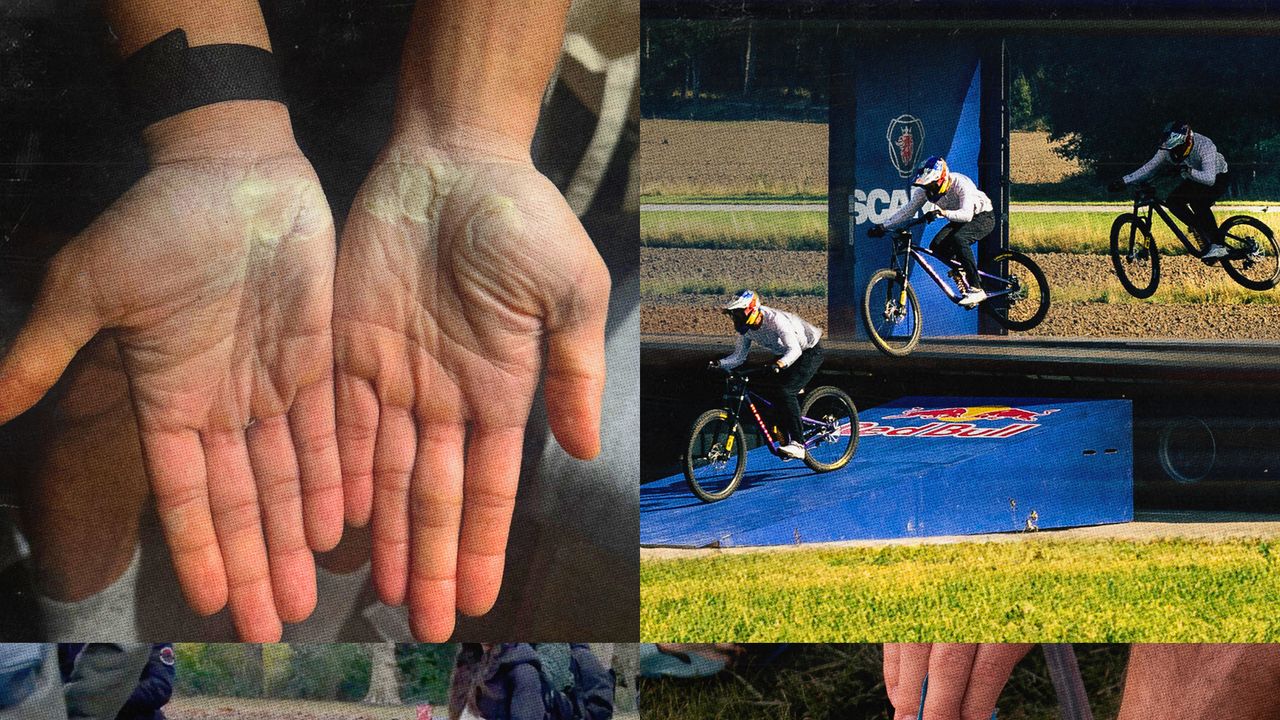
For more than 18 days straight this past May, Mason Wright woke up every morning at 5 a.m. and ran laps around a track at a high school in Layton, Utah. The early-spring air was typically crisp, and the smell of dew-covered grass reminded him of childhood. By the time students would arrive for class, he’d have run 10 miles. At lunch, he kept running. And when student athletes came out for after-school track practice he would still be there, running alongside them. When the sun finally set over the mountains, he’d crawl into a van parked beside the field, sleep as much as he could, and do it all over again. He ran through freezing mornings that left frost on the ground and rainstorms that flooded the track, leaving his feet so waterlogged that his skin split open.When Wright finished his extended sprint, he became the third person in the world to run 1,000 fairly consecutive miles around a track, a project he embarked upon because, as he puts it, “I wanted something that genuinely sounded impossible.”Mason Wright camped nearby a high school track to complete a self-assigned challenge of running 1,000 consecutive miles in a row. Photo courtesy of Twogood.When Wright finished his extended sprint, he became the third person in the world to run 1,000 fairly consecutive miles around a track. Photo courtesy of Twogood“I wanted something that genuinely sounded impossible,” Wright says of the project. Photo courtesy of Twogood.Wright isn’t the only one with an appetite for the absurd. There’s now a never-ending slew of guys inventing and completing preposterous physical challenges, often with elaborate, self-imposed rules meant to make them as miserable as humanly possible. Many have teams chronicling every grueling mile and setback online. If they manage to pull it off the challenge, they emerge as semi-viral niche sports heroes in their corner of the fitness internet. In 2020, ultramarathoner and Navy Seal David Goggins launched his annual 4x4x48 challenge, inviting his followers to run four miles every four hours for 48 hours. In December 2025, UK-based athlete Travis Kerry set the world record for longest nonstop bear crawl after bear crawling 50 kilometers (31 miles) across the streets of London, and nine months later Kevin Ocipeka from Germany burpee broad-jumped his way 26.2 miles along a track in 155 hours, 44 minutes, and 51 seconds—longer and faster than anyone had burpeed before.“There’s this flywheel effect of extreme one-upmanship going on on social media,” says Michael Ceely, a psychotherapist and high-performance coach who works with athletes.But beyond bragging rights, why are men motivated to push themselves to such dire limits? And what, exactly, are they getting out of it?Many of the men I spoke to for this piece are drawn to the unknown. Once they have an idea, they hyperfixate on it until they accomplish it. Professional mountain biker Matt Jones says the concepts come from just about anywhere. “That’s how my brain works,” he says. He can’t drive past a rooftop or construction crane without wondering whether he could ride it or jump off it. “It doesn’t take long before you start going down a rabbit hole of crazy ideas, and then actually becoming obsessed with them enough to wanna do them,” he says. For the stunt he pulled off in November 2025, he spent months calculating the precise timing needed to jump through the open trailers of two trucks traveling in opposite directions, with only a split-second margin for error.Matt Jones in Sweden strategizing for his 2025 ‘Through’ project, in which he jumped through the open trailers of two trucks traveling in opposite directions. Photo courtesy of Eisa Bakos.Matt Jones. Photo courtesy of Eisa Bakos.Matt Jones performed a world first jumping between two moving trucks. Photo courtesy of Eisa Bakos.William Goodge, an ultrarunner who embarked on the arduous task of running 50 marathons in 50 states in 24 days this October, is similarly attracted to the uncertainty that comes with each challenge. “If I wasn’t scared by it, I wouldn’t be enthusiastic,” he says. “That’s the whole point in this journey for me.” His quest, which culminated at this year’s NYC marathon, was nearly as logistically challenging as it was physically demanding. A flight delay or bad weather could have set him back a few hours, potentially derailing his entire schedule. On four of the days, he needed to run three marathons with only short stretches of rest or travel between them.The thrill of chasing a near-impossible goal can seem grim once you’re in the thick of it, though, and that misery is equally part of the appeal. Kerry had dreamed of earning a Guinness World Record since childhood, and when he saw someone bear-crawl a marathon, he decided to take the record even further: 31 miles, compared to 26. He tested the movement on a treadmill, taking 20 minutes to cover a single kilometer. It was, he says, “the hardest fucking thing I’ve ever done.” But he figured if he could do one kilometer, he could do 50. “It’s just one 50 times, and I just need to get better at it,” he says.Yet halfway through his bear crawl across the cobbled streets of London, rain was coming down, his hands were cold, and he was wearing a pair of garden gloves he had cut the fingertips off to prevent his palms from getting torn on the pavement. “One of my best mate’s jobs the whole time was squeezing water like a literal udder out the end of my gloves,” he says. Kerry thought about calling it quits. “Even though I physically wasn’t at the end of my limit, mentally I was like, I just can’t do this anymore,” he says.UK-based athlete Travis Kerry completed a 50-kilometer bear crawl across the cobbled streets of London in 2025. Photo courtesy of Travis Kerry.Kerry still hasn't regained feeling in his fingertips after completing the challenge. “I don’t know if that’s ever gonna come back,” he says. “A small price to pay.” Photo courtesy of Travis Kerry.His coach could tell he was losing steam, so she told him to stand up and scream. “I went to the edge of Tower Bridge and screamed the word ‘fuck’ as loud as I possibly could,” he says. The release felt incredible. He got back down on his hands and feet and kept crawling.Despite the sense of accomplishment they represent, these feats can come at a serious physical cost. Both Wright and Kerry say they may have suffered permanent nerve damage after their massive efforts. Wright, who ran 400 miles on stress fractures, says the pain that would take over his body was “unbearable.” Kerry hasn’t regained feeling in his fingertips. “I don’t know if that’s ever gonna come back,” he says. “A small price to pay.” Jones acknowledges that he’s spent most of his most epic moments in the last 10 years in physical pain. “I think there’s a limit to the force you can take and the number of years you can take it for,” he says.The men who do these challenges put their bodies through hell in the search for personal growth and self-discovery. Take Goodge. He began running after losing his mom to cancer. “I wanted to feel physical pain to deal with the mental and spiritual pain of what I was going through,” he says. Compared with what she endured, he says, his own discomfort seems trivial. “I’m doing it in her honor. I’m doing it for Stand Up to Cancer. I can carry on. I’ve got no excuse not to take another step.”Wright also found himself confronting the grief of losing his father when he was younger during his 1,000-mile run. “When you lose someone close to you, your world stops, but the world around you continues,” he says. “You almost feel like you’re stuck in time.” Running endless laps around the same track while the students’ lives continued brought that feeling back. “It forces you to let go of these things or else you’ll go more crazy,” he says.Matt Valaoras, who holds hours-long planks at music festivals and sporting events, started planking as a way to manage his anxiety. As a college student, he could only plank for 45 seconds, but he added on time every day until he could hold it for several hours. As he’s held his core steady through rough conditions (the worst of which was a swarm of bugs biting him while he planked the duration of a Savannah Bananas baseball game), he’s “stacked the evidence” that he can handle anything that’s thrown at him—physical or otherwise. “I can confidently say, ‘Okay, I can do this because I, I did that, and it was worse than I expected,’” he says.Ceely says it’s common that physical suffering can sometimes be a socially acceptable way for men to process emotional suffering. “Men have a hard time expressing weakness or vulnerability or saying ‘I just feel bad, period,’” he says. “They want to say, ‘Here’s what I did to fix it.’ Which, in a way, is a healthy coping mechanism. It’s better than being depressed.”Valaoras acknowledges that this is part of the equation for him. “For a lot of guys, myself included, it’s easier to exhaust yourself physically than explain what’s exhausting you mentally. I’ve definitely used exercise as a way to avoid confronting things emotionally.” Nevertheless, he says that following some kind of physical exertion, he feels more comfortable opening up.Meanwhile, Kerry says that he uses his emotional suffering as a way of fueling his physical feats. “One who chooses suffering is choosing to use their brain’s deflection mechanism to channel that emotional suffering into physical capabilities,” he says. He references the so-called pain cave—a term that many distance runners have used to describe the most miserable moments of an event, when the brain and body start to wear thin. “By focusing on that emotional trigger,” he says, that “becomes the person’s ‘why’.”This form of emotional release can create a powerful cycle of anticipation and reward—encouraging more and more challenges. “You get adrenaline, endorphins, dopamine,” Ceely says. “There’s a physiological kind of addiction that can start just because you’re human and you’re wired that way.”And it becomes a lot harder to stop if you have an audience expecting an encore. While most of the athletes I spoke to insisted they would still be doing these challenges if no one was watching, social media introduces pressure and expectations; it “moves the goalposts because the wilder the idea is, the more it sets the standards and moves the bar,” says Jones. Wright acknowledges that you can’t “run these miles and post about it on social media without some ego involved.” As he planned his track run, he was set on doubling the stakes of his last challenge, which was a 421-mile run across Utah. “800 miles isn’t cool, so it had to be 1,000,” he says.Jones says he wouldn’t attempt his most outlandish stunts without the pressure to hold onto his brand sponsorships or please the fans in his comment sections. He, unlike most men who we spoke to for this piece, is a professional Red Bull athlete, whose livelihood in part depends on pulling off these spectacles. “Would I jump through two moving trucks just for a laugh? Probably not,” he says. “No, I wouldn’t at all.” He nevertheless enjoys his audience’s admiration. “I guess that’s vanity in a way, isn’t it?” he says. “But it’s also the currency of what we do.”None of these men seem particularly interested in finding a comfortable stopping point. Wright says he has yet to find his limit. Valaoras has world records attempts in mind. Goodge doesn’t plan on slowing down.“I want to be on the edge. How close can we get without falling off?” Goodge says. “How close to the sun can we fly, like Icarus, and not get burnt?”
50 Marathons in 24 Days. Men Are Inventing Extreme Physical Challenges for the Hell of It
Full Article
Original Source
Read the full article at Gq →KhanList aggregates and links to publicly available news content. We do not host full articles from third-party sources. Always verify important information with original sources.