
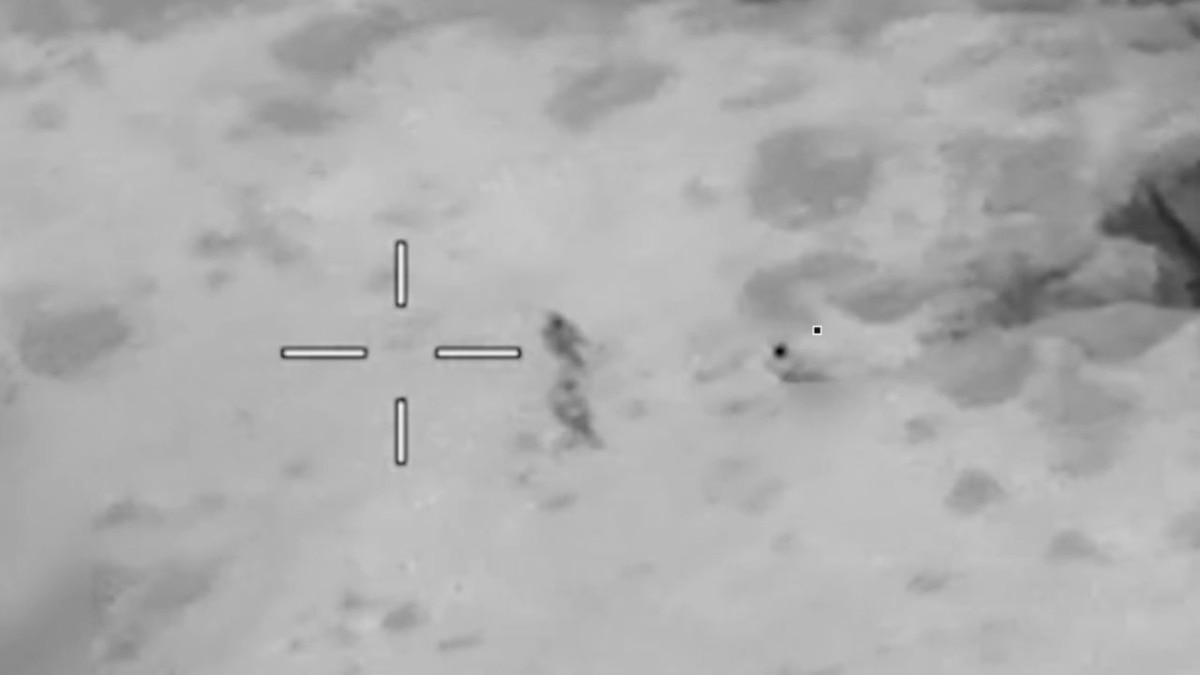
Newly declassified footage shows how US forces rescued a wounded F-15E crew member stranded in Iran after his jet was shot down. The operation revealed the scale of the mission, including CIA deception, air strikes and a 50-hour push to bring him out.The footage shows US service members carrying out the high-risk mission to recover the officer. (Photo:X/@60Minutes)Stranded, badly wounded and hunted behind enemy lines, a US Air Force colonel survived two days hiding in Iran before US forces rescued him. Months later, newly declassified footage shows how American forces pulled of a daring operation to reach him after his F-15E fighter jet was shot down in Iran in April.The footage, first obtained by CBS News' 60 minutes, shows US service members preparing and carrying out the high-risk mission to recover the officer, identified by his call sign as Bravo. More than 90 US troops were on the ground for the operation, while several hundred personnel supported it from the air and thousands more worked behind the scenes.First on 60 Minutes: Newly declassified video shows service members from U.S. Joint Special Operations Command rescuing Bravo, one of the two U.S. Air Force officers shot down over Iran in April. Bravo was stranded for two days – alone and badly wounded, behind enemy lines. pic.twitter.com/jAfLa5tfL7— 60 Minutes (@60Minutes) September 14, 2026HOW US FORCES MOVED IN TO RESCUE BRAVOBravo was the weapons-systems officer in the two-person F-15E crew, while his pilot, Alpha, occupied the front seat.The aircraft was shot down by an Iranian shoulder-fired missile on April 2 near the mountainous region south of Isfahan. The missile damaged Bravo's parachute after the crew ejected, sending him into a free fall at an estimated 70-100 mph. "At one point when I looked up and saw no parachute, that was the most terrifying thing I've ever seen," Bravo told CBS' 60 Minutes."So I paused, right then, and I prayed, 'Lord, your will be done. But if I'm getting through this, I need help.'" Bravo hit the ground hard, breaking his back, an arm and a shoulder. He landed about five miles from Alpha, who was rescued in a dangerous daytime operation roughly six hours after the crash. Bravo, however, was still somewhere in the Iranian mountains.WOUNDED AND HUNTED BEHIND ENEMY LINESDespite his injuries, Bravo moved away from his landing site and climbed towards a 7,000-foot ridgeline. He eventually found cover in the mountainous terrain as Iranian forces began searching for the downed airman."There was clear intent out of the Iranian ground force to come find those two guys," General Dan Caine, chairman of the Joint Chiefs of Staff, told CBS.US commanders faced a difficult choice: sending another rescue team too early could expose Bravo and the rescuers to even greater danger.Bravo eventually established contact with US forces, telling them he was injured but still moving. He spent another day in the mountains with little food or water as the search around him intensified."Never let a lack of motivation put you on Iranian TV," Bravo said.CIA HELPED CONFUSE IRANThe rescue operation expanded beyond conventional military assets. According to CBS, the CIA launched a deception campaign intended to mislead Iranian forces searching for Bravo, while using highly classified capabilities to pinpoint his location.Once his position was identified, US forces began preparing to reach him.Newly declassified footage shows American bombers and drones striking Iranian Revolutionary Guard forces near the area where Bravo was hiding. The strikes helped create a window for the rescue force to move towards the isolated airman.The scale of the operation was extraordinary. More than 90 US service members went onto Iranian soil, while several hundred personnel were involved in the air operation and thousands more provided support.The rescue force entered the area using two large search-and-rescue aircraft and a makeshift desert airstrip before launching smaller MH-6 "Little Bird" helicopters towards Bravo's position on the ridgeline.THE 50-HOUR RACE TO RESCUE BRAVOFor Bravo, seeing the rescuers marked the end of nearly two days of hiding, injuries and uncertainty."One of the greatest moments of my life," he said.When the rescuers reached him, his message was brief."Let's go."But the danger did not end there.The rescue aircraft became stuck in the sand at the makeshift airstrip, leaving more than 90 elite US service members stranded inside Iran. The US military ultimately destroyed the marooned aircraft and the Little Bird helicopters to prevent sensitive technology from falling into Iranian hands.Bravo was finally evacuated as the sun rose on Easter Sunday, about 50 hours after the F-15E was brought down.The US military had launched separate missions to recover both members of the crew, ultimately bringing Alpha and Bravo home safely. US Central Command confirmed at the time that the two service members were recovered in separate search-and-rescue operations."I believe that it's a testament to God's provision in my life to bring me through that moment in a way that didn't prevent injuries, but prevented any catastrophic injuries that would have affected my ability to survive," Bravo said.He said the mission ultimately represented something larger than his own survival."It's a story of the teamwork, the training, of the faith, of the decisions and the leadership to do something that will live in history as an example of what America's willing to do, in order to uphold our promise and leave no man behind."- EndsPublished By: Satyam SinghPublished On: Sep 14, 2026 18:23 IST
50 hours behind enemy lines, 90 troops on ground: Video shows US pilot's Iran rescue
Full Article
Original Source
Read the full article at Indiatoday →KhanList aggregates and links to publicly available news content. We do not host full articles from third-party sources. Always verify important information with original sources.