
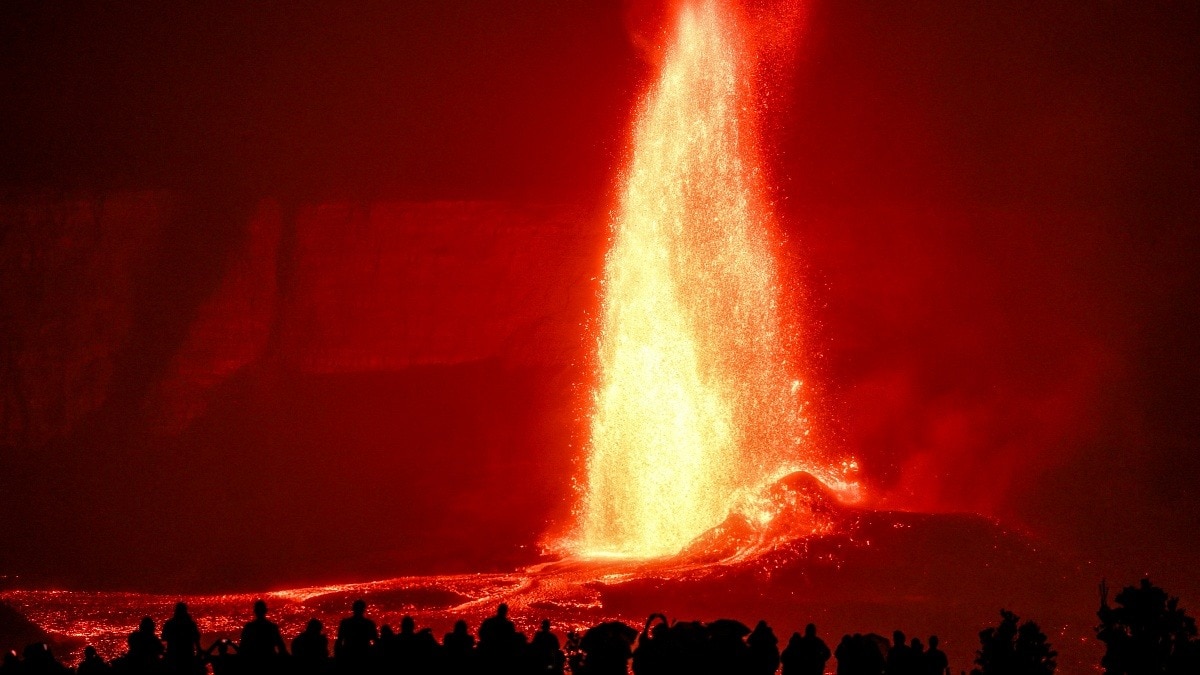
Hawaii's active volcano has produced dozens of lava-fountain episodes since late 2024, giving scientists a closer look at how eruptions work.Lava erupts from Halema'uma'u crater within the summit caldera Kaluapele, at the Kilauea volcano. (Photo: Reuters)New Delhi,Oct 13, 2026 10:40 ISTHawaii’s Kilauea volcano has been putting on a spectacular show, sending glowing fountains of molten rock hundreds of metres into the sky. But behind the fiery display, scientists are uncovering clues about what makes these eruptions erupt in powerful, repeated bursts.A study published in the journal Science has provided fresh insights into the phenomenon, using observations gathered during Kilauea’s ongoing eruption. People on horsebacks watch lava shooting out of Kilauea volcano's. (Photo: AP) Researchers found signs that trapped gases and changes in pressure beneath the volcano play a key role in driving the fountains.Kilauea, one of the world’s most active volcanoes, began its latest phase of repeated lava fountains on December 23, 2024. By September 2026, it had produced 54 such episodes, with some fountains reaching hundreds of metres high, according to the US Geological Survey (USGS).#Kilaeu volcano eruption in #Hawaii Blue skies+ Red lava eruption... @HiHyderabad @ApnaSecbad VC #808hikers https://t.co/OTvkWNIQnC— Savoir Vivre (@InterferonEi) October 11, 2026WHY DO VOLCANOES SHOOT LAVA IN THE AIR?To understand the phenomenon, imagine opening a bottle of a fizzy drink. When the pressure is released, dissolved gas escapes rapidly, producing bubbles and foam. Something similar happens inside a volcano, although on a vastly larger and more powerful scale. Molten rock, called magma while it remains underground, contains gases trapped under pressure, and as fresh magma gathers beneath the surface, pressure builds up.When the system releases that pressure, the magma rises and gases form bubbles, helping propel the molten rock upwards, and that's the lava fountain we see. Lava fountains are seen in the latest episode of an ongoing eruption of Kilauea volcano. (Photo: USGS/AP) On Kilauea, the eruptions happen in distinct episodes rather than as one continuous burst. The fountains can last several hours before stopping, followed by a quieter period that may stretch for one or two weeks.Scientists have proposed different explanations for these bursts, with one suggesting that gases dissolved in rising magma escape rapidly as pressure changes. Meanwhile, another proposed that a layer of gas-rich foam above the magma expands suddenly, triggering the eruption.WHAT DID SCIENTISTS FIND AT KILAUEA?By tracking ground movement, earthquake signals, sounds and gases released by the volcano, researchers identified patterns that offered clues to the process.Kilauea Volcano Eruption in Hawaii May 25, 2025 https://t.co/mKenRIObgm— Black Hole (@konstructivizm) May 28, 2025Before the fountain began, the floor of Kilauea’s summit crater swelled and tilted, suggesting that magma was gathering below. Additionally, scientists detected repeated bursts of seismic energy and low-frequency sounds before some eruptions.These signals appear to be linked to trapped gases building up and escaping, causing magma to move up and down through narrow openings in the rock, much like a piston moving inside an engine.The team also found relatively little carbon dioxide escaping from the volcano, weakening the idea that expanding carbon-dioxide-rich foam was the main driver of the fountains.The findings remain preliminary, and scientists have said that more work is needed to understand exactly how these eruptions begin and end.What is for sure is that lava fountains are more than a natural spectacle, and can also shower nearby areas with hot rock fragments, release volcanic gases and feed lava flows that spread across the landscape.- Ends
50 explosions in a year: Kilauea eruption reveals the science of lava fountains
Full Article
Original Source
Read the full article at Indiatoday →KhanList aggregates and links to publicly available news content. We do not host full articles from third-party sources. Always verify important information with original sources.