
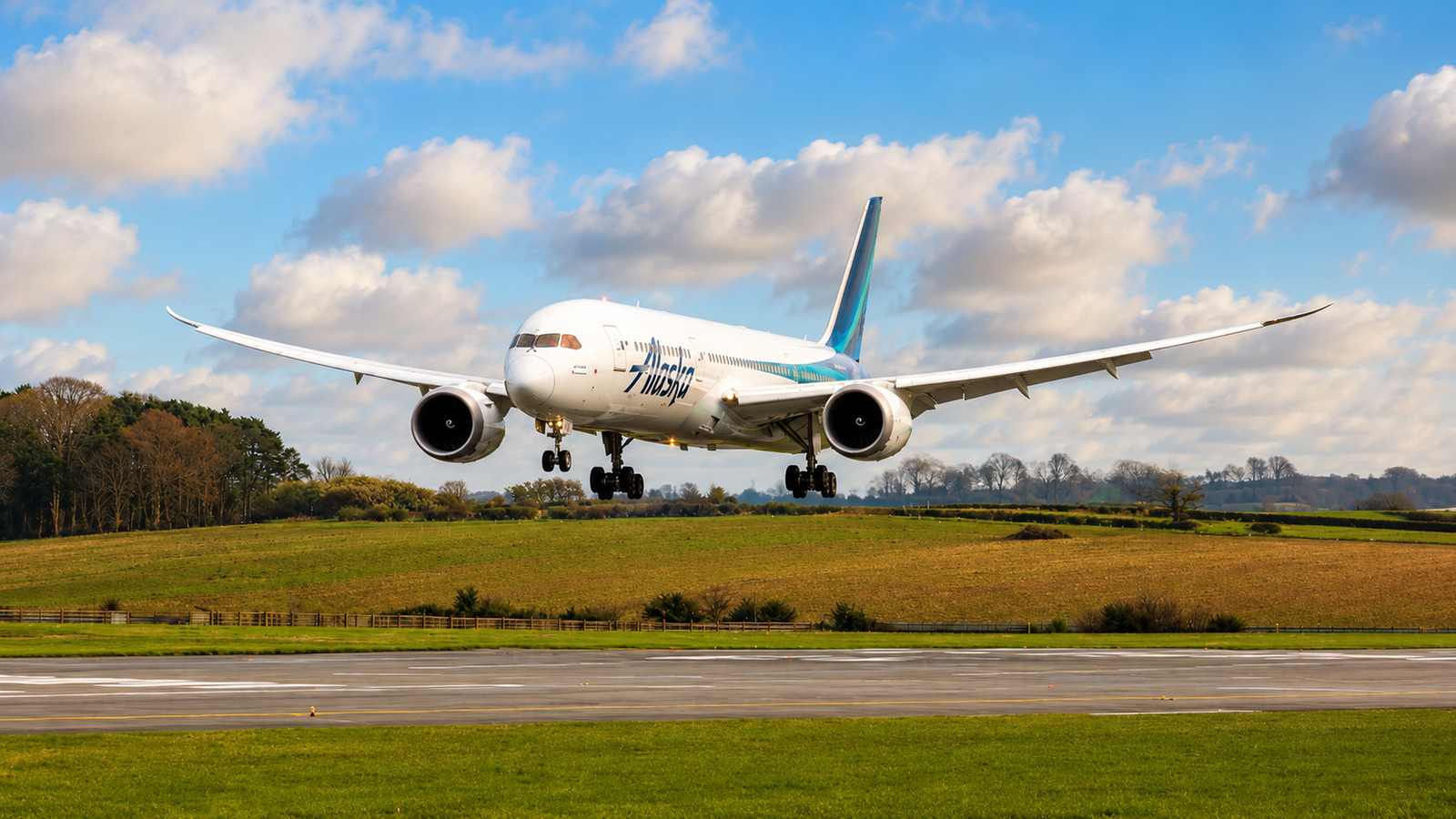
Published Aug 20, 2026, 2:48 PM EDT Paul has had a career of 25+ years focused on the international technology sector, which has taken him to over 100 countries. Along the way, he developed a deep love for aviation, with a travel bucket list measured by aircraft types flown rather than destinations reached. Now he brings that avgeek passion, along with the journalism experience he accumulated early in his career, to write insightful pieces for Simple Flying. Alaska Airlines is doubling down on its transformation from a (primarily) West Coast carrier into a global airline. The carrier has announced that it will launch nonstop flights from Seattle-Tacoma International Airport (SEA) to Athens and Paris from May next year. Both routes will operate seasonally through October using the airline's Boeing 787-9s. The additions will give Alaska five European destinations from Seattle, little more than a year after its first-ever European flight departed for Rome in April. However, Alaska's rapid expansion creates two challenges: Paris takes the airline directly into another major market already served by its arch-rival, while the new routes also put pressure on its Dreamliner deliveries and the crews that say that its long-haul flights are already understaffed. Athens Will Become Alaska's Longest-Ever Route Credit: Shutterstock Athens' Eleftherios Venizelos International Airport (ATH) is the more adventurous of Alaska's two new routes. At 6,197 miles (9,972 km), SEA-ATH will become the longest route Alaska has ever operated, while the airline says it will be both the first-ever Seattle-Athens nonstop, and the only nonstop connection between Greece's capital and the US West Coast. Its three-weekly schedule reflects the highly seasonal nature of Greek leisure demand, while Alaska's large Seattle connecting network should allow it to draw passengers from across the western United States, Alaska and Hawaii. Paris Charles De Gaulle Airport (CDG) represents a different proposition. Alaska will be entering a mature market rather than creating one, as Delta Air Lines and joint-venture partner Air France already connect Seattle with CDG with up to 12 weekly flights. However, starting with five weekly flights rather than three suggests that Alaska expects significantly deeper demand, and CEO Ben Minicucci points towards the fact that Paris is already among the most searched destinations on alaskaair.com: “We fly where our guests aspire to go, and Athens and Paris have been high on that list for years.” The two new additions build on a European network that barely existed 16 months earlier. Rome Fiumicino Airport (FCO) opened Alaska's European era in April, followed by London Heathrow Airport (LHR) in May, and Reykjavík later that month. Alaska's Seattle-Europe network First service Peak frequency Aircraft Seasonal? Rome April 28, 2026 Daily 787-9 Yes London Heathrow May 21, 2026 Daily 787-9 No Reykjavik May 28, 2026 Daily 737 MAX 8 Yes Athens May 12, 2027 3x weekly 787-9 Yes Paris CDG May 25, 2027 5x weekly 787-9 Yes For now, London is the sole year-round European route, while Reykjavík is notable for using the smaller Boeing 737 MAX 8 rather than tying up one of Alaska's scarce Dreamliners. By summer 2027, Alaska will ultimately have seven intercontinental destinations from Seattle, including the existing operations to Tokyo Narita Airport (NRT) and Seoul's Incheon International Airport (ICN), with at least five more planned by 2030. The Battle For Seattle Is Going Global Credit: Alaska Airlines Alaska and Delta were once close partners in Seattle. In 2012, Delta described Alaska's domestic network as a key enabler of its expanding international gateway, with Alaska feeding passengers into Delta flights to destinations including Amsterdam, Paris and Tokyo. But Delta increasingly built its own domestic network at SEA, reducing its reliance on Alaska, and bringing the two carriers into direct competition. The relationship steadily deteriorated before their codeshare and frequent-flyer partnership ended in 2017. Nearly a decade later, that competition has gone global. By summer 2027, five of Alaska's seven intercontinental destinations from Seattle will also be served nonstop by Delta: London, Paris, Rome, Seoul and Tokyo Narita. Alaska will use the 787-9 across all five markets, while Delta primarily deploys the Airbus A330-900 to Europe and Narita, and the larger Airbus A350-900 to Seoul. The overlap has developed quickly, and recent route announcements have increasingly resembled a series of counter-moves. Alaska entered Delta's established Seoul and London markets, Delta hit back by following Alaska into Rome, and Delta recently announced that it will return to Narita in March 2027. Alaska's new Paris route now takes the fight into another long-established Delta market and a core SkyTeam hub. Competing Route Alaska Frequency Alaska aircraft Delta frequency Delta aircraft Tokyo Daily Boeing 787-9 Daily from March 27 Airbus A330-900neo Seoul 5x weekly Boeing 787-9 Daily Airbus A350-900 London Daily Boeing 787-9 Daily Airbus A330-900neo Rome Daily (seasonal) Boeing 787-9 4x weekly (seasonal) Airbus A330-900neo Paris 5x weekly (seasonal) from May 2027 Boeing 787-9 Daily Airbus A330-900neo The stakes are particularly high because each airline starts from a different position of strength. Alaska Air Group carried 50.7% of all SEA passengers in 2025, more than twice Delta's 24.1%, and therefore has a huge local customer and connecting base to feed its new 787 operation. Internationally, however, the positions are reversed: Delta accounted for 24.8% of SEA's international passengers, compared with Alaska's 14.7%. Alaska's long-haul expansion can therefore be viewed as an attempt to translate its commanding overall Seattle position into international market share, while Delta is increasingly deploying its far larger long-haul resources to prevent precisely that from happening. Alaska Airlines Needs Its Dreamliners To Arrive Credit: Alaska Airlines While Alaska may have home ground advantage, Delta has a huge weapon in terms of its fleet depth. It operates over 180 widebodies across the A330, A350 and Boeing 767 families, and it has dozens more A330s, A350s and Boeing 787-10s on order. Alaska Air Group does have 24 Hawaiian AirlinesAirbus A330-200s, but those aircraft are intended to remain centered on Honolulu; Alaska has explicitly designated Seattle as its Dreamliner hub. Consequently, the expansion of its Seattle global network is particularly dependent on the 787 delivery stream. That stream remains thin in the near term. Alaska ended 2025 with five 787-9s, expects a sixth by the end of 2026 and a seventh in 2027. Four larger 787-10s are then scheduled to arrive in 2028, taking the Dreamliner fleet to 11. Alaska has acknowledged the risk directly in its annual report, noting that Boeing production constraints have already affected 787 deliveries and warning that its smaller size means delays could have a disproportionate impact on growth. Year-end 787-9s 787-10s Total Dreamliners 2025 5 5 2026 forecast 6 6 2027 forecast 7 7 2028 forecast 7 4 11 By 2032 — — 17 That could make summer 2027 particularly demanding: Alaska will potentially need its small Dreamliner fleet to cover Tokyo, Seoul, London, Rome, Paris and Athens, with little of the fleet redundancy available to Delta. Longer term, Alaska already has enough firm orders to reach 17 Dreamliners, including five additional aircraft intended to be 787-10s. But if its goal of at least 12 long-haul Seattle destinations is only the beginning, then another widebody order seems like an inevitability.
5 Ways To Europe: Alaska Airlines To Launch Seasonal Nonstop Flights To Paris & Athens In 2027
Full Article
Original Source
Read the full article at Simpleflying →KhanList aggregates and links to publicly available news content. We do not host full articles from third-party sources. Always verify important information with original sources.