
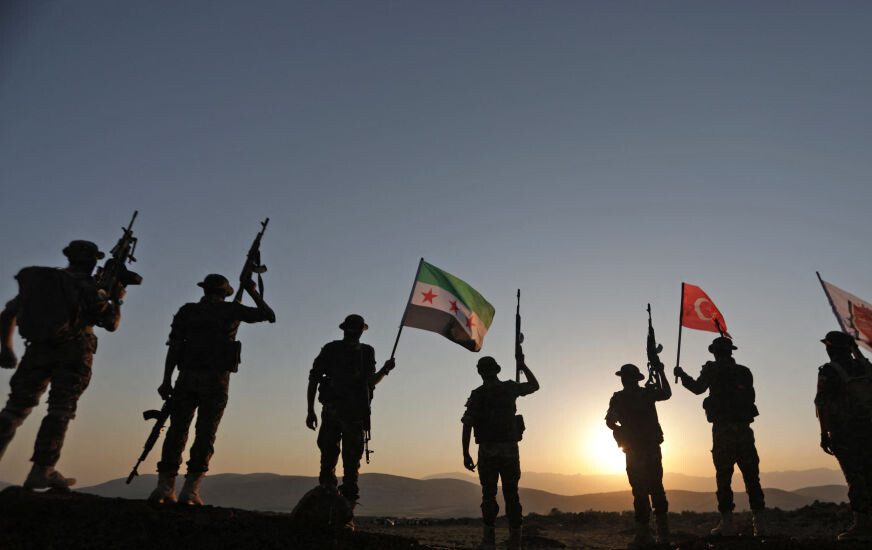
Turkey has emerged as one of the leading patrons of Syria’s new government under President Ahmad al-Sharaa, following the December 2024 fall of Bashar al-Assad’s regime. Ankara had built ties with Sharaa years earlier when he governed the Turkey-adjacent northwestern enclave of Idlib, but those ties have grown sharply over the past 20 months. Ankara now provides Damascus with military assistance, political backing, economic support, and international legitimacy, while deepening its own security footprint inside Syria. Turkey’s growing influence in Syria has alarmed their neighbors, particularly Israel, which increasingly views the prospect of entrenched Turkish military power on Syrian territory as a direct strategic threat. 1. Turkey’s interest in Syria predates Assad’s fall. Turkey was one of Bashar al-Assad’s staunchest opponents, funding Syrian rebels from the start of the civil war. Its relationship with the group now ruling Syria reflects a history of both cooperation and mistrust. Prior to ousting Assad, Sharaa led Hayat Tahrir al-Sham (HTS), which grew out of al-Qaeda’s branch in Syria, also led by Sharaa. Turkey designated HTS as a terrorist organization in 2018 due to its al-Qaeda ties, yet gradually expanded cooperation with the group as HTS took control over Idlib and fought Islamic State (ISIS) strongholds in northwestern Syria. HTS allowed Turkish patrols to operate in its territories and facilitated the establishment of Turkish observation posts in northern Syria. The group also positioned itself as a gatekeeper for Ankara, curbing drug trafficking into Turkey, preventing ISIS infiltration, and apprehending individuals wanted by Turkish authorities. In 2019, Sharaa also allegedly supported Turkish military operations east of the Euphrates against Kurdish factions. 2. Turkey has become Syria’s foremost military partner. Turkey signed an August 2025 memorandum of understanding with Syria to “improve the capabilities of the Syrian Army, develop its institutions and structure, and comprehensively reform the security apparatus.” Since then, Turkey has continued to provide the Syrian military with weapons, equipment, and military infrastructure. Turkish-built armored personnel carriers have been spotted on numerous occasions in Syrian military service, while the Financial Times reported that Turkey was installing radar systems along Syria’s Mediterranean coast as part of efforts to rebuild Syrian air defenses. In July 2026, a Turkish frigate docked at Latakia Military Port as part of a visit intended to support the restructuring of the Syrian Armed Forces. Turkey has also maintained a substantial military foothold on Syrian territory. Ankara retains multiple bases and positions in northern Syria and has expressed interest in expanding its military presence elsewhere in the country. Turkish Defense Minister Yasar Guler has stressed that Turkey does not intend to withdraw from Syria. Turkey reportedly maintains roughly 20,000 troops in the country, concentrated primarily at major bases and military positions in Idlib and Aleppo provinces. 3. Turkey’s Syria strategy isn’t Neo-Ottoman nostalgia but a springboard against Israel. Turkey has consistently framed its objectives in Syria as defensive. During and after Syria’s civil war, Turkey’s main aim was to prevent a Kurdish autonomous zone tied to the separatist Kurdistan Workers’ Party of Turkey (PKK) along its border. Turkey insisted that the PKK’s Syrian offshoot, the Syrian Democratic Forces (SDF), integrate into a centralized command rather than pursue federalism on the Iraqi model, an aim largely secured when Damascus seized the northeast in early 2026. Interpreting Turkey’s ambitions in Syria as a “Neo-Ottoman” land grab is attractive, but inaccurate. Interviews conducted over a year with senior Turkish officials found cadres preoccupied with deflecting apparent threats rather than reclaiming imperial lands, with civilizational rhetoric functioning largely as domestic propaganda. Turkey’s present Syria posture does not yet amount to an Ottoman restoration project. The springboard thesis to contain and undermine Israel is more persuasive. Erdogan’s declaration that Turkish security “does not begin in Hatay, but rather in Aleppo, Damascus, and Beirut” signals wider ambitions beyond border defense. Ankara’s attempts to place Hisar air defense batteries and radar at T4 and Abu al Duhur, roughly midway to Israel, position Syria as forward infrastructure in a widening rivalry with Jerusalem. Turkey is converting its military leverage in Syria into economic influence, embedding Turkish companies in energy, transportation and infrastructure to secure a long-term role in Syria’s reconstruction. Turkish firms Kalyon and Cengiz joined a $7 billion consortium to build gas-fired power plants and a solar facility, while Azerbaijani gas began flowing to Syria through Turkey in August 2025. Turkish companies are also involved in the roughly $4 billion redevelopment of Damascus International Airport. Ankara has promoted the restoration of the Hejaz Railway as part of a corridor linking Turkey through Syria and Jordan to Saudi Arabia, potentially making Syria a key transit route for Turkish trade with the Gulf. 5. Turkey’s influence in Syria is real, but constrained. Erdogan describes Turkey not simply as a regional power but as a founding actor in a new world order. Syria may be a central node in this strategy, but Turkey is likely to be constrained in this endeavor. Syrians are not interested in becoming a pawn in regional geopolitical rivalries, least of all Ankara’s confrontation with Israel. Polling in Damascus and Homs found just 5 percent favoring a purely military response to foreign incursions, against half preferring diplomacy; a later wave recorded 63 percent opposing Syrian military intervention in Lebanon. President Sharaa has meanwhile pursued a security agreement with Israel while cultivating connections with Washington, Riyadh, and Doha, a balancing act that precludes Turkish dominance. Arab capitals are equally ambivalent about Turkish ambitions. Cairo remains wary of Damascus’s Islamist origin, and Egypt and Saudi Arabia treat Turkey as a partner on some files and a competitor on others. Rhetoric steeped in Ottoman nostalgia plays well in Anatolia but alarms the Gulf states whose financing Ankara needs. Israeli air dominance has capped Turkey’s footprint outside the north. Economics may prove just as decisive: inflation in Turkey reached 31.8 percent in July 2026 with the policy rate held at 37 percent, and the reconstruction windfall Turkish firms anticipated has not materialized. Military reach and diplomatic wins of sorts, including the Mecca Pact signed in August, may not substitute for the capital Ankara lacks. Sinan Ciddi is a senior fellow and director of the Turkey Program at the Foundation for Defense of Democracies (FDD), where Ahmad Sharawi is a senior research analyst. For more analysis from the authors and FDD, please subscribe HERE. Follow FDD on X @FDD. Follow Sinan and Ahmad on X @SinanCiddi and @AhmadA_Sharawi. FDD is a Washington, DC-based, nonpartisan research institute focusing on foreign policy and national security.
5 Things To Know About Turkey’s Relationship with Syria
Full Article
Original Source
Read the full article at Fdd →KhanList aggregates and links to publicly available news content. We do not host full articles from third-party sources. Always verify important information with original sources.